David Harding
At the end David Harding quotes from Bertolt Brecht, About the Way to Construct Enduring Works.
It seems relevant
1.
How long
Do works endure? As long
As they are not completed.
Since as long as they demand effort
They do not decay.
Inviting further work
Repaying participation
Their being lasts as long as
They invite reward.
Useful works
REQUIRE PEOPLE
Artistic works
Have room for art
Wise works
Require wisdom
Those devised for completeness
Show gaps
The long-lasting
Are always about to crumbleÉ.
…..
2.
So too the games we invent
Are unfinished, we hope;
And the things we use in playing
What are they without the dentings from
Many fingers, those places, seemingly damaged
Which produce nobility of form;
And the words too whose
Meaning often changed
With change of users.
3.
Never go forward without going
Back first to check the direction.
Those who ask questions are those
Whom you will answer, but
Those who will listen to you are
Those who then ask you.
Who will speak?
He who has not spoken.
Who will enter?
He who has not yet entered.
Those whose position seems insignificant
When one looks at them
Are
The powerful ones of tomorrow
Those who have need of you
Shall have the power.
Re Gallery Visits in London, New Year 05/06
Re Richard Long’s show at the Haunch of Venison, Colin Kirkpatrick interviewed Richard Long some time ago and it touches on some of the issues…
Dimitrijevic, Smithson and Magritte
At the Scottish National Gallery of Modern Art last winter I saw a room of photography that SNGMA had recently purchased. This included a group of six photographs by Braco Dimitrijevic entitled This could be a place of historical importance (I have not been able to find images of this work online). For me this work clearly links with Robert Smithson’s Visit the Monuments of Passaic New Jersey. Talking to our friend Gail about this she made the link with Magritte’s Ce n’est pas une pipe. So what is the link between these artists in the early 70s and surrealism?
What art have I seen?
‘Visiting Picasso‘ Roland Penrose collection resulting from his friendship with Picasso, on show in the Library in the Dean Gallery.
Exercises
Fluxus Performance Workbook
Edited by Ken Friedman, Owen Smith and Lauren Sawchyn
and
52 Events 2002
by Ken Friedman
Summary of Human Settlement: Nooteboom
“Seaweed becomes kelp,
shell becomes stone,
liver becomes light,
earth becomes turf,
and rocks and sea-wrack becomes soil in which to grow potatoes”
A ‘summary of human settlement’ for the Gaelic speaking crofting community on Aran on the West coast of Ireland quote in The Guardian 06.05.06 from Nomad’s Hotel: Travels in Time and Space,
Cees Nooteboom, Havill Secker, 2006
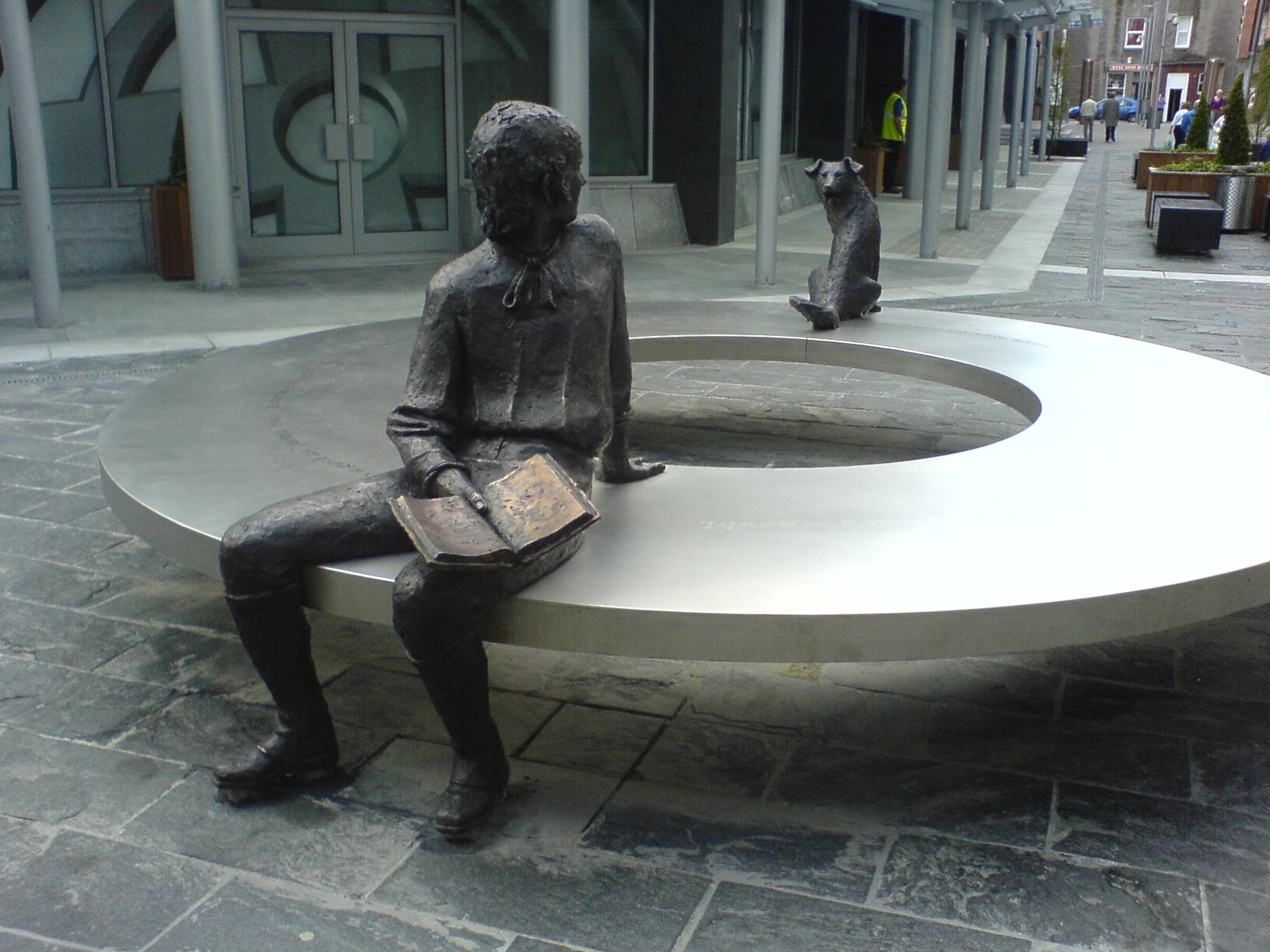
What art have I seen?
Elements of Change craft exhibition at Dick Institute, Kilmarnock
Infobabelise by Ben Woodeson
Review of Ben Woodeson‘s show at the Jerwood Space over Christmas and New Year 2005/06.
What was a technical exercise for a bunch of engineers – getting mobile phones to send text messages to each other – is just another innovation that has pushed the development of culture in a whole new direction. Short bursts of characters. Innovative use of punctuation. It has all happened in ten years and even grandparents are using it. We live in an ‘information age’. We are skilled navigators and interpreters of a complex visual and auditory world. Another generation seduced by the white heat of technological development.
In Woodeson’s work everyday human concerns are made the object of an art that behaves as interference. He describes this as “primitive attempts to re-use and re-examine that which is commonplace and everyday.” It is the only way to explain this group of work. Its the everyday made into nonsense. Where in Wallace and Gromit or in Heath Robinson the madcap machines are intended to produce benefits for their inventors, Woodeson makes these contraptions for our benefit – so that we can begin to become sensitive to the extent to which what we think is communication is almost always noise.
The exhibition is made up of three works – one in the café and one each in the two gallery spaces. ‘Herbalgerbilverbalisor’ collects speech from the reception desk, filters it through voice recognition software and then ‘types it out’ in light boxes in the far gallery. The work contains all the key issues – remoteness, indecipherability, use of the everyday human, complexity and randomness.
Woodeson avoids trite judgements and does not rely on the trendy to carry the work. The far gallery could have been cluttered with computers and screens running Linux. Rather, the alphabet stands alone blinking at you from the light boxes. The clue to the computer function is in the one box in the bottom corner, like the blinking cursor in DOS, waiting for action.
Where Gallery Three blinks, Gallery Two taps. A series of jaunty electro-magnets tap out an apparently abstract pattern. The electro-magnets are thread-sized spindles of copper wire in pairs. Power pushes them apart, release results in a click. Controlled, this results in old-fashioned Morse code. Woodeson has programmed these automated distress beacons with short extracts from self-help texts. The title gives away the attitude: ‘Chicken soup from Mars’. Texts which deal with leadership merge with texts on wealth and with relationships. There is one pair clearly together on the right hand wall – one is titled ‘Low-down on Going’ and the other ‘Blow Him Away’. Electro-magnetic sex therapy if only I could decipher it.
(De)cipher is a key concept for Woodeson. He ensures that the work cannot be deciphered exactly. His work creates circumstances in which people cannot understand each other, characterised by misheard conversations, misunderstood texts, unintelligible telephone messages – definitely not handwritten letters or quiet face to face conversations.
Woodeson’s work involves considerable technical skill – electrician, programmer,
cabinetmaker crossed with hobbyist. The irony of unintelligible self help texts, and the complexity of first using speech recognition software to overhear conversations with the receptionist (“Where is the toilet?”) and then have them typed out too fast to be read, all speaks of enormous effort for negligible reward – in his words “technical investigation with maximum effort for minimal achievement.”
The art exists in a liminal space between the real and the virtual. There is the physical presence of the electromagnets in the gallery, the light boxes, the microphones, but the meaning is attenuated through the virtual. Meaning is stored and modified as electricity.
In the gallery there is a shared experience of the physical, but the meaning is not accessible. By inference our own constructions exclude us from understanding each other.
Failure – unrealised projects
Murdo Macdonald had told me about the duplication of statues of Robert Burns. The ones we are familiar with in Scotland also exist in the USA, Canada, Australia and New Zealand. We made a proposal to the Maclaurin Trust to develop an exhibition for the 250th anniversary of the birth which was going to happen in 2009. We did a presentation to them. They never responded – they must have buried it. Read it: Proposal Burns Statues MM.
Reading
A Guid Cause: The Women’s Suffrage Movement in Scotland, Leah Heneman, Aberdeen University Press, 1991.
This book covering the early connections between suffrage, education and slavery, and the subsequent development of suffrage in Scotland as a strong and distinctive movement, with its own characters and events, is well researched and thoroughly readable.
My starting point was discovering somewhere that Fanny Parker, the neice of Lord Kitchener, had in 1914 with another suffragette, attempted to blow up Burns Cottage, Alloway. Parker was an active and militant suffragette and spent more than one episode in prison as a result. Not only was she forcibly fed by tube, but she and others were given ‘nutritional enemas’. This book set her attempt to bomb Burns Cottage in a clear historical context.
I also discovered another interesting connection. Louisa Innes Lumsden, another suffrage campaigner and one of the first three women to graduate from Cambridge, must be one of the Lumsdens’ of Clova. In the short biographical sketch it mentions that she was chair of the Rhynie School Board.
Jane Jacobs 1916-2006
Obituaries: Toronto Star, Washington Post, The Guardian
Anne Douglas and I used Jane Jacobs The Nature of Economies as a means of interrogating the first phase of On The Edge Research in “Leaving the (social) ground of (artistic) intervention more fertile“, a paper presented at the Darwin Symposium, Shrewsbury; Waterfronts IV, Barcelona; and Sensuous Knowledge 2, KHiB, Bergen.
On The Edge Research is a practice-led research project based at Gray’s School of Art, Aberdeen. OTE has, since it was launched in 2001 with a major award from the UK Arts and Humanities Research Council, focused on developing new articulations of the value of the visual arts. In 2005 Anne Douglas, the principle researcher, and I wrote a paper which started out with the question – what is sustainability in the visual arts? This is a particularly tricky question especially in the UK because of public subsidy. Any discussion about sustainability will normally veer off into a discussion of the Arts Councils. Jane Jacobs book the Nature of Economies seeks to set out the fundamental rules of development looking at developmental processes in natural systems. She argued that the same rules that govern the development of ecosystems also apply to economies, and we explored the application of this thinking to ‘arts development’.
- What is really important is to recognise that development occurs at multiple levels simultaneously (ie fractally),
- that all development requires co-development (ie nothing happens in isolation),
- that all development requires various forms of governors (ie feedback loops, bifurcations and emergency adaptions).
- Development occurs qualitatively and quantitatively.
- Development occurs in a cycle of differentiation from generality.
I am very sad that such an important thinker, who I only recently learnt so much from, has died.
Originally posted 1 May 2006

 CHRIS FREMANTLE
leave a comment