Pecha Kucha

Edinburgh Volume #5 at Royal Scottish Academy of Art and Architecture
The Mound, Edinburgh, EH2 2EL +44 (0) 131 225 6671 http://www.royalscottishacademy.org
On 7 August 2009 START 19:30 END 21:30 DOOR £5, £3 concession (includes refreshments)
Places are limited: to book e-mail studiodub@mac.com
To compliment their two “Lyrical Abstraction” exhibitions of sculpture (see http://www.culture24.org.uk/spliced/art69969) in the interiors and gardens of William and Robert Adam’s Mellerstain House 14th June – 30th Sep. 2009, and Charles Rennie Mackintosh’s Hill House 15th Aug. – 31st Oct. 2009 as part of the Japan UK 150 Festival, Kate Thomson and Hironori Katagiri of Ukishima Sculpture Studio, in association with architects Gordon Duffy and Rebecca Wober of Studio DuB, have organised a pecha kucha on the theme of relationships between Art & Architecture.
Pecha kucha is a great fun idea started in Tokyo a couple of years ago by Mark Dytham and Astrid Klein – two architect friends of sculptors Kate Thomson & Hironori Katagiri. It has gone viral and is now on in over 218 cities around the world.
Participants show 20 slides for strictly 20 seconds each, meaning that the audience experiences an exhilarating high speed journey through a kaleidoscope of inspirations, ideas and work, with the concise nature of the presentations keeping the interest level high. 6min40 seconds each means there is the opportunity to introduce more interesting speakers and still have time to move around and talk to each other over a drink during the interval and afterwards.
See http://www.pecha-kucha.org/cities/edinburgh/5 for more information.
Featuring presentations by…
Jock McFadyen, painter http://www.jockmcfadyen.com
Hironori Katagiri, sculptor http://www.ukishima.net
Kate Thomson, sculptor http://www.ukishima.net
Calum Colvin, multi media artist http://www.calumcolvin.com
Charlie Sutherland, architect: Sutherland Hussey http://www.sutherlandhussey.co.uk
Gordon Duffy + Rebecca Wober, architects: Studio DuB http://www.studiodub.co.uk
Dan Brown: Edinburgh Sculpture Workshop http://www.edinburghsculpture.org
Alastair Clark, Assistant Director: Edinburgh Printmakers http://www.edinburgh-printmakers.co.uk
Michelle de Bruin, sculptor http://www.artist.org.uk
Elaine Alison and Pat Bray, sculptors http://www.allisonandbray.com
Chris Fremantle, environmental art producer and researcher
What Art/Reading?
Chris Biddlecombe’s book when visitors appear produced as part of his work with the Arthur Conan Doyle Richard Lancelyn Green Collection and the Aspex Gallery which resulted in the exhibition Between Worlds, 2009.
Biddlecombe explores his own interests through the cypher of Arthur Conan Doyle and the Richard Lancelyn Green Collection held by Portsmouth City Council.
Conan Doyle’s public persona as author of the Sherlock Holmes stories is entwined with his less well known involvement in Spiritualism. Richard Lancelyn Green obsessively collected anything to do with Conan Doyle and Sherlock Holmes. Biddlecombe has, in turn, obsessively explored this material during an off-site project co-ordinated by the Aspex Gallery.
The book is a juxtaposition of the moments when Holmes and Watson first meet their ‘clients,’ drawn from the stories; and a number of psychic research photographs found in the Richard Lancelyn Green collection. Biddlecombe has made drawings of an almost anthropological or illustrative character from the photographs. Each photograph appears to contain both people and spirits, not always human. Interestingly Biddlecombe’s drawings apply the same mark making techniques to both subjects, and therefore emphasise an equality of reality. The spirits are as real as the sitters.
As is highlighted in the text for the exhibition, trickery does not necessarily preclude truth. Visitors may be the product of the imagination, but that makes them no less significant.
What Art?

The unacceptable face of Britain
Aesthetic of European stag party culture
Blue Cowboys out of Newcastle rebranded to maximise market penetration take Gdansk by storm
Find them on youtube under the name StudioSzkic
Explore Polish bars
Tree climbing, table Squennis, arm wrestling,
begging bankers
Sexercise disco on a streetcorner in NY in PLish
Who is mixing the beats? They should be on iTunes as well.

Resources on the history of climate change and science
A timeline of the development of the science of climate change (1800 to the present), part of a much larger site and educational resource created by Spencer Weart (author of The Discovery of Global Warming) and hosted by the American Institute of Physics.
An article on the history of Climate Change science from the Guardian in 2007
Reading
Gary Snyder
Endless Streams and Mountains
This web site has the first section of this book length poem, and juxtaposes it with the visual work it refers to – very interesting to see the two together. The poem is a deceptively simple description of the contents of the images.
What Art have I seen?
Garden and Cosmos: The Royal Painting from Jodhpur at the British Museum
Poor. Old. Tired. Horse. at the ICA
Radical Nature at the Barbican
What Art have I seen?
The University of Trash at the Scultpure Center
Art space become alternative pedagogical space. Quote “I saw enough of this sort of thing in the 70s.”
So are we revisiting the 70s? If so, why? And what is the difference between now and the 70s?
What art have I seen?
Socrates Sculpture Park, Long Island City.
What sticks in the mind?
Fifty bums raised in the air: yoga in the Park.
A giant doilly suspended in the trees
(Jennifer Cecere, Mom, 2009)
Looking across to Manhattan’s volume.
A series of physical challenges modelled on an exercise assault course
(Risa Puno, The Big Apple Showdown Spectacular, 2009)
A carnival wagon with artefacts displayed
(Dana Sherwood and The Black Forrest Fancies, The Ladies Society of Alchemical Agriculture, 2009)
A black barn of jig-sawed patterns
(Bernard Williams, Socrates Ply- Teck Barn, 2009)
A small garden, the most valuable space for urban-dwellers
(Jeanine Oleson, Retribution, 2009)
Socrates Sculpture Park reinvents itself as a cross-over public space between art and temporary amusement park. Away with formal sculptural concerns: roll up, roll up to the crazy summer Saturday on a field in the sun. Is it New York or is it somewhere in Kansas? Is it Little House On The Prairie or is it socially engaged practice? Even without the specific ‘dialogics’ intended to captivate the art audiences, Socrates is busy.
What art have I seen?
Art Sites in Riverhead. I noticed a sign saying art + architecture. It’s a gallery with an outdoor sculpture space that also seems to be involved in local green developments. The building looks like it used to be a light industrial unit and is really well converted, both the building and the landscape.
I’d have liked to see the exhibition Called to Action, curated by Lillian Ball, on Restoration projects.
Outdoors there was an interesting mix of large scale sculptures – some made of very permanent materials (steel)

and others clearly very temporary tent structures.
 The relationship of the tents to the ground, the way they protected an area of grass and weeds, was interesting.
There was a small patch of plants with a sign indicating that this was based on work done by Cornell University Extension programme: Weeds and Your Garden.
Sag Harbor Whaling Museum
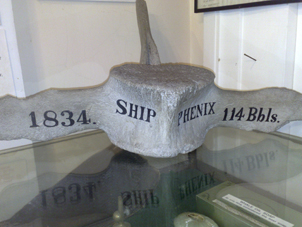
The Whaling Museum at Sag Harbour, Long Island, is a remarkable cabinet of curiosities. There isn’t a hierarchy and there isn’t a narrative or simple message. Located in the former Masonic Temple, a remarkable building originally built as a home, it contains a wide range of products of 18th and early 19th Century whaling industry as well as aspects of town history. From a cabinet of walking sticks with ivory handles, to memorials made of whale vertebrae, to the tools for carving up the carcases, all the ephemera of the industry is represented – and it’s not all scrimshaw. But in amongst this is also the stuff of seafaring: the medicine cases, the shackles for punishment and the ships logs. There are even Inuit artefacts collected by sailors, and a display indicating the relationship between the indigenous Americans, their own whaling, and the Europeans arriving on the Island. We are so used to the managed learning of museums, that this looks like an installation by Mark Dion. In fact the Museum should contact other museums to do with whaling and make a publication of whaling ephemera from different parts of the world – I found a list of museums connected with whaling at Whalecraft (there are a number in Scotland).

Rural and city
Martin Wolf in the FT (3 May 2006) summarises Jane Jacobs’ arguments for the importance of cities (not countries) and their role in relation to regions.

 CHRIS FREMANTLE
leave a comment