Chris Dooks’ Elephant
Chris Dooks’ brilliant new compositions, made in pain but with hope.
Mashing Up: Art+Labour
“MASHING UP” :
Art+Labour
a public conversation
CCA 5
Tue 9th Nov 2010
12.30-6pm
http://www.variant.org.uk/events.html
Art+Labour is a public conversation exploring the conditions and experiences of creative labour in the cultural industries – working conditions, pay, working hours; freedom and autonomy, pleasure and obligation; insecurity and uncertainty; social reproduction, networking and isolation – and artists’ organising within it – unions, artists’ associations, or self-organised studio/exhibition spaces.
Panelists include:
Angela McRobbie
Professor of Communications, Dept. of Media & Communications, Goldsmiths
Scottish Artists Union
The representative voice for artists in Scotland
Graham Jeffery
Reader: Music and Performance, The School of Creative and Cultural Industries, UWS
Katarzyna Kosmala
Reader, Centre for Contemporary European Studies, UWS
Gesa Helms
Researcher & artist
Brett Bloom
Member of Chicago-based art collective Temporary Services who recently produced ‘Art Work : A national conversation about art, labour, and economics’
Owen Logan
Researcher, School of Divinity, History and Philosophy, University of Aberdeen
Facilitated by Gordon Asher
Effective Learning Tutor, UWS Centre for Academic & Professional Development
Event is free but ticketed, tickets available from CCA Box Office:
CCA, 350 Sauchiehall Street, Glasgow G2 3JD
tel : +44 (0)141 352 4900
http://www.cca-glasgow.com
“MASHING UP” : Art+Labour is organised by Leigh French, co-editor of Variant, and Sophie Hope, member of Making A Living, in co-operation with Graham Jeffery of The School of Creative and Cultural Industries, University of the West of Scotland, and supported by CCA, Glasgow.
LOANS &
INTERNSHIPS
WORKSHOP
CCA 5
Tue 9th Nov 2010
10.30am – noon
Sophie Hope & Leigh French
examine the Case Studies
Public time?
 Claire Docherty’s comments at the Mapping the Future (of public art in Scotland) event in Dundee yesterday were billed as a discussion of ‘public time’ and focused on the current state of public art. She seemed to be arguing around a need to move beyond a dichotomy of monumentalism or critical ephemeralism looking in particular at what she called public time. She described a number of projects which were iterative or cumulative or strategic, i.e. that, without monumentalism, tried to develop relationships with audiences and participants (the public?) over a period of time. She highlighted gardening and pavilion projects, slow food, conversation and referenced her own year long programme of One Day Sculpture across New Zealand. The obligatory Ranciere reference – participation does not equal critical legitimacy – was made.
But her comments remained looking around in the (public) art world. Whilst time and space are different dimensions of the same experience, the focus of public art, certainly in Miwon Kwon’s construction, has been an evolution of the understanding of space and the abilities of artists and designers to shape and reveal space.
“Yet despite the meanderings of the last 15 years we often continue to use such a search for resolution in lieu of admitting that there is a need to understand the relative value of work that deals with time as much as space.” (Proxemics, 2006, JRP Ringier, p.99)
Nothing is ever cut and dried, but when Liam Gillick raised the issue of shifting the focus from public space to public time, and I’m not sure if that’s where Docherty got the idea from, he prompted in my mind thoughts about the public experience of time, not artists’ construction of time.
Turn your thoughts to public time and approach that idea:
Waiting, waiting lists, waiting rooms, wasting
Travelling, delays, speed, dislocation,
Working, pressure, shifts, holidays, nightworkers, clickworkers, payday
Boredom, repetition, necessity, cuts, dole,
Queuing, waiting,
Shopping, retail therapy, footering
Beer o’clock
Timeless places, casinos without clocks or natural light, skara brae
Sleep disorders, postcode lotteries,
Today vs PM, rolling news,
“The geese from Siberia are three weeks earlier this year”
(the list is as long as the time invested in making it – half an hour yesterday, another five minutes today)
Time is a curious phenomenon. It is structured within society, historically by culturally determined cycles derived from the process of the planet’s angle and rotation around the star at the centre of our solar system. In Scotland, because of our Northerliness, the pattern of the seasons mean that our school holidays are different from England. We have different festivals (Michelmas has just passed, Lammas before that, and in the future Candlemas) with associated happenings, including food and drink. Marking time and the pattern of activity related to the seasons has slipped our minds’ because we shelter, light and heat our lives. Other cultures have a more present experience of seasonality, including for instance the Sami (image above). We rarely extend our timescale to even one cycle of seasons, let alone thinking beyond our own lifespan.
If there is value in drawing attention to scale, then it is equally important to draw attention to value. Time is money. Or rather there is a more complex relationship where social position is related to time and money. Just as money is unspecialised form of exchange (and humans are unspecialised animals) so time (as we organise it in Western society) is an unspecialised form of measurement enabling a little of one person’s time to be valued very highly and a lot of another person’s time to be bought extremely cheaply. In this way time is like space. Public art is complicit in the gentrification of space. Can public art not also be accused of being complicit in the gentrification of time?
Detailed summary of all three Mapping the Future events on PAR+RS website.
Postscript
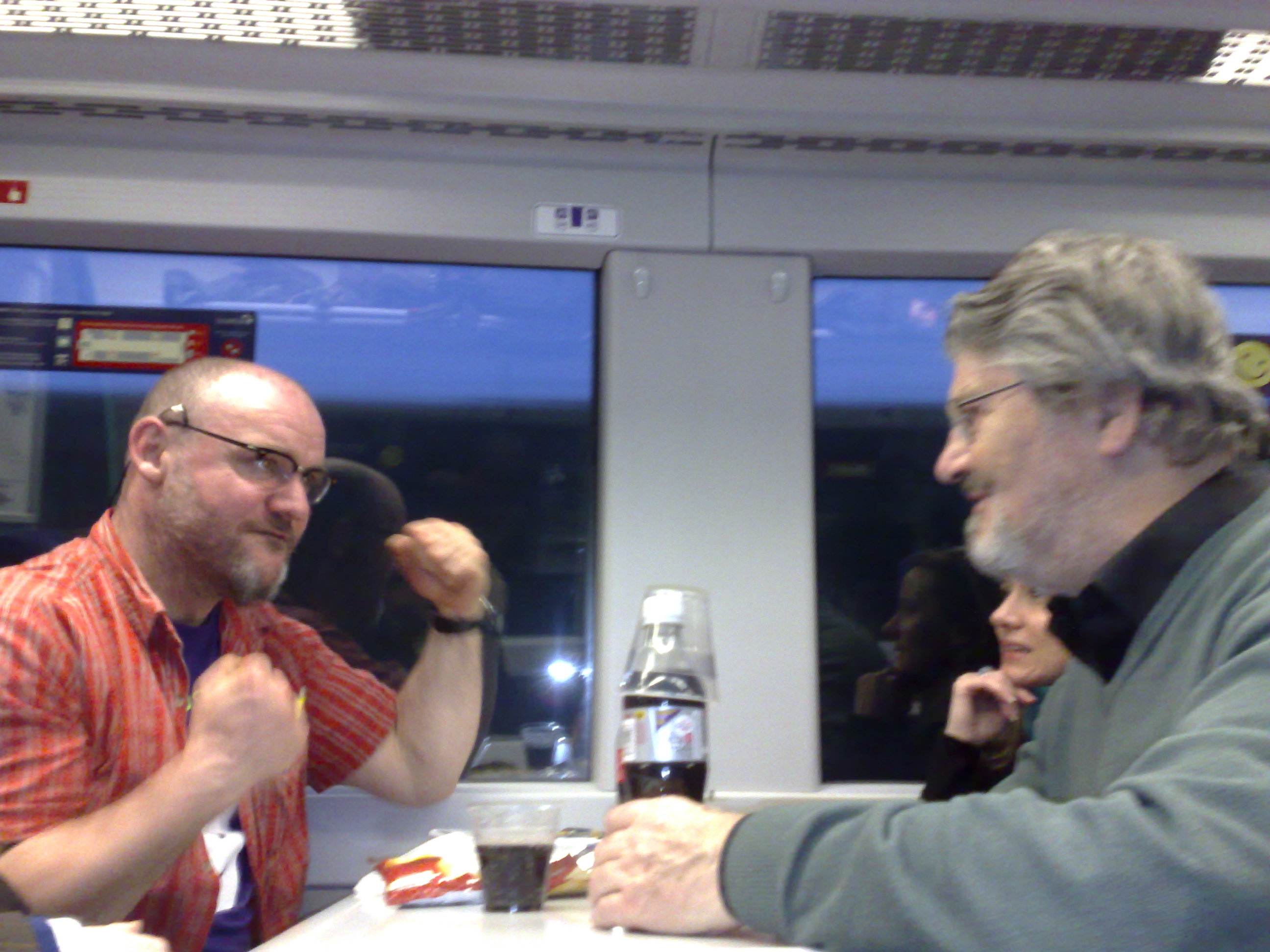
"I always knew you were wrong." Ross Sinclair and David Harding on the train returning from the seminar.
What Art have I seen?
Walid Raad‘s exhibition at the Whitechapel including the Atlas Group Archive manages to address the condition of conflict through the construction of fictions that draw out the banality and give the banal new meaning. The careful judgement exercised, that neither belittles nor glorifies, but rather makes the everyday, the personal, the experiential, seem significant. The fiction of the police agent #17 turning his camera away from the cafe’s where he’s meant to be documenting the conspirators, and instead recording sunsets is curiously powerful. It’s the story that makes the banality of the sunsets, not even well filmed, into something that keeps the attention.
Rachel Whiteread’s Drawings at Tate Britain emphasise her interest in focusing on absence. Like the Atlas Group Archives’ Sweet Talk File, the process of exclusion renders the abstract qualities of ephemeral reality into an aesthetic object.
Cameraless Photography at the V&A, curiously focuses on the opposite of Walid Raad’s work: where the work in the Atlas Group Archive uses the camera to question the nature of documentary, these artists, as at least one of them says explicitly, choose to avoid the camera precisely to avoid its implication of the documentary.
A Manifesto for a time when the environment bites back

One of 30 presented at State of Play (Saturday 9 October 2010, James Arnott Theatre, University of Glasgow) an event organised by AHM.
AHM – Ainsley Harding Moffat ‘WORK AS IF YOU LIVE IN THE EARLY DAYS OF A BETTER SOCIETY.’ Sam Ainsley, David Harding and Sandy Moffat are a collaborative group working with individuals and institutions locally, nationally, and internationally, who share similar or related aims and aspirations – namely to place the arts centrally in the making of a new Scotland.
It’s not often that artists organise conferences and symposia, but in the tradition of Littoral, this one brought together an excellent introduction to the current Scottish cultural policy context from Philip Schlesinger; a reflection on a career trajectory from Christine Borland; a critical theory dérive on the statelessness, medievalism and prosumers from Neil Mulholland and some words of wisdom from the older generation in the form of Sam Ainsley and Sandy Moffat. The next event is 2 April at the National Galleries of Scotland in Edinburgh.
It went a bit flat at the end. I think there had been such a good range of presentations that the audience didn’t know how to respond effectively. There is a sense of imminent doom, not least because of the underlying ideas shaping Creative Scotland, impending public sector retrenchment and the end of the buoyant art market. But no-one could quite put the target in focus. It was certainly helpful to have Peter McCaughey’s rallying call for the audience to join the Scottish Artists Union en masse. There is a need to bend Creative Scotland into a relevant shape (the conceptual underpinnings having been shown to be deeply flawed and the current spectral suggestions that its role is akin to an investment bank being laughable).
But equally Brett Bloom’s talks Temporary Services‘ Art Work initiative to establish a national conversation (in the US) on art, work and economics is also very much to the point. I suppose my question would be, was Christine Borland the best choice? She spoke eloquently about the importance of getting involved in Transmission and the challenges of developing a career, but there is a point where an artist is represented by one of the foremost galleries and is exhibiting in major international bienniales is reinforcing the existing model of artworld career success, rather than offering alternatives. If one of the problems is, as Bloom suggested, the proliferation of MFA programmes producing young artists geared for a conventional route, and as Schlesinger commented, the current model works on massive overproduction from which a few stars emerge, then we need to explore alternatives rather than re-state existing models.
One of the real challenges for the future events planned in this series is to explore how fine art education can or is reinventing itself, and how artists are operating outside the artworld. This was hinted at, and Christine Borland’s comments that there is evidence that doctors engaging in medical humanities as part of their education are demonstrably better able to deal with ambiguity than their peers was an interesting point of departure. What is it about a fine art education that enables engagement with other disciplines to wider social benefit, and how can we construct pedagogical models that promote this?

 CHRIS FREMANTLE
1 comment