What art have I seen? Oral Suspension

Photo courtesy of Look Again Festival
David Blyth and Nick Gordon collaborated on this at once jokey and nuanced exhibition in Look Again‘s new space on St Andrew Street. It’s great to have a space on a street in central Aberdeen, but this exhibition should have been in the Aberdeen Art Gallery in terms of its scale and ambition. Open at exactly the point the City further cut its commitment to the arts, this shows what outstanding work is happening in the North of Scotland: an ecosystem being damaged by short term thinking.
Nick Gordon is a graduate of Gray’s, a sculptor and part of the group running a new printmaking workshop on Orkney. David Blyth teaches at Gray’s (and taught Nick).
The works are weavings of traditional folklore with newly discovered uses of the skate (and it’s iconic shape) are complemented by the artists’ investment in the project, taking skate oil supplements during the whole development of the work and offering ‘traditional’ recipes including a skate skink.
The human symbolic relationship with the skate is complex, not least because of the curious sense of a human face particularly in the landed hanging skate. Strange as this is, it is complemented by the strangeness evoked by other aspects, hinting at secret societies and mysterious rituals.
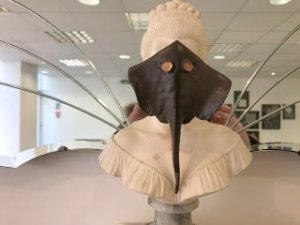
Image courtesy of Mood of Collapse blog
Jon Blackwood’s short text associated with the exhibition highlights connections with local conservation organisations, and the general threat to skate populations (some being on the IUCN Red List). He quotes Donna Haraway alluding to the complexity of connection and interdependence.

This exhibition demonstrates how art can take us into a deeper relationship with the more than human, but also how both art/culture and other living things are undervalued and threatened by our current insistence on valuing everything through the market.
What counts as ‘impact’?
Does an email citing a published ‘output’ inviting you to submit papers and join an editorial board of a new Journal count as impact?
I’m asking this because I regularly get emails mentioning the paper Gemma Kearney and I had published in the International Journal of Art and Design Education which, according to Google Scholar, is the 3rd highest rate Visual Art Journal.
I’ve pasted a typical email in below.
The paper, Owning Failure, has been cited three times (again according to Google Scholar), but I’ve had countless emails about it.
Other papers are more frequently cited, but this is the only paper ever mentioned in these invitations.
So good Journal, low citations, lots of soliciting emails… is that any sort of impact?
From: Journal AJAC
Sent: 08 March 2019 07:37:13 (UTC+00:00) Dublin, Edinburgh, Lisbon, London
To: Christopher Fremantle (gsa)
Subject: Dear Fremantle, C; Kearney, G: Invite You to Submit Papers and Be Editorial Board/Reviewer Panel Member
International Journal of Literature and Arts
(ISSN Print:2331-0553 ISSN Online: 2331-057X)
Open Access Policy (OA) Peer-review 50-70 Days Paper Publication
[http://img.literarts.org/logo/w523582388996.png]<http://www.literarts.org/home>
Dear Fremantle, C; Kearney, G
International Journal of Literature and Arts (IJLA) is a peer-reviewed academic journal, establishing a solid platform to all academicians, practicing managers, consultants, researchers and those who have interest in emerging global trends in literature and arts.
Having been greatly attracted by your paper titled “Owning Failure: Insights Into the Perceptions and Understandings of Art Educators”, we wholeheartedly invite you to submit papers and join the Editorial Panel/Reviewer Team.
Become the Editorial Board Member/Reviewer
We have been dedicated to building IJLA into a world’s top journal. Well-known experts are cordially welcomed to join the Editorial Board/Reviewers Panel.
Have any interests of joining the Editorial Board/Reviewers Panel?
Please find more here: http://www.literarts.org/joinus
Advantages of Joining the Editorial Board/Reviewers Panel:
1. Quickly improve your perceptibility in your research fields.
2. Get cutting-edge materials on latest scientific discoveries.
3. Authoritative certification in PDF format launched by the editorial office.
4. Have your personal profile listed on the journal’s page.
5. 10% off of the original APC.
Submitting Your Article
IJLA was launched with the aim of promoting academic communication all over the world in a more productive way.
During the past years, lots of scholars have contributed many papers to the journal. With your contribution, experts from all over the world will achieve more in the process of scholarly research. We invite you with sincerity to contribute other unpublished papers that have similar topics to the journal. Your further research on this article is also welcomed.
If you are interested in submitting a paper, please learn more here:
http://www.literarts.org/submission
Here attached the abstract of your research which has impressed us most:
Title: Owning Failure: Insights Into the Perceptions and Understandings of Art Educators
Keywords: failure; artists; practice-led; pedagogies; learning
Abstract: Failure forms an important dimension of art and design and is inherent in creative endeavours. This article explores current literature on failure in the art and design context and offers a contribution through qualitative research drawing upon interviews with lecturing staff in a UK art school. The findings from this research emphasise the complexity of the concept of failure. Three key themes emerged regarding respondents’ perceptions of failure: failure as a process, as a means of learning and as an issue in assessment culture. This research is exploratory in nature, and whilst the limitations of the small sample are accepted, the article contributes to the dialogue and discussion surrounding the often emotive concept of failure.
Regards,
Margaret Fredricks
Editorial Office of International Journal of Literature and Arts

Audiences and… pt3
Reflecting on what it means to put someone at the centre of making art… Projects Director for ArtLink, Alison Stirling’s thoughts published on the Creative Scotland website.
The more they work together, the more the person at the centre benefits; the clearer the idea the more the person at the centre benefits; the more artists and thinkers are involved, the more the person at the centre benefits; the more time they spend learning from each other, the more the person at the centre benefits.

 CHRIS FREMANTLE
leave a comment