What art have I seen? Women in Revolt
Scottish National Gallery of Modern Art
All the inter relationships with work/domestic labor, sexualisation, violence, racialisation, socialism, Mrs Thatcher, etc. Lots of really interesting works I hadn’t seen before. Lots of provocative activist approaches. Important inclusion of examples of zones and magazines, of postal works and of all the Workshops
The first panel highlights the wider social context including women’s rights or lack of them in marriage, equal pay or not, racialised discrimination, and the decriminalisation of gay male relationships in 1967. Problem is I’m at the exhibition in Edinburgh and in Scotland the law didn’t change for men over 21 until 1981. Not good. One of the key threads in feminist and queer theorising is inequalities and some are manifest in geographies. Curators should have caught that.
What art have I seen? Re/Sisters: A Lens on Gender and Ecology
Overwhelming, moving, shocking, humorous and irreverent. Last hours of the exhibition (16.30 on the last day). So much I didn’t know as well as many I did but hadn’t seen other than in books.
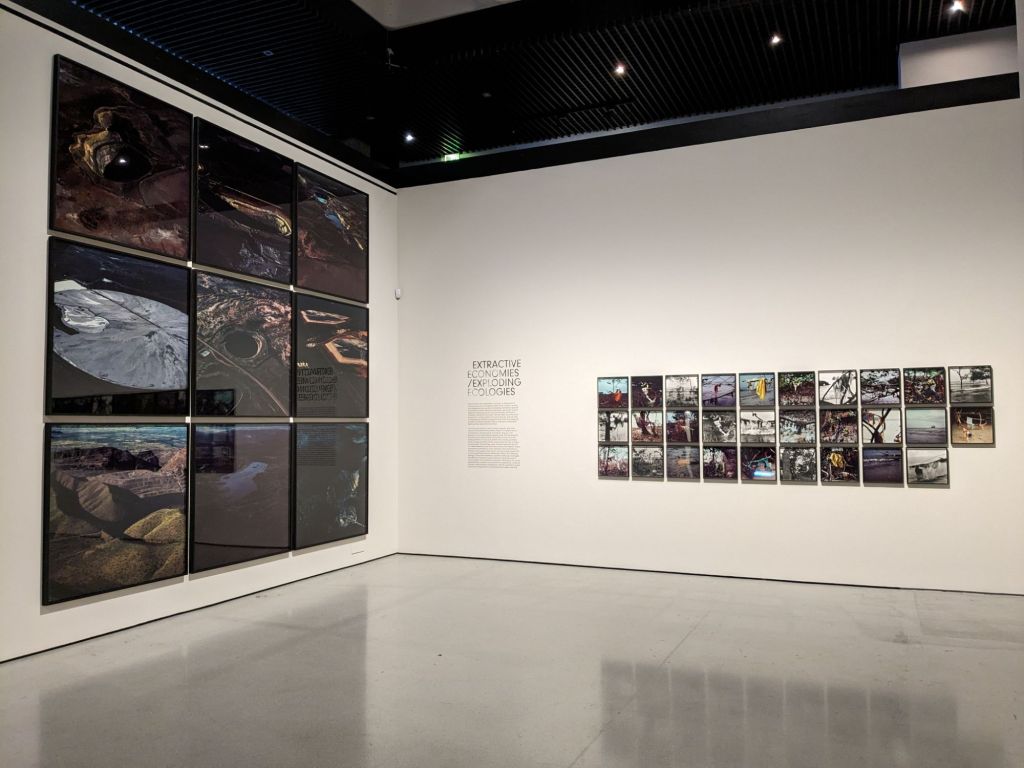
That being said a very significant proportion of this is documentation of one sort of another – documentation to record site specific performance (eg Ukeles and Shaffer) or documentation to enable or make us see real life exclusions (eg Godwin), or activism such as anti-nuclear protests, and resistance to mineral extraction. Some work did documentation in other ways such as using existing media (eg Bethônico’ use of newspaper documentation of mud slides),
The entrance juxtaposition (above) of Simryn Gill’s work, on the one hand smaller images of plastic bags stuck in vegetation after water levels recede or on the other larger images of open cast mining sites in Australia, kind of sets the stage.
There are multiple explorations of being other or dissolving – Aguilar, Corrine, Hammer, Huggins, Mendieta, Miracles, Neo Naturists, Shaffer, Urya, Woodman (and others).
There are long term explorations of multiple dimensions of reality in huge places (eg Chloe Dewe Matthews’ ‘Caspian: The Elements’).
Not all the work is activist, some is simply sensuous and vivid such as Carolina Caycedi’s ‘Multiple Clitoris’ (below) made from kaleidoscoped images of a river.

What’s missing though?
The ecosexuals…
Anything living…
The manifestos…
The ‘public artists’…
Whilst the New Naturists and others are doing something along these lines, Beth Stephens and Annie Sprinkle amongst others are reimagining Earth as lover and their various ‘marriage ceremonies’ would have added a distinct dimension.
And along those lines there is literally no living material in the exhibit… I know the Barbican can do it .. they had the Harrisons’ Full Farm in ‘Radical Nature’. What about Jackie Brookner’s work which might have brought water from the roof into the gallery and purifies it flowing over a mossy tongue – look it up, it’s great!
I didn’t see Mierle Laderman Ukeles’ Manifesto of Maintenance Art which is a foundational document in this field, not any of Agnes Denes’ Manifestoes. And I bet there are many others, the inclusion of which would have also troubled the curatorial authority. Which raises a thought about how conventional the display is – largely framed works arranged nicely with neat labels. What if the Manifestoes had been printed on the walls behind or adjacent to the works? Layering up meaning…?
Finally the ‘public artists’, though that is too neat a category for Betsy Damon and the Keepers of the Waters or Aviva Rahmani and her Trigger Point Theory or Bonnie Ora Sherk and ‘The Farm’ or Patricia Johansson, or Jody Pinto, or ffs Loraine Leeson and her project with the Old Geezers just up the road on the River Lea creating renewable energy…
The review in the New York Times highlights many of these concerns, concluding with questions for the institution around how it engages with what the works in the show are raising and drawing attention to…
Great exhibition, really glad I saw it, definitely buying the book…
What art have I seen? Dorothea Tanning
Dorothea Tanning at the Tate Modern. Jake asked if in an exhibition of Max Ernst there would be so much reference to his wife – seems unlikely. Mostly we don’t know about the women in male artists’ lives, unless they are ‘muses’ or lovers. Tanning’s narrative in the interpretation panels is woven with Ernst’s.
Beside this it is also interesting that all the publicity images are from the first phase of her work, which is most obviously part of the Surrealist tradition we are familiar with. There is mention of the fabric sculptures, but no images of the later much more optically complex and freely painted works. These explore the fragmented sense of subconscious experience. Rather than glimpses through doors, we have actually fragmented elements merging in complex patterns and forms. The resolution of this in the room-scale installation of fabric forms is truly Lovecraftian.
Reading
A Guid Cause: The Women’s Suffrage Movement in Scotland, Leah Heneman, Aberdeen University Press, 1991.
This book covering the early connections between suffrage, education and slavery, and the subsequent development of suffrage in Scotland as a strong and distinctive movement, with its own characters and events, is well researched and thoroughly readable.
My starting point was discovering somewhere that Fanny Parker, the neice of Lord Kitchener, had in 1914 with another suffragette, attempted to blow up Burns Cottage, Alloway. Parker was an active and militant suffragette and spent more than one episode in prison as a result. Not only was she forcibly fed by tube, but she and others were given ‘nutritional enemas’. This book set her attempt to bomb Burns Cottage in a clear historical context.
I also discovered another interesting connection. Louisa Innes Lumsden, another suffrage campaigner and one of the first three women to graduate from Cambridge, must be one of the Lumsdens’ of Clova. In the short biographical sketch it mentions that she was chair of the Rhynie School Board.

 CHRIS FREMANTLE
leave a comment