New writing
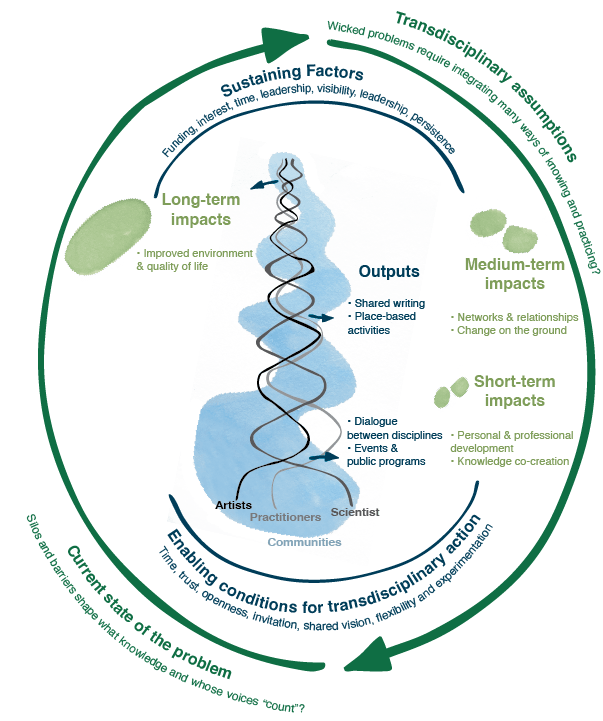
Three pieces of work that have all taken ages to get out are now published! They all bear on the Culture-based Climate Action agenda, the critical project to articulate the role and capacities of cultural actions across arts and humanities in addressing the nexus of crises: climate, biodiversity, and pollution.
Firstly, the article on Uncertainty and Indeterminacy resulting from events held between two environmental research projects – newLEAF and Creative Landscape Futures https://www.tandfonline.com/doi/full/10.1080/01426397.2025.2537772
Abstract: Landscapes, intentionally or otherwise, are often planned and managed in ways that create determined outcomes involving production, conservation, and aesthetics. While the focus of much research is on how to plan landscapes more effectively, this article explores how uncertainty and indeterminacy are inevitably also part of the research process. We present the results of discussions among a multidisciplinary group of researchers across the arts, humanities, social and natural sciences. We articulate discipline-specific understandings of indeterminacy and uncertainty and synthesise points of similarity and difference between them. Common concerns are with the limits of knowledge; conceptions of futures; the role of chance and change; and the dichotomy of action or ‘doing nothing’ in landscapes. We highlight arts research that works distinctively to develop subjectivities and create different relations with control and management. We emphasise the challenge of research to manage risks versus the need for indeterminacy to enable adaptation and promote novelty.
Secondly, a magazine article on developing a Theory of Change based on the NATURE PLACE programme of artists’ residencies with land and natural resource managers and researchers https://www.thenatureofcities.com/TNOC/2026/01/21/how-artists-help-to-transform-natural-resources-management-building-a-theory-of-change/
And thirdly, the article developing an analysis of the evaluations of artists, scientists, land managers and organisers of the NaturePLACE (formerly UFS Arts) program. This will be published in The International Journal of Social, Political and Community Agendas in the Arts.
Abstract: This paper uses a knowledge exchange-based approach to evaluation to explore the reported experiences of artists, scientists, and land managers participating in the ‘NaturePLACE Program’ (formerly UFS Arts), focusing on the period 2016-2024. The primary aim of the Program is to build understanding of and engagement with urban social-ecological systems through the arts. The approach to this evaluation draws on a range of literature on research in the arts, as well as research and knowledge exchange impact evaluation from the environmental research domain. The evaluation reported in this paper is distinctive in focusing on the interactions of participants rather than on perceptions of beneficiaries. The data analyzed comprises evaluations (n=49) submitted at the conclusion of the residency by six cohorts involved in the NaturePLACE program (2016, 2017, 2018, 2020- 21, 2022-23, 2024-25). This paper provides important insights into the impacts on artists, scientists, and land managers from transdisciplinary place-based work. Causes of impact not previously noted within the framework are identified as related specifically to the arts, including modes of sensuous aesthetic attunement, forms of focusing attention and eliciting public discourse, and shaping cultural imaginaries. Critical reflection also becomes evident as an aspect of capacity building.
The Art of a Life Adapting, published in Leonardo
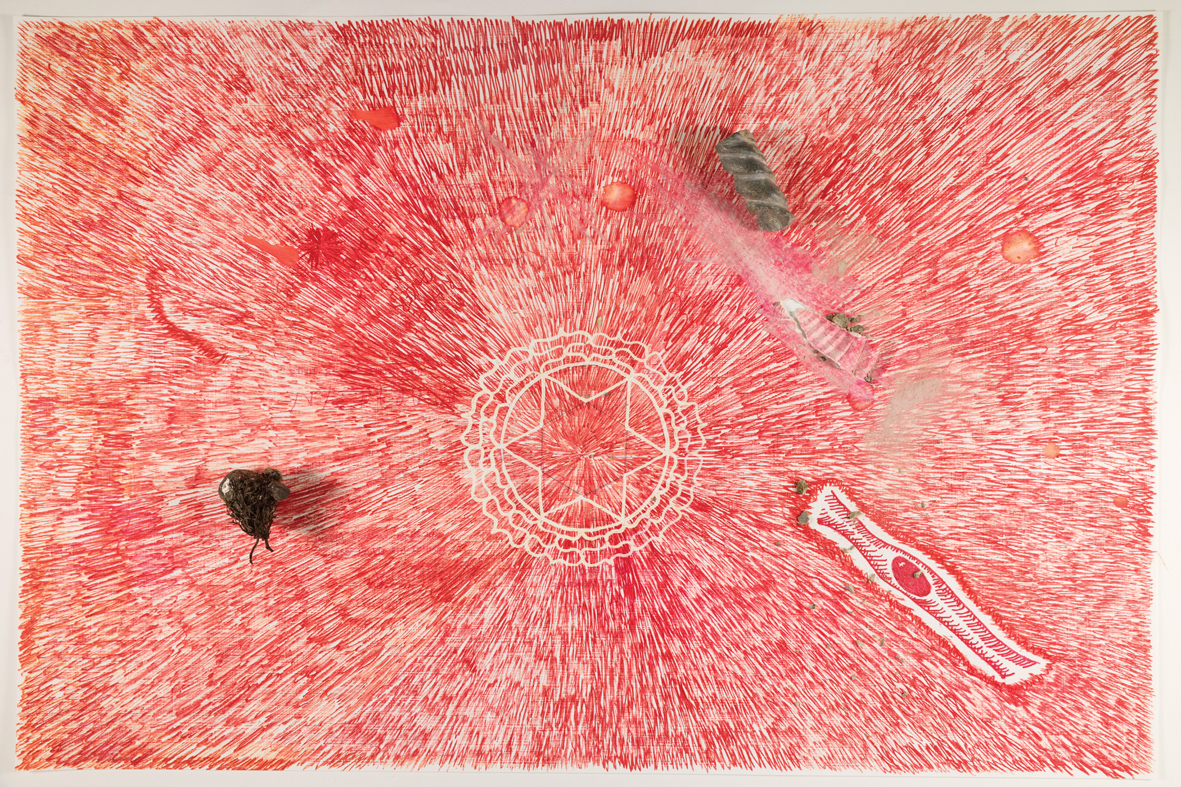
‘Drawing 2016’, pen (Sharpie), found object, sculptural object, 2016. (Photo: Fergus Connor)
Statement ‘The Art of a Life Adapting: Drawing and Healing’ just published in Leonardo Vol 53 No 1. You can find an earlier version here. Drawings are here.
There is a lot of talk about adaptation in relation to the climate crisis, but there is also an increasing recognition that cancer survival rates mean that a larger proportion of the population is and will be living with the long term consquences of cancer treatment. This has been highlighted by the EU Horizon programme, “The EU has already placed the needs of survivors as one of the key pillars of its Beating Cancer Plan and has now launched a consultation aimed at identifying where research is needed most.” (‘Treating cancer is only part of the journey’: the overlooked needs of cancer survivors, online.)
The role of arts and cultural practices, as well as approaches to understanding adaptation conceptually and practically, all need further consideration (see recent blog on climate adaptation). We know arts & culture has multiple contributions to make, including:
- offering forms of autonomy in palliative care, as explored in the ‘Tracing Autonomy’ project by Prof. Ben Colburn of University of Glasgow, Jeni Pearson and Kirsty Stansfield of the Art Room in the Prince and Princess of Wales Hospice in Glasgow.
- playing a role in ’emotional regulation’ (Daisy Fancourt’s recent research provides significant evidence), but there are also issues around ‘uncertainty’ which also connect climate-related adaptation with cancer-related adaptation.
- opening up ways of ‘living with uncertainty’, which medics recognise as an important part of their professional practice, but is equally significant for patients.

 CHRIS FREMANTLE
1 comment