What art have I seen? Stories Real and Imagined, Research and Practice, OMOS

Sam Ainsley’s exploration of relations, body to world, micro to macro, pattern to image… One of the really important figures in Scottish art as artist, teacher and leader.
The exhibition resulting from RSA Residency Awards:
Victoria Clare Bernie – exploring an 18thCentury donation of three works by a woman artist whose biography was unknown
Samantha Clark’s ambient works on water and space
Joel Dixon’s experimental photography
Flore Gardner’s and Robert Powell’s variously quirky works
MV Brown’s snapshots queering and challenging our understanding of countryside, nircely complemented by the OMOS installation of video and photography taking drag into the Scottish landscape.
Contribution to TNoC’s Roundtable
Artists and scientists that co-create regenerative projects in cities? Yes, please. But how?
Honoured to be able to contribute along side a great group of people all working on regenerative approaches all over the world.
My contribution to The Nature of Cities Roundtable on co-creating regenerative projects in cities focuses on an approach to evaluation that works across arts, culture, science and environmental management. Based on work done by Laura Meagher, Catherine Lyall and Sandra Nutley and further developed with input from Dave Edwards, the framework draws attention to conceptual shifts, capacity building, instrumental impacts, attitudinal shifts and enduring connectivity. It is focused by the challenges and impacts of working across different ways of knowing and ways of working.
The whole round table is great with stimulating and informative perspectives from all sorts of different contexts.
Review for Climate Cultures: The Raven’s Nest by Sarah Thomas

Mark Goldthorpe very kindly asked me to do a review for Climate Cultures. It was fascinating to review Sarah Thomas’ The Raven’s Nest and to explore the inter relation between a great book and a PhD done in combination.
In The Raven’s Nest Sarah Thomas tells us a story of falling in love, moving to another culture and learning its ways. Many things have agency in the book, including all sorts of other living things as well as landscapes and even buildings. Daylight too is an actor. Nested within the book is a photo essay, a visual journey parallel to and intersecting with the words.
Neurodiversity promotion on Exhibition Road


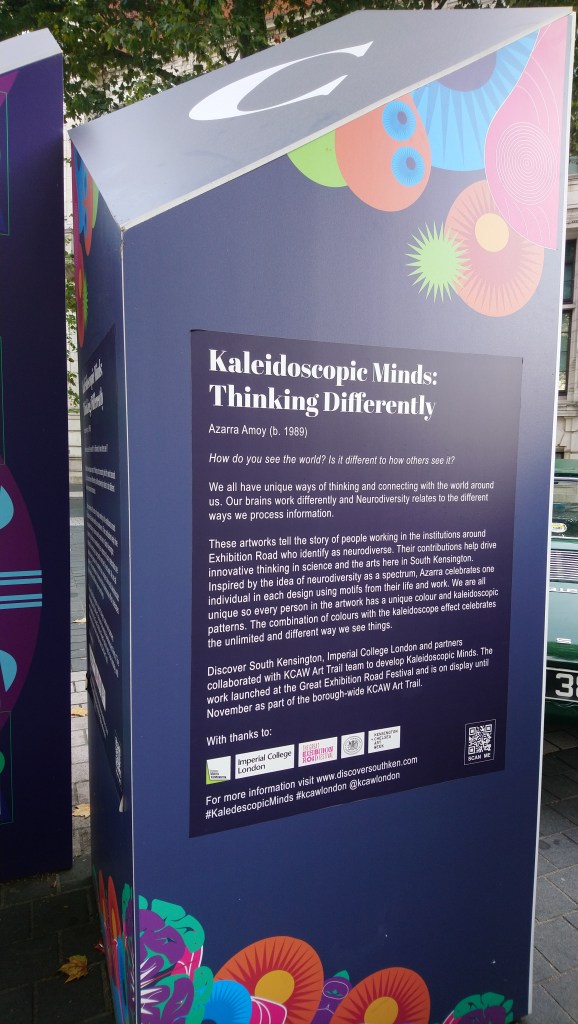

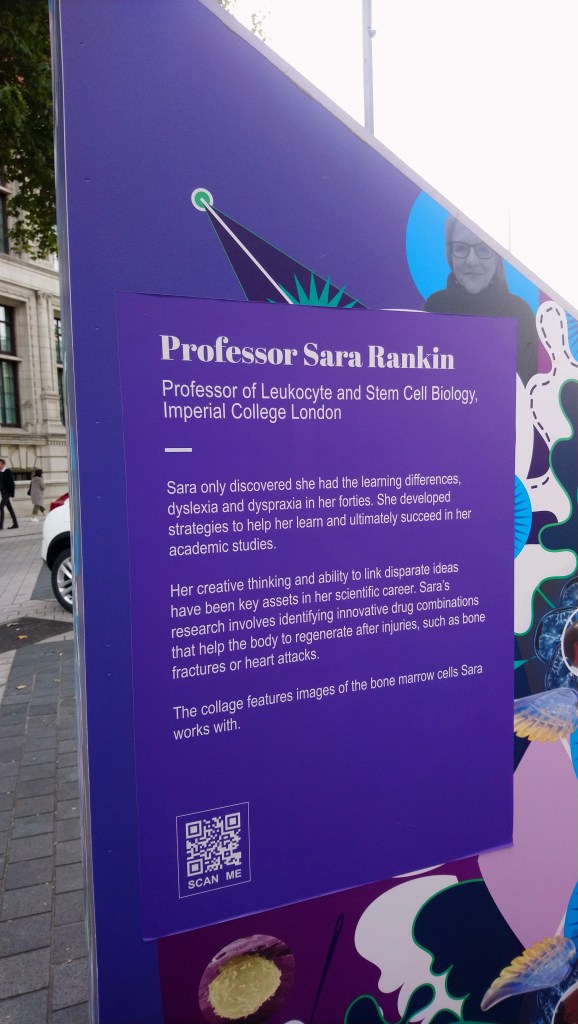

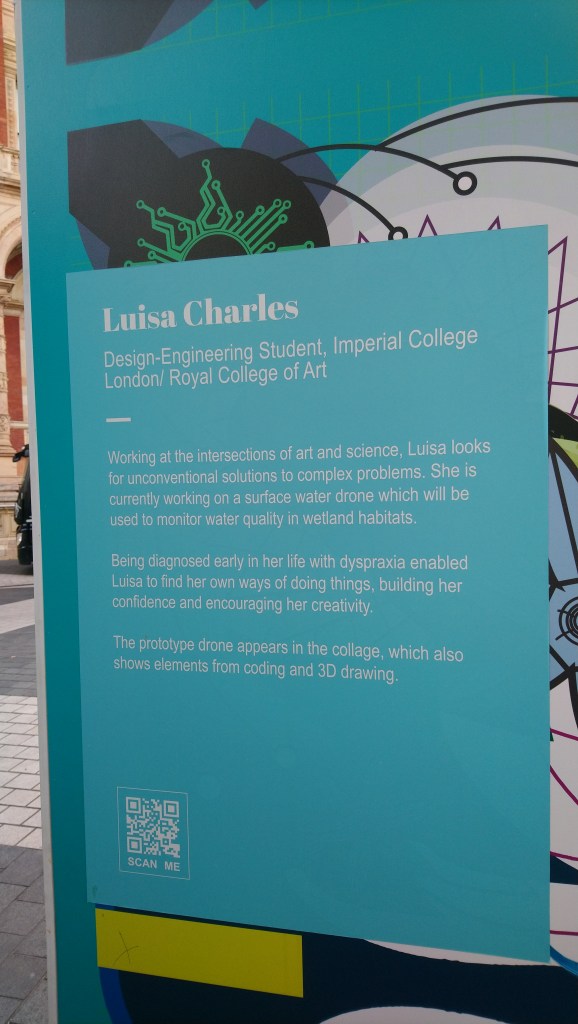

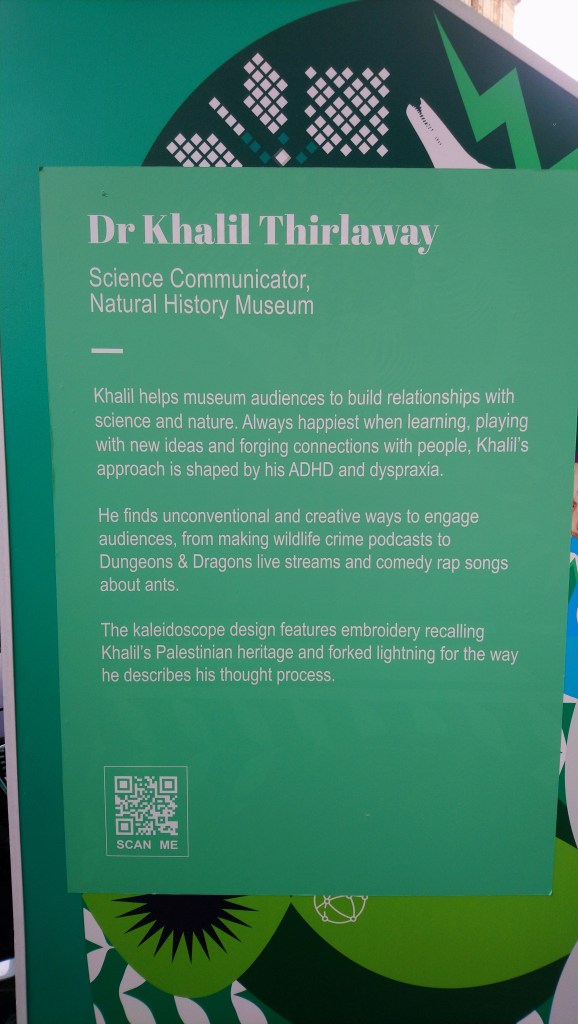

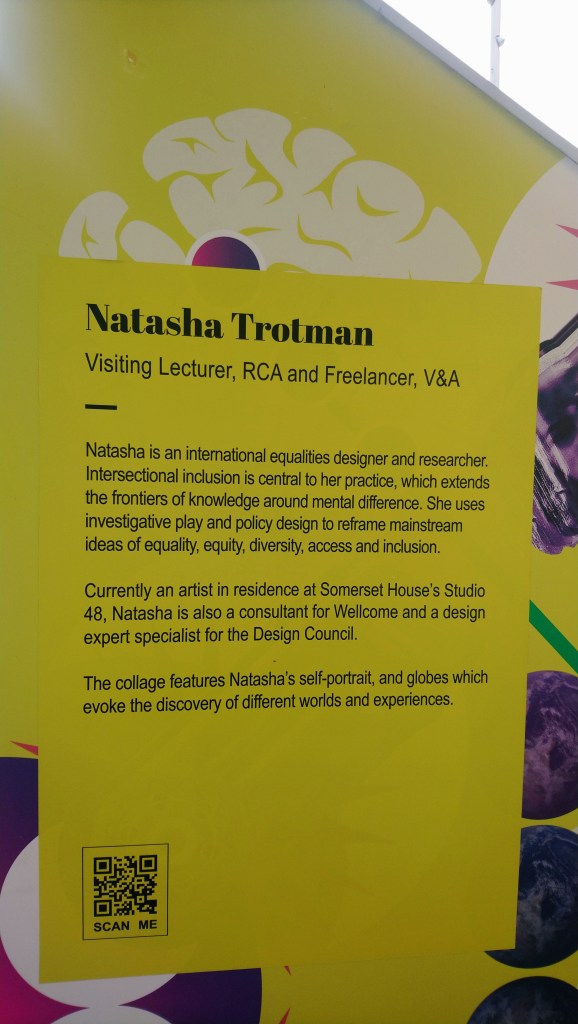
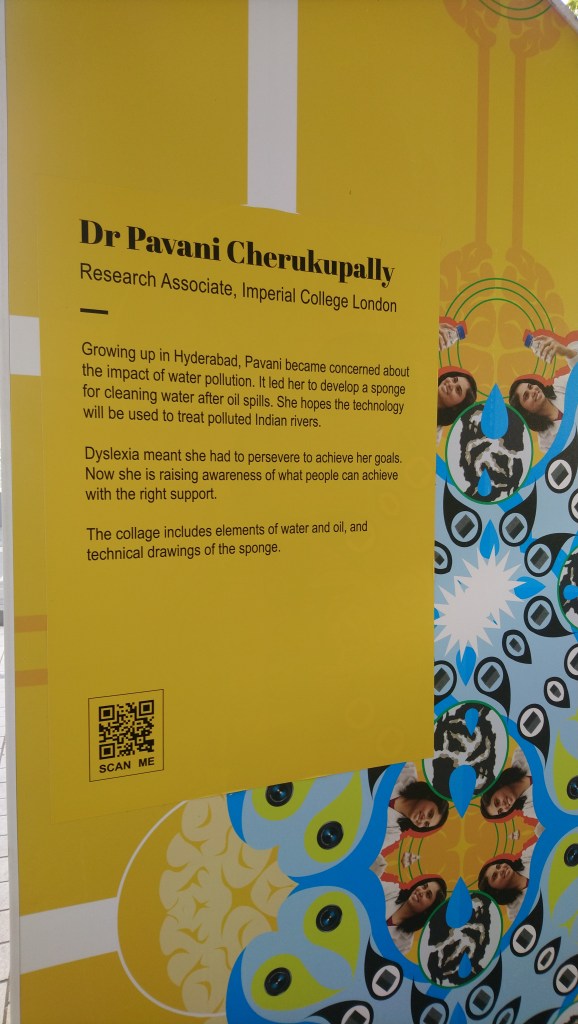

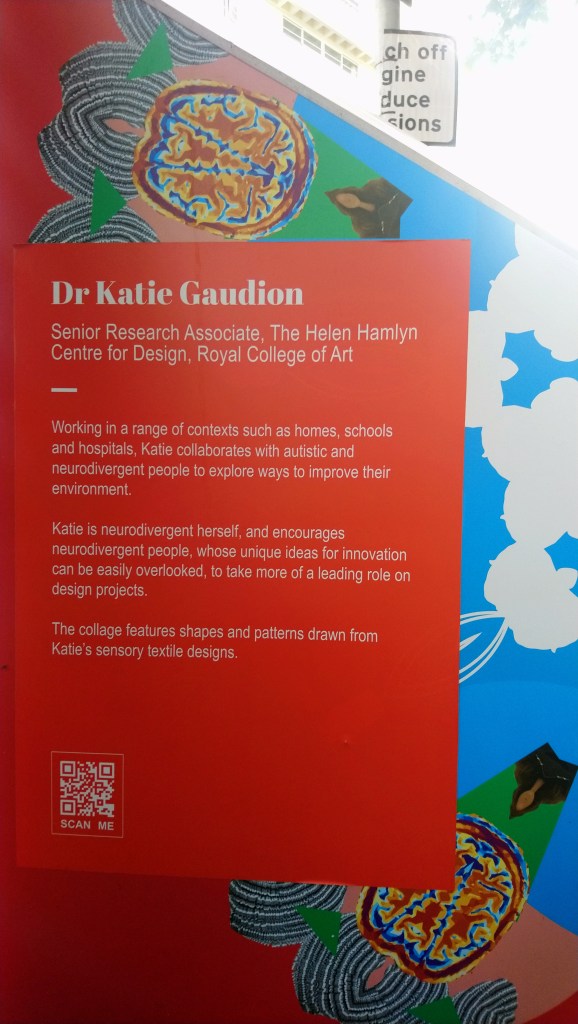

Came across this inspiring installation on Exhibition Road in Central London. It highlights neurodiverse researchers in the leading institutions (Imperial College, Science Museum, V&A, Royal College of Art) along this key street. The graphics are engaging and the individual examples highlight the importance of neurodiversity in research.
What art have I seen? In the eddy of the stream
Cooking Sections and Sakiya’s exhibition at Inverleith House in the Royal Botanic Gardens Edinburgh is as good an example of putting the wellbeing of the web if life first – the challenge Helen Mayer Harrison (1927-2018) and Newton Harrison (1932-2022) set themeselves in the early 70s and which is now clearly the challenge for all of us.
Cooking Sections “is a practice that examines the systems that organise the world through food, and how food can be used to explore, trace and advance climate justice.” Sakiya “is an academy, a residency programme, a research hub, and a farm located in Ein Qiniya, a small agricultural village seven kilometres west of Ramallah, in Israeli-occupied Palestinian territory… By grafting local traditions of self-sufficiency onto contemporary art and ecological practices, Sakiya seeks to create new narratives around relationships to land, knowledge-production, and commoning.” (Sakiya are also working with Arts Catalyst and have a residency opportunity at the moment.)
Cooking Sections have been working in Scotland and in particular on the Isle of Skye for some years now – Emma Nicolson first worked with them on the Climavore project when she was the Director of Atlas, and she has curated this in her role of Head of Creative Programmes for the Royal Botanic Gardens Edinburgh. This enduring connection is significant.
The exhibition “…draws attention to the breakdown of ecosystems through the removal of plants and the ensuing long-term harm to people, communities, and other species.”
There is an important set of proposals around commoning which directly relate to Newton Harrison’s On the Deep Wealth of this Nation, Scotland. Where that work proposes understanding the soil, water, air and forests of Scotland as commons that we are dependent upon and asks for a ‘commons of mind’ to commit to putting back more than we take out, the proposals around commons in this exhibition include that the whole intertidal zone of Scotland should be established as a commons and that a Scottish Office for Commoning should be established. This proposal needs published as a full page pull out in the Highland Free Press or another widely distributed publication.
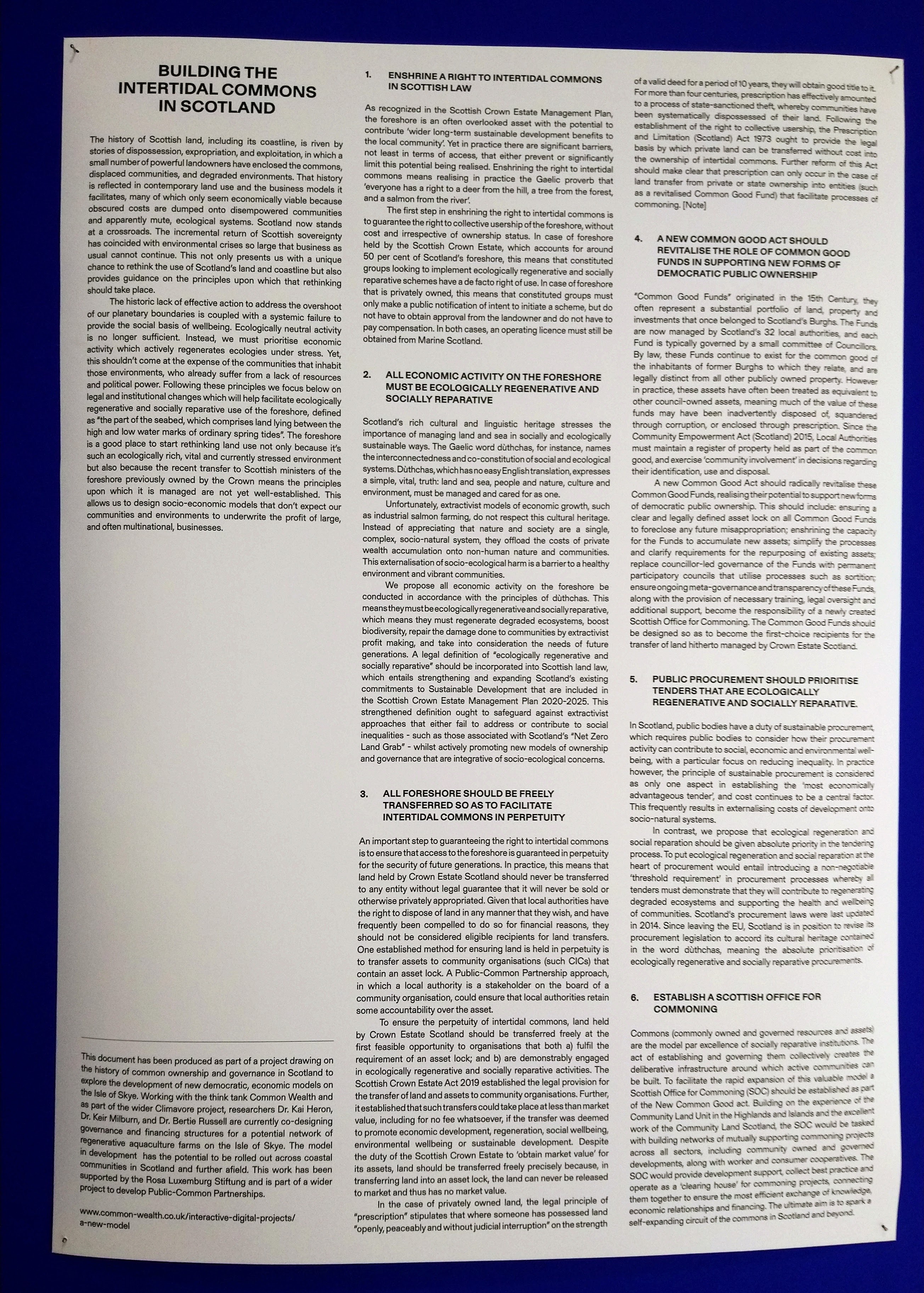
This forms one part of a series of installations focusing on salmon and forests, mussels and muscles, oysters and terrazzo. Each reveals an aspect of an ecology and a different way of imagining exchange and reuse rather than extraction. Some like the work on seaweeds and shellfish is being developed to a functional scale to offer alternatives to industrial fish farming which is destroying coastal waters in the Highlands.
Deborah Bird Rose talks about the two violences of colonialism – the violence to people and the violence to the environment. Sakiya’s installation focuses on the violence to the environment done by British colonial rule of Palestine even before the imposition of the state of Israel. The British colonial administration ruled that a large number of culturally significant plants were weeds to be exterminated. The main display is of botanical specimens of 33 plants, their cultural significance and their ecological role. Another remarkable creation in the exhibition is a carved wood frieze of these plants, reminiscent of a plaster cornice. Throughout Inverleith House we can hear singing. The installation in the final room echoes through the whole space, lamenting ecological and cultural loss.
In the eddy of the stream judiciously uses whimsical and suprising installations as well as scientific data (highlighting what we know as well as what we don’t know) and beautifully crafted elements – these works hold the challenging evidence of human ignorance of and violence to ecosystems in a way that draws us into careful attention through an experience that is rich and rewarding.

What art have I seen? Köln Skulpturen Park

Köln Skulpturen Park makes evident several key moves used by sculptors creating outdoor works
- Reflection – we have an Anish Kapoor mirrored disc, a Dan Graham pavilion and a Tom Burr work of black reflective panels
- Fairy tales – two of the pieces added to the collection recently (video here) evoke traditions and archetypes Mary Bauermeister’s arrangement of tree stump seats into a space for a different way of spending time in nature and Guan Xaio’s Old Eggs and the Catcher which seems to allude to folk stories
- Repurposing – Dane Mitchell’s Post Hoc, two fir tree mobile phone masts, take a piece of infrastructure and repurpose it to tell a different story, in this case of loss.
- Buildings – the focal point of the park is Suo Fujimoto‘s white concrete structure. The ‘building’ surrounds a tree. The act of looking in and looking out both create frames with which to appreciate the leafy environment. Of course, much like the Farnsworth House, you need a certain level of privilege to appreciate the views without being concerned about the functionality of the building.
Mies van der Röhe said
When one looks at Nature through the glass walls of the Farnsworth House, it takes on a deeper significance than when one stands outside. More of Nature is thus expressed – it becomes part of a greater whole.
Fujimoto’s piece is the sculptural version, framing and organising nature. It even has works installed in and on it.
Lois Weinberger‘s intervention made a few years ago is one of the more radical ‘pieces’. Very much in contrast with the formality of much of the work (di Suvero, even Fischli and Weiss), his trench, in reality a bulldozer driven in a straight line for 100m cutting through paths and leaving spoil heap at the end of the line, offers a different aesthetic. Related to Robert Smithson’s various experiments with entropic processes, and with Gordon Matta-Clark’s cuts, but this is negentropic – it is focused by emergence, its aesthetic is what happens when we stop controlling nature. Its counterpoint is Karin Sander‘s piece of plastic grass inserted into the equally managed grass.
The curatorial approach is in some respects more radical than some of the artists’ works. As I understand it each new exhibition, comprising some temporary works and some new permanent installations, is focused by a previous work. This year’s exhibition refers back to the Weinberger’s piece. This iterative accumulative approach forms a nice counterpoint to novelty as a curatorial approach.

 CHRIS FREMANTLE
leave a comment