What art have I seen? Suzanne Lacy speaking at Chelsea School of Art
I wouldn’t normally post a lecture under this heading, but Suzanne Lacy’s presentation at Chelsea School of Art on Wednesday evening was brilliant. I’m going to try and reconstruct the thread of argument as I heard it, and where it particularly made me think.
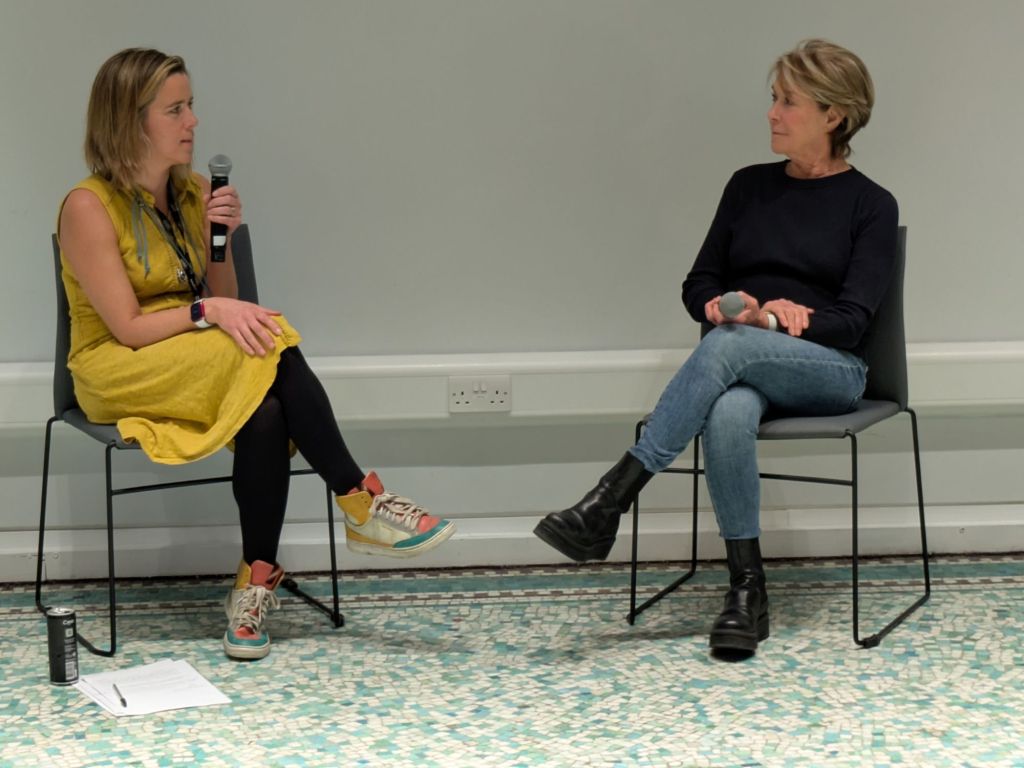
Suzanne started by highlighting the importance and dialogue with British artists over a very long period, naming Margaret Harrison, Conrad Atkinson, Susan Hillier (I think,) and also name checking the Artist Placement Group.
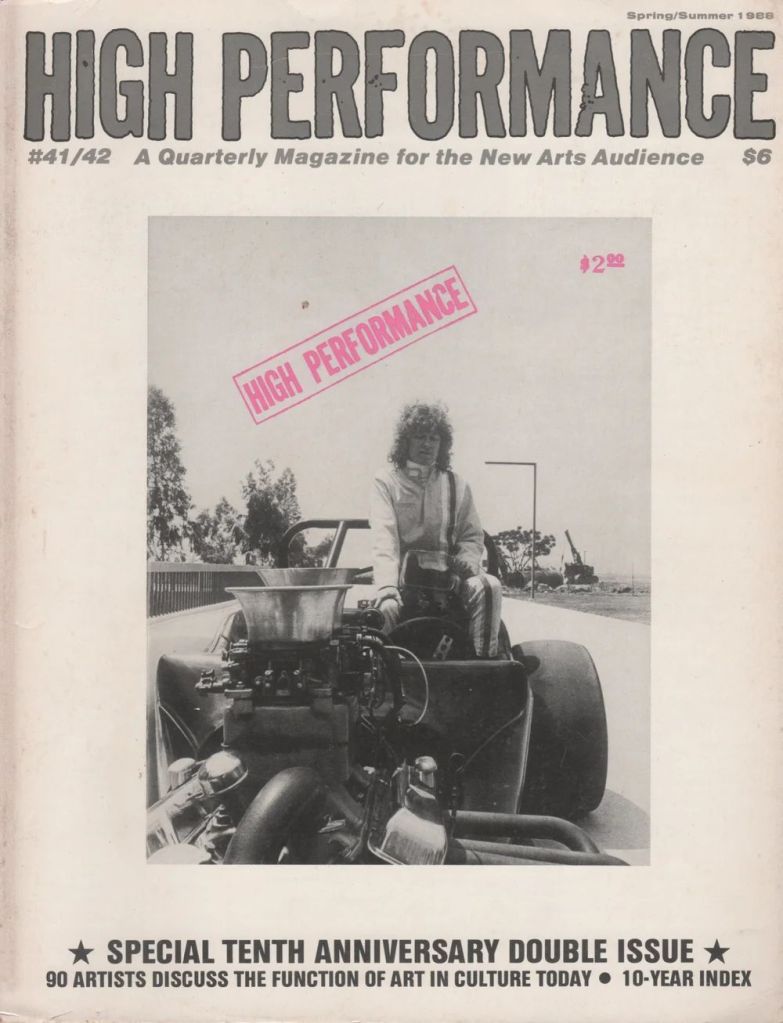
Suzanne then positioned herself in relation to colleagues arguing that whilst critical theory is a means to understand the various forms of power and its exclusions (“a broad philosophical framework to challenge social inequity”), critical pedagogy is the place where the rubber hits the road (I use this particular idiom because Suzanne is revisiting Cinderella in a Dragster (1976) as part of the celebrations of 50 years of High Performance magazine…)
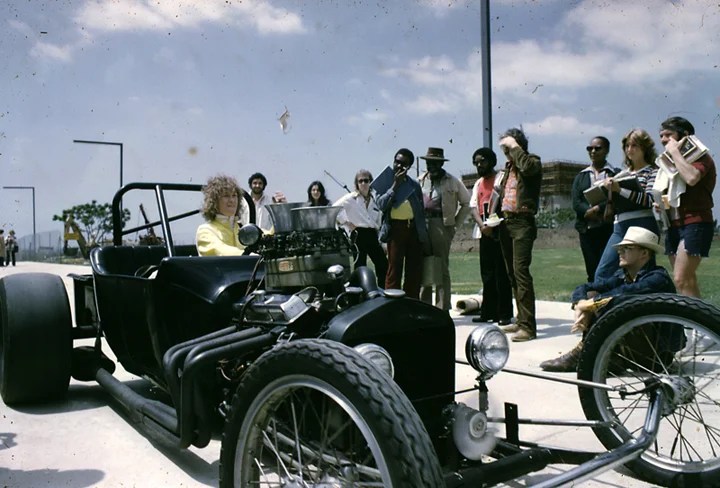
It was celebrated at the 10 year anniversary too.
Suzanne argued that pedagogy is critical because education is actually a social equaliser and critical pedagogy takes the concerns of critical theory into the context of teaching, asking not only what to teach? but also why and how? and also where and when? And Suzanne specifically drew attention to the way that critical pedagogy raises challenges of impact and effectiveness which are perhaps not so central to critical theory and are also sometimes ‘parked’ or at least consider troublesome by some artists and curators.
I’ve always had an interest in critical pedagogy and in particular the many various approaches of artists. One manifestation that led to the production of Ecoart in Action is the creation and sharing of scores and exercises (e.g. Draw it with your eyes closed). The ecoartscotland mobile library is another.
I’ve also become increasingly interested in questions of impact and effectiveness – how do we evaluate art practice particularly when interacting with other disciplines in public contexts?
Suzanne is a first generation Feminist artist activist.* She described herself as first and foremost a performance artist, although she acknowledged that mostly she is categorised in terms of social practice. Suzanne describes Feminism as having “an aesthetic drawn from quotidian life”, and that “experience is the material”. She highlighted that Judy Chicago showed how “aesthetics was a pathway to the political”.
Suzanne argued that pedagogy – how you learn – is central to Feminism, maybe most obviously evident in consciousness raising, but also in the multiple intersections of Feminism, art, and learning.
One of Suzanne Lacy’s mentors was Allan Kaprow and his approach to performance had a big impact. Suzanne connected his concern with the everyday into Feminist aesthetics, but also highlighted how Kaprow “had an aversion to prescriptive thinking” that Suzanne suggested can characterise Feminist art when addressing for instance rape culture or racism. For Suzanne the roots of all of this are in Freire and Giroux, for Kaprow in Dewey.
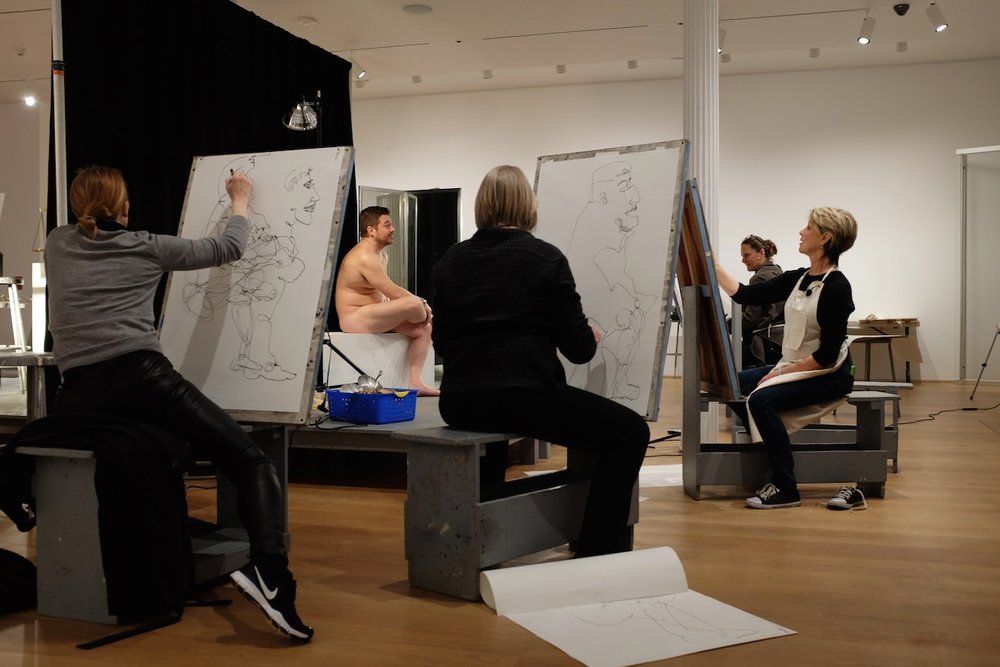
The most literal example of pedagogy was perhaps the project Suzanne and Andrea Bowers did together, firstly occupying a gallery in New York where Andrea taught Suzanne to draw, and then reversing the exercise in Los Angeles where Suzanne taught Andrea performance.
Pedagogy was one of three concerns that Suzanne Lacy discussed. The other two were subjectivity and relationality. Suzanne selected works for the presentation from across her career to date that served to draw out specifics, including Cleaning Conditions (for Kaprow), the University of Local Knowledge with Knowle West Media Centre (including videos on raising pigeons, learning to dance, relationships with horses resulting in filmed discussions in a pet food store), De tu puño y letra, Across and In-Between, What do women (footballers) want?, and Between the Door and the Street as well as others.
Subjectivity is again central to Feminism and consciousness raising and in turn the political, but it is also not uncomplicated because, as I think I understood Suzanne to argue, subjectivity as it engages in public becomes identity, and identity also gets simplified into singular dimensions. Singular dimensions enable organising but also resistance. On several occasions Suzanne carefully corrected herself to ensure that there was never a reduction or simplification that created an exclusion that wasn’t intentional.
The work Cinderella in a Dragster is an exploration in taking on an identity to explore a subjectivity. Suzanne connected this with the work of Bonnie Ora Sherk and of Eleanor Antin.**
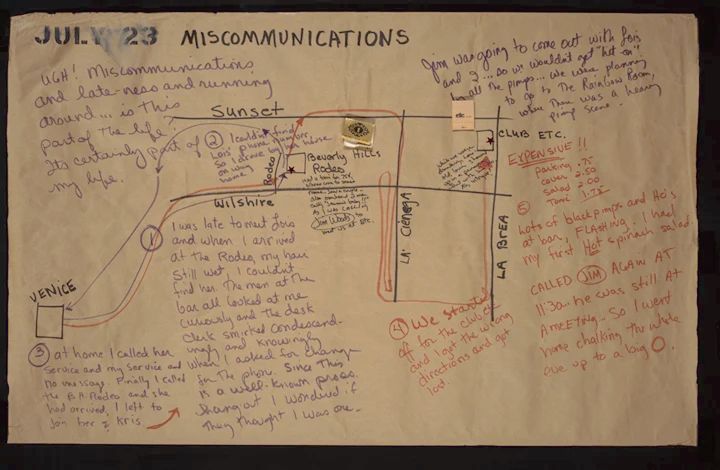
In this thread Suzanne discussed her work Prostitution Notes (1974). She noted how everyone knows someone who has taken money for sex one way or another and showed us diagrams tracing how this can then be mapped across a city. It was clear that prostitution was a tricky subject which Suzanne neither wanted to avoid, nor felt was in any way simple. She made a point of noting her discussions with Margot St James, the sex positive activist.
Suzanne asked a really interesting question in the middle: “How did we do in communicating the work to younger artists? How do younger artists understand what our generation did?”
She didn’t answer this question, but rather left it hanging in the room.
Suzanne described negotiation, something overlooked even in social practice, as “the painterly stroke of the brush on canvas” going on to say that coalition building is dangerous work, and that experience in common can be a basis on which to think. She attached three words to this: “reveal, be open, and admit mistakes”. She also talked about scale, what it takes to be moved, and the visual aspects of scale, saying “I make creative decisions, I don’t make content”.
During the Q&A with Lana Locke who had organised the event as part of ongoing research, Suzanne drew several people in the audience into the conversation including Mark Thomas of Manchester Met who has produced multiple works in England and Ireland with Suzanne, and Dominique Heyse-Moore now at the Tate.
These are abiding concerns and issue of pedagogy was central to Suzanne’s PhD (which focused on her Oakland Projects) as well as to the Working in Public Seminars which Anne Douglas, her Supervisor and Professor of Art in Public Life, organised as part of the process. This articulation, particularly in relation to critical theory and critical pedagogy, as well as to subjectivity, was really acute. As a lecture in an hour Suzanne compellingly drew out key ideas that through her practice and works become a clear philosophical position. Some of the questions Suzanne raised, particularly around impact, were not answered directly, but it is interesting how the ‘Lyall, Nutley, Meagher, Edwards Prism’ (as I call it) offers a way to understand this. The Prism focuses on Conceptual Shifts (Aha Moments), Capacity Building, Practice and Policy Changes, Attitudinal Shifts, and Enduring Connections. It is so easy to see where the Conceptual Shifts are driven by the art, but bound up with the Capacity Building precisely because of how pedagogy is inseparably part of this work. The Attitudinal Shifts, normally conceived in terms of increased willingness to collaborate across disciplines, can be reconceived in terms of Suzanne’s coalition building and finding common experience as a basis.
Suzanne so clearly articulated the way her generation’s Feminist art practice brings an overarching aesthetic concern with the everyday into relation with a pedagogy grounded in experience, and sees these as capable of being directed towards the political. She made a compelling case for critical pedagogy as a way to think about this.
*Lacy studied with Judy Chicago – they are 6 years apart in age. Suzanne was part of the first year of Chicago’s Feminist Art Program at University of California, Fresno.
**There is a retrospective of Eleanor Antin’s work touring Europe at the moment.
Bibliography
Edwards, David M., and Laura R. Meagher 2020. “A Framework to Evaluate the Impacts of Research on Policy and Practice: A Forestry Pilot Study.” Forest Policy and Economics 114 (May): 101975. https://doi.org/10.1016/j.forpol.2019.101975.
Fremantle, Chris, and Leslie Mabon 2021. Cultural Adaptations Evaluation Report. Creative Carbon Scotland. https://doi.org/10.48526/rgu-wt-1513437.
Fremantle, Chris, Melehat Nil Gulari, Susan Marie Fairburn, Leigh-Anne Hepburn, Gail Valentine, and Laura R. Meagher 2016. “Impact by Design: Evaluating Knowledge Exchange as a Lens for Evaluating the Wider Impacts of a Design-Led Business Support Programme.” Proceedings of the 20th Design Management Institute (DMI): Academic Design Management Conference (DMI:ADMC): Inflection Point: Design Research Meets Design Practice, 405–30.
Fremantle, Chris. 2011 ongoing. Ecoartscotland Library. Books, Variable. https://ecoartscotland.net/bibliography-2/.
Geffen, Amara, Ann Rosenthal, Aviva Rahmani, and Chris Fremantle, eds. 2022. Ecoart in Action: Activities, Case Studies and Provocations for Classrooms and Communities. New Village Press.
Lacy, S. 2013. Imperfect art: working in public: a case study of the Oakland Projects (1991-2001). Robert Gordon University, PhD Thesis.
Paper Monument, ed. 2012. Draw It with Your Eyes Closed: The Art of the Art Assignment. N+1 Foundation/Paper Monument.

 CHRIS FREMANTLE
Thanks Chris… actually this brings to mind how GAROIAN, Charles (2012) ‘Sustaining Sustainability: the pedagogical drift of art research and practice. Studies in Art Education 53(4), 283-301.. Summer ) who saw the Harrison’s work as re-imagining education overall, as a holistic, life-affiriming pedagogy. Sort of my jumping off point for all my work at Haumea Ecoversity in developing ecoliteracy eco-pedagogy for creatives and cultural practitioners, but which appropriate for education. I know mine is just one of many efforts to re-enchant education & creative practice education considering the global advance of organisiations like the Ecoversities Alliance, but to me that was the most important finding I had from the Harrisons work… Newton’s final words to me were to “just keep going”. I did write a general overview of some of these thoughts, and tying in foundational values based learning for holism with the Earth Charter at https://www.academia.edu/116621971/Understanding_How_Creativity_Works_for_a_Better_World_Unifying_Insights_From_Ecological_Art_Practice_and_Values_Based_Transformative_ESD_Learning
Thanks Cathy! I was going to go back to Garoian’s book – it’s on a shelf and had come to mind
It was that particular journal review of the Harrison’s work that was insightful for re-imagining a holistic pedagogy from their transversal co-creative work for education (and creative practice included) overall