What art have I seen? Jim Lambie
Jim Lambie’s exhibition at the Fruitmarket, part of Generation, includes classic work Zobop (the floor) and Shaved Ice (the mirror ladders). I think I recognised both Rainbow Rising and Deep Purple in Rock in Stakka (the albums gaffer taped together with the images taped out leaving only the background colours visible). By chance I saw Zobop in Transmission in 1999. It’s still a great piece of work, drawing attention to the smallest details in the space in which it’s installed. It’s definitely sculpture, but it could be painting too.

What art have I seen? Jimmie Durham
An older man with shoulder length grey hair wearing a bad suit sits behind a battered office desk. Someone appears from off screen left and puts a watch on the desk in front of him. The man picks up the stone on the desk and hits the watch repeatedly until it breaks. At one point he shifts his grip from one handed to two handed enabling him to hit the watch more accurately. When the mangled watch eventually spins off the desk he reaches down, opens the drawer of the desk and pulls out a stamp pad and date stamp. He then pulls out a pad of paper. He date stamps the paper, pulls a pen out of his pocket, signs the paper and hands it to the person who put the watch on the table in the first place. They have been standing looking into the corner of the room (as if instructed so that their photo can be taken by a security system. They didn’t watch their watch being destroyed). They leave. Meanwhile the man behind the desk rapidly puts the pen back in his pocket and the stamp pad and date stamp away in the drawer. He assumes his former position. Another person steps forward, this time with a dust buster. It’s hard to break a dustbuster with a stone, but the procedure is repeated. The dustbuster is beaten with the stone until it spins of the desk. The stamped and signed paper is handed over. Slowly the area surrounding the official becomes littered with the remains of things brought to him for processing.
Jimmie Durham’s Traces and Shiny Evidence, currently at the Parasol Unit, is one of the most powerful groups of work you’re likely to see. The video work described above is entitled Smashing and was made in 2004.
The whole ground floor is an installation that, for me, answers the question, what would be the form of a contemporary ‘political garden’? Gardening can be a political act. It has been in the case of other artists such as Ian Hamilton Finlay, and was for some in the pre-American and French revolutionary period. This garden (albeit actually an installation in a gallery with no living things included) takes its cue, according to Durham, from an observation by the writer and philosopher Walter Benjamin, “that the rainbow colours in a thin film of oil on a puddle of rainwater are the best sign of modern times.”
Plastic pipes in bright colours span the room connecting oil barrels which have been gone through a ‘respray’ process with that particular sort of paint used on cars modified by boy racers that changes colour depending on where you are standing. Thick puddles of automotive paint spill out of the barrels and puddle on the ground. Other parts of cars (bonnets from Renaults, boot lids from Audis) lie scattered around. Skeletons of animals and birds are trapped in the spilt paint, or lie in corners having been repainted in rainbow colours.
You could accuse Jimmie Durham of being didactic. You’d be hard pressed to interpret these works as anything other than an indictment of our fossil fuel and consumer culture.
The third work that makes up the exhibition is much more ephemeral and strangely beautiful. Large sheets of white paper cover the upper gallery walls. They are loosely patterned with charcoal ‘drawings.’ These have an extraordinary three dimensionality and character. You can make out everything from small mice to large bears, all curiously beautiful and at once precise. If you watch the ‘film of the show’ in the foyer, you realise these have been made by taking children’s soft toys, shaking them in a bag of charcoal dust, and them throwing them at the paper. In the context of the other works, these shadows take on a resonance with the shadows left on walls after the atomic bomb dropped on Hiroshima.
What art have I seen?
SxSW (Christine Borland, Dalziel+Scullion, Graham Fagen) at the Maclaurin Galleries in Ayr – another part of the show I saw at Gracefield. Also saw the small sculpture show drawn from the collection with some lent works.
What art have I seen?
Christine Borland, Dalziel+Scullion and Graham Fagen at Gracefield Arts Centre in Dumfries.
What art have I seen?
‘Life & Invitation& Vapour in Debri&’ at The Modern Institute.
What art have I seen?
The Arrival of Spring new works by David Hockney at Annely Juda. The charcoal drawings are masterpieces, where the ipad drawings are interesting, striking, etc.
What art have I seen?
Abstract Drawing at the Drawing Room. http://drawingroom.org.uk/exhibitions/abstract-drawing
What art have I seen?
C, an exhibition at the Edinburgh Centre for Carbon Innovation by MFA/MA Art Space and Nature. Yanli’s manifest anger, the sound of breathing, Christina’s clouds moving across the atrium, Javier’s black cubes emerging from amazing geology, ‘designer’ algae in the cafe, a 3D 3 question graph.
What art have I seen?

View of Reclaimed. Photo Chris Fremantle
Reclaimed: The Second Life of Sculpture at the Briggait, Glasgow
and then Broth Mix screening at the Kinning Park Complex (with a discussion afterwards)
What art have I seen?
John Singer Sargent watercolours at the Museum of Fine Art Houston. I went with Donna Glassford.
The quarries at Cararra, Bedouin in the middle east, harbours around the Mediterranean, Venice, gardens in Firenze, vagrants and other artists, Tommies at the end of the war.
Sargent was an outstanding society painter, but this exhibition of watercolours is so much more inspiring. Watercolour is a particular skill and you will never see better, but there is a fascinating compositinal judgement – a harbour seen through a row of trees, the underside of the Rialto.
Also interesting that this exhibition is of works held by the MFA Boston and Brooklyn Museum. It represents the work shown in two shows at Sargent’s New York dealer (1909 and 1912) which were both bought ‘in toto’ by the then Brooklyn Museum Director.
What art have I seen?
Oceans, Tania Kovats at The Fruitmarket,
and
Constructions of Landscape: Works in Progress 3
Sam Dransfield, Ryan Gibson, Paolo Monti, Aleksandra Zawadaat Stills
What art have I seen?
Foreign Bodies, Common Ground at the Wellcome Trust. The exhibition is extended to 16 March and is well worth a visit. There are some outstanding works, including in particular Katie Paterson’s Fossil Necklace, Miriam Syowia Kyambi and James Muriuki’s Pata Picha Photo Studio, but also Zwelethu Mthethwa’s participatory photography project focused on ‘impilo engcono’ (good health).
What art have I seen?
Table of Contents by the Siobhan Davies Dance, which was engrossing. I have to admit, I also saw the Sarah Lucas retrospective – the Tramway website avoids any images of the main theme of the exhibition – I’m at a loss to understand why.
What art have I seen?

Empty Military Road, Roseneath, Eòghann Mac Colla (I hope the artist doesn’t mind me doing this – I haven’t asked permission)
Eòghann Mac Colla‘s Place Changes Perspective in the Village Hall in Dunlop, Ayrshire. Well worth the jaunt on a Friday evening to see new work, hear Eòghann’s brother play the pipes, and see a community come out to support an artist (and also now elected member of the local authority).
What art have I seen?
Living with war: artists on war and conflict at the Gallery of Modern Art, Glasgow
Illuminating art, design and health
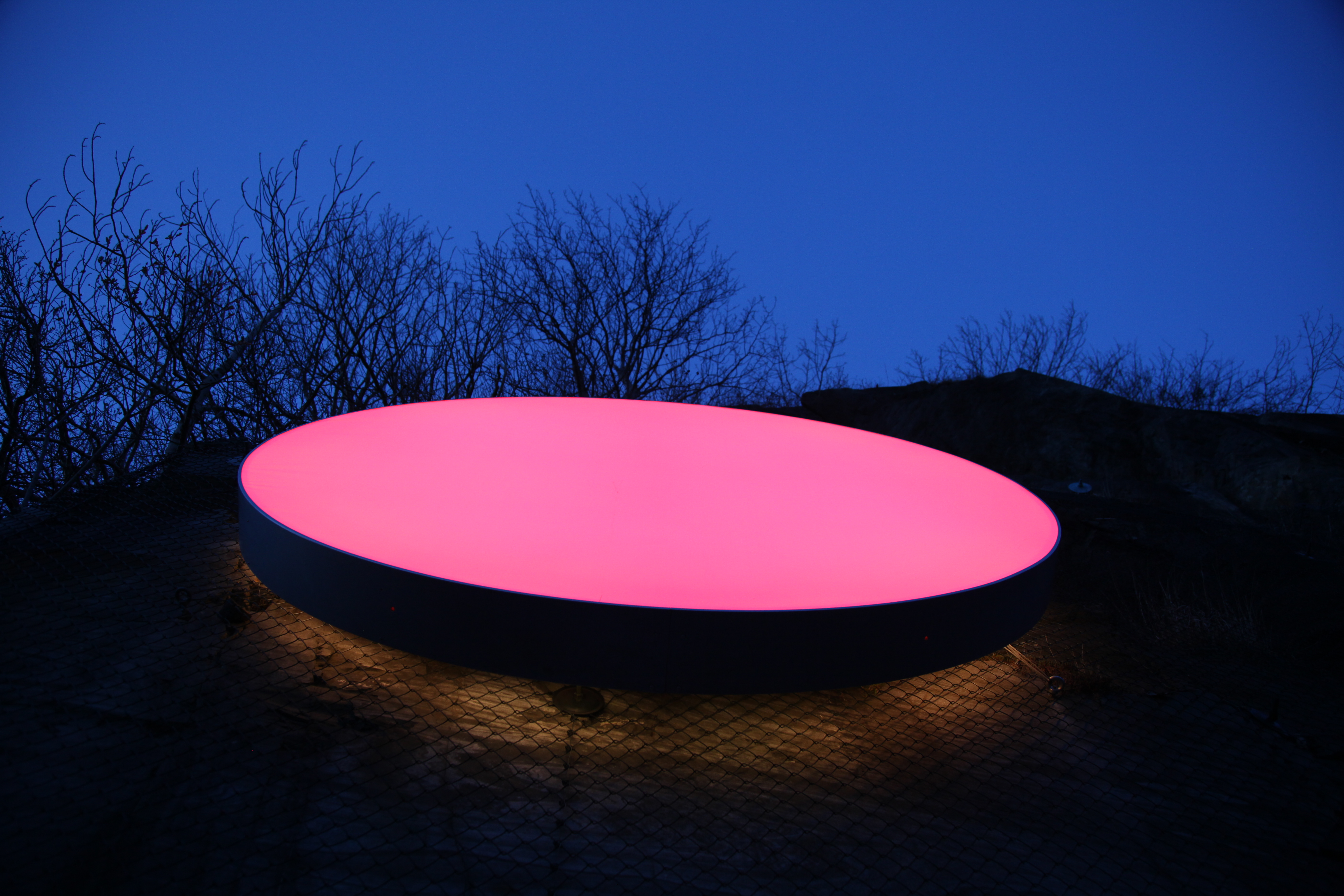
Lisa Pacini and Christine Istad,
Sun, 2012 – photo courtesy of Marres
Two interesting trajectories across the need for light particularly in winter. The one is a blog from the Wellcome Trust on research being undertaken by their Research Fellow, Dr Tania Woloshyn, on the history of phototherapy, and the other is an exhibition at Marres House for Contemporary Culture in the Netherlands entitled Winter Anti Depression where they have created an Art Resort, a sensory environment in response to the winter.
The idea that the lack of sunlight affects those of us living in northern climates is not new, and research into the history of treatments highlights the complexity of the amount of sunlight that is healthy.
The exhibition demonstrates a number of art and design approaches to activating the senses. Different works explore different senses from textured surfaces that you feel through your feet, to sounds to cocoon you in your bed, to light and colour. The installation comprising a range of yellows is particularly evocative (see below).
Light and colour are increasingly significant in the design of healthcare contexts. New technologies such as ‘Sky Ceilings’ and lightboxes can bring a feeling of daylight into rooms that lack windows. The ‘temperature’ of light, especially with the increasing availability of LED bulbs, is enabling much more sophisticated design of environments. But what is clear is that light and colour are not ‘universals’. On the one hand their meaning is culturally informed, and as these examples highlight, also informed by seasonality. We might want healthcare to be 24/7, but our bodies respond to seasonality just as they do to day and night.
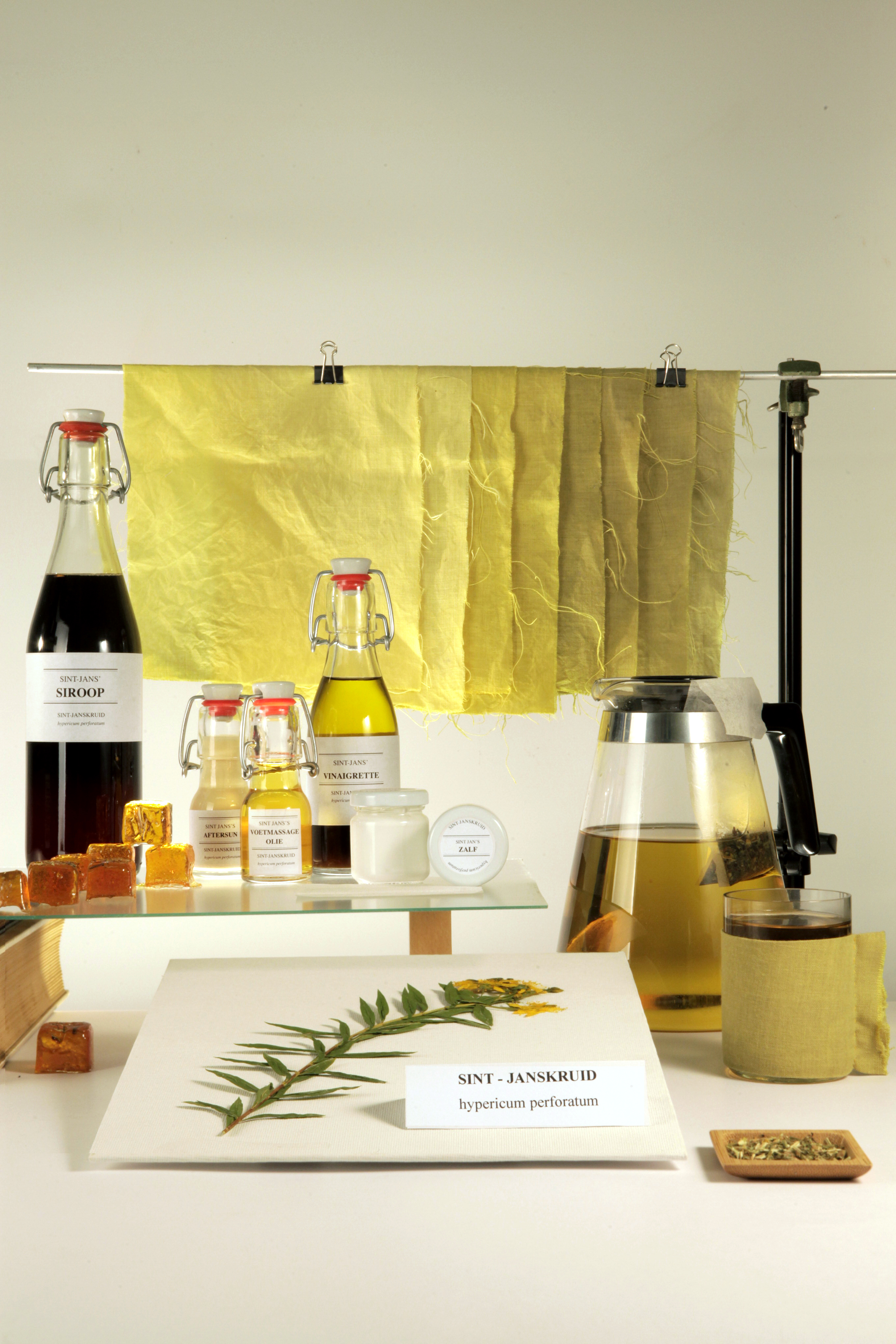
Katja Gruijters
Saint John’s wort Lab, 2014, photography Jonas de Witte Courtesy of Marres
What art have I seen?
Sylvia Grace Borda’s Camera Histories at Streetlevel.
Comments on Farm Tableaux are posted on ecoartscotland.
What art have I seen?
J D Fergusson and Louise Bourgeois at the Scottish National Gallery of Modern Art.
What art have I seen?
40/40 forty years forty artists from Glasgow Print Studio at the Maclaurin Galleries, Ayr
What art have I seen?
Interwoven Connections: The Stoddard Templeton Design Studio and Design Library, 1843-2005 at the Mackintosh Museum in Glasgow School of Art
What art have I seen?

View of the Mercat Building at Glasgow Cross, Frank Boyle
Frank Boyle’s political cartoons and watercolours at South Block
Jeremy Deller’s ‘Manchester Procession’ and Chris Johanson’s ‘Considering’ at the Modern Institute.
What art have I seen?
Louise Bourgeois at The Fruitmarket in Edinburgh. Focused on the Insomnia Drawings. Went back on Wednesday 30th and looked at the large works upstairs.
What art have I seen?

Soft Rush Mantle (detail) Photo Chris Fremantle
Encircled by Gold: Under Brigid’s Mantle, Caroline Dear at the Scottish Storytelling Centre in Edinburgh. There is a beautiful book which links the story of Brigid with the environment on Skye and the work of the archaeologists in the vicinity.
What art have I seen?
Leonardo da Vinci: the Mechanics of Man, Queen’s Gallery, Edinburgh. An in depth presentation on Leonardo’s anatomical studies. Remarkable drawing when as they point out he was using a goose feather – it’s incredibly even and tidy and smaller than you expect. But then it’s clear from the audio guide that present day anatomists are deeply impressed with his skill – they comment on how precisely the skull is bisected and then transected. They also comment on how easy it is to get septicemia particularly from the organs of the digestive tract, and that cleanliness and accuracy are key (not things one normally associates with the Renaissance or perhaps with artists?). There are references to where Leonardo was getting it wrong: he still thought that the arteries and veins were two separate systems – he hadn’t quite got to the circulation of blood, though he was clearly very close. The exhibition could have had more in depth interpretation – there is a huge amount of information on each page, but they have produced an ipad app which allows you to see each page, pan and zoom as you would expect, but also with provide a translation of all the text on the page in position.
What art have I seen?

Glimpse, Will Levi Marshall and Donald Urquhart, 2013. Photo Chris Fremantle

Glimpse, Will Levi Marshall and Donald Urquhart, 2013. Photo Chris Fremantle
Glimpse, one of the Featured Projects in the Environmental Art Festival Scotland, is an ephemeral installation just off the A701 – we went into the woods at the Barony, but perhaps the best way to see the work is as you travel along the road between Dumfries and Moffat.
What art have I seen?
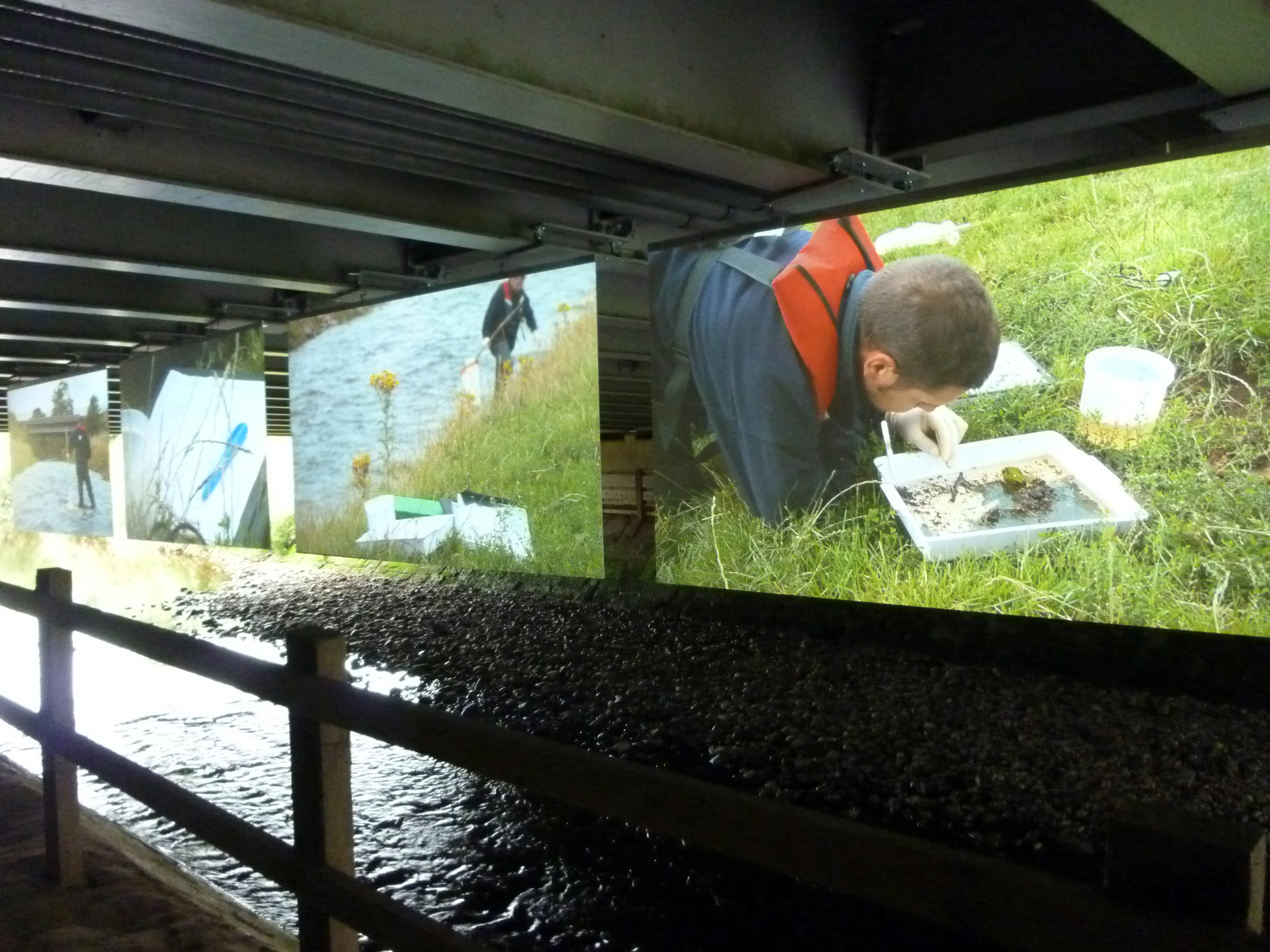
Cinema Sark, Prof Pete Smith and John Wallace, 2013. Photo Chris Fremantle
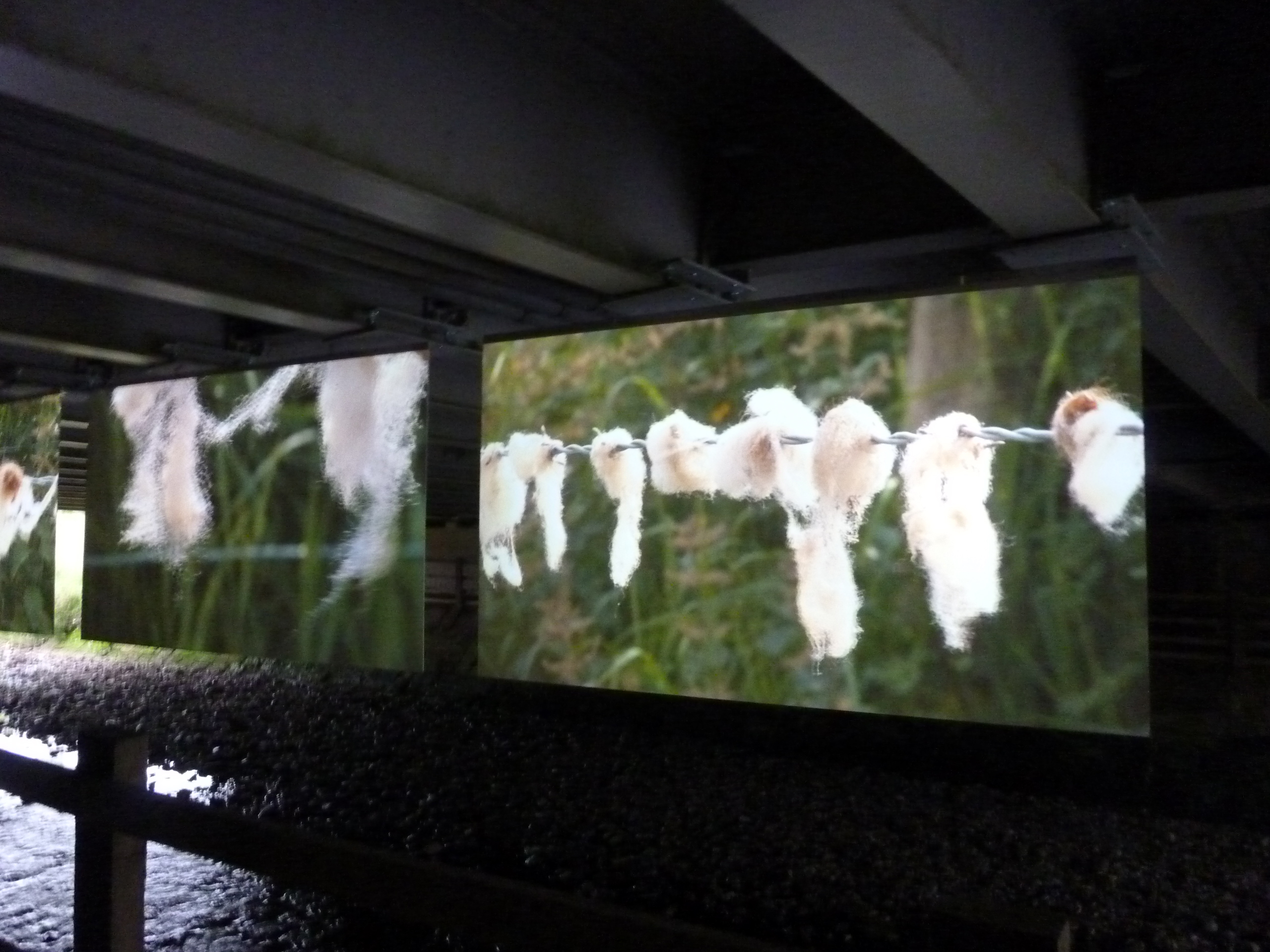
Cinema Sark, Prof Pete Smith and John Wallace, 2013. Photo Chris Fremantle
Cinema Sark at the Environmental Art Festival Scotland. It’s not often that video presented as sited work so elegantly uses it’s setting, or so engrosses the viewer. This work is a meditation on the many dimensions of the Sark, the river that divides Scotland and England in the West. The space under the M6 motorway is both a constant reminder of the context, but also an ideal location for the screening.
What art have I seen?
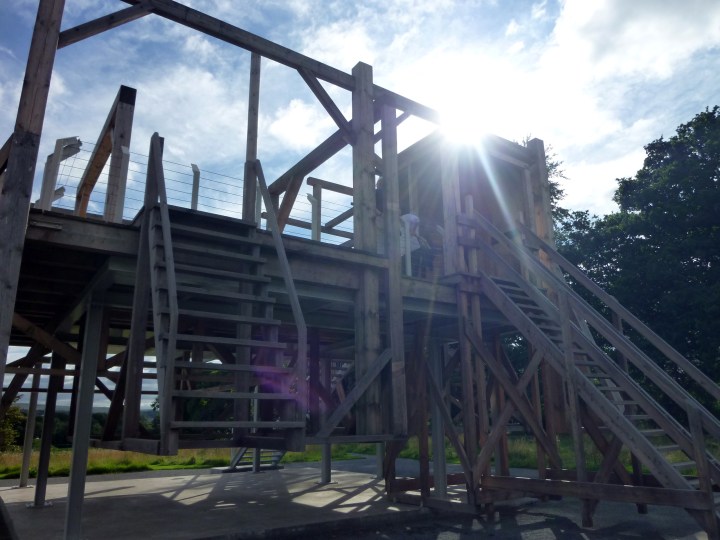
Sam Durant’s work first shown at Documenta. Photo Chris Fremantle
What art have I seen?
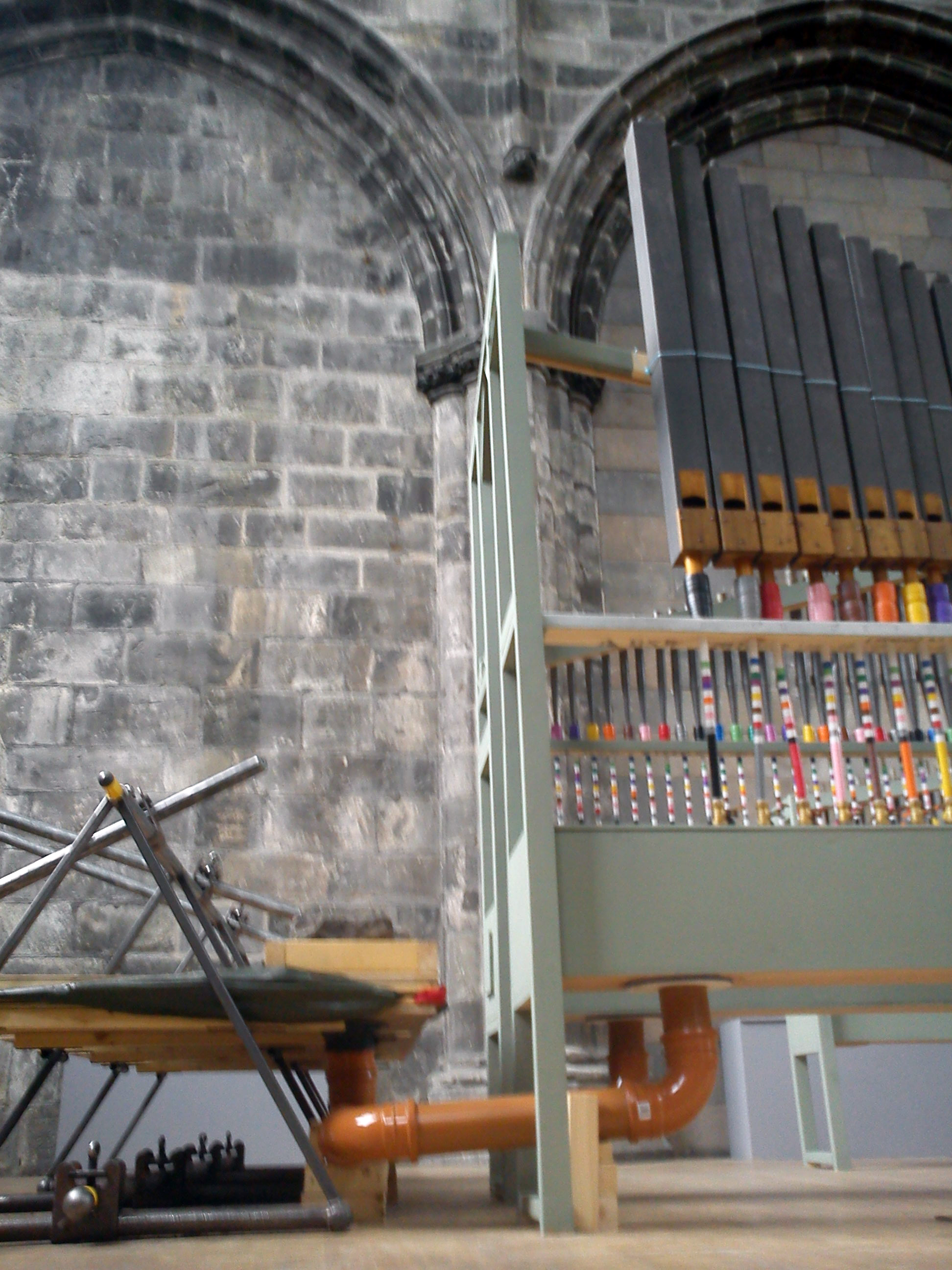
Sarah Kenchington’s Wind Pipes, 2013. Photo Chris Fremantle
Sarah Kenchington’s Wind Pipes for Edinbugh
What art have I seen?

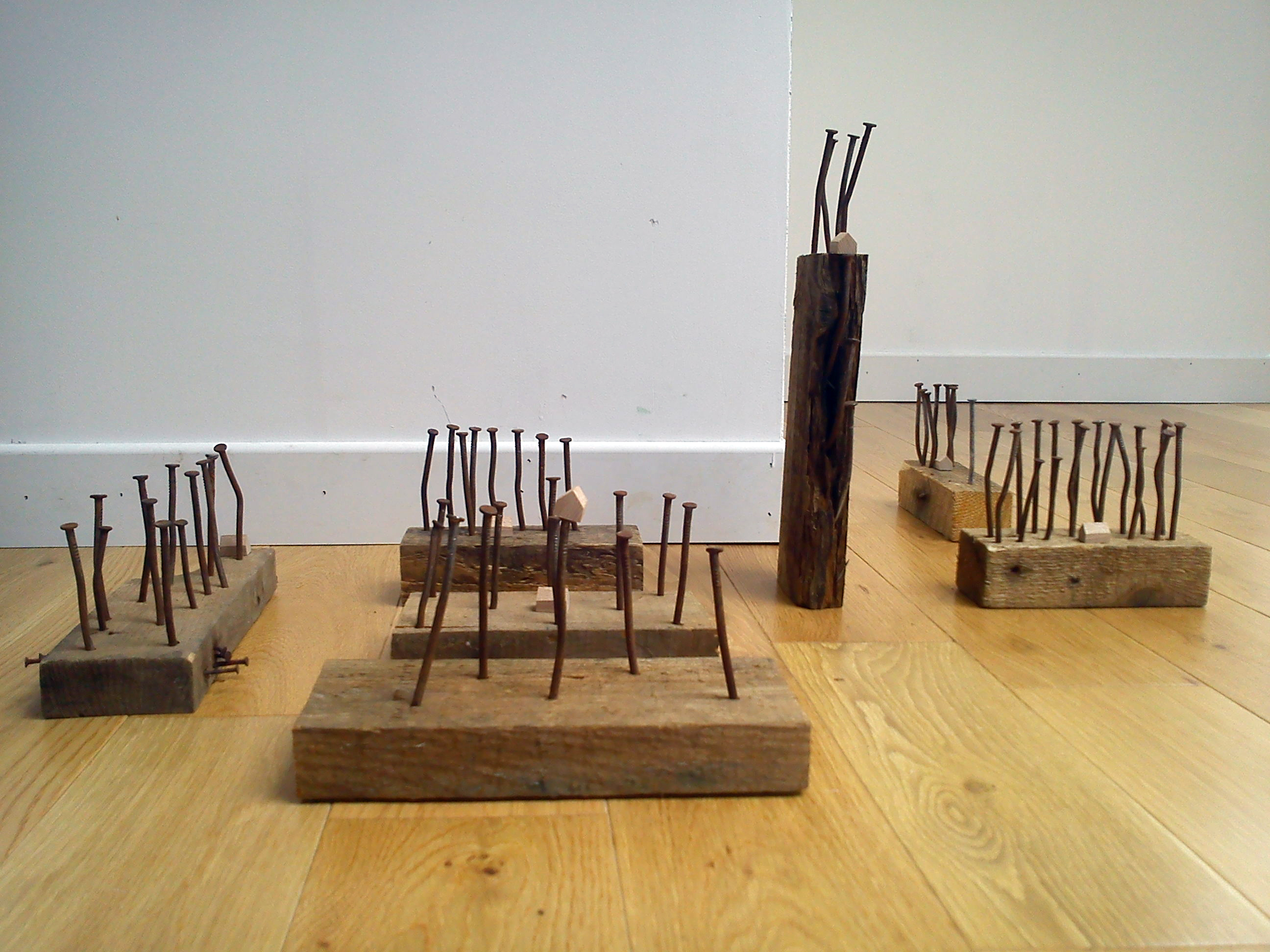
Robert Irwin installation, Photo Chris Fremantle
Robert Irwin at Pace London
What art have I seen?
Saints Alive at the National Gallery
and
Memory Palace at the V&A
Saints Alive is as interesting a response to the contents of the National Gallery as I have seen in this long running series of Artist Associates (not that I’ve seen them all). The images, drawings and collages are worth spending a lot of time with, and the kinetic sculptures are as visceral as they needed to be – when Thomas’ finger pokes Christ’s chest it is scary.
The Memory Palace is better than I expected having seen the programme on last week, and I thought it would be good. I have to say that I think the curators could have pushed the idea of illustration harder. There are some exciting responses to the potential of the project, but there are also 3d realisations of what are recogniseable graphic novel tropes and there are parts that are simply graphic novel elements on walls, albeit beautifully done. Other parts, the printing (stereotype?) plates are stunning. It is interesting to see so many hands contributing to the telling of a story, and each brings its own subtle implications.
What art have I seen?
Schwitters in Britain at the Tate Britain.
Schwitters after Duchamp yesterday evoked a further set of relationships. Fascinating to see these two masters of the 20th Century, one sometimes derided and the other not well known. The Duchamp exhibition, well described here, is explicitly about influence. The Schwitters exhibition is a more traditional historical narrative shaped by geography and war. It has two contemporary responses Laure Prouvost and Adam Chodzko attached at the end. There are also interesting similarities in the exhibition design, though the Barbican is perhaps more compelling.
Peter McCaughey reminded me, Schwitters’ interest was achieving the smallest, shortest, gap between idea and realisation (“Merz art strives for immediate expression by shortening the path from intuition to visual manifestation of the artwork” Merz Painting, 1919 http://en.wikiquote.org/wiki/Kurt_Schwitters). What is the relationship between Schwitters and Latham? One second drawings?
What art have I seen?
What art have I seen?
Peter Howson‘s exhibition From Death to Life at the Maclaurin Galleries, Ayr
What art have I seen?
George Wyllie: Scul?tor and Navigator at the Royal Glasgow Institute of Fine Arts and Critical Dialogues: Scotland + Venice at the Lighthouse.
What art have I seen?
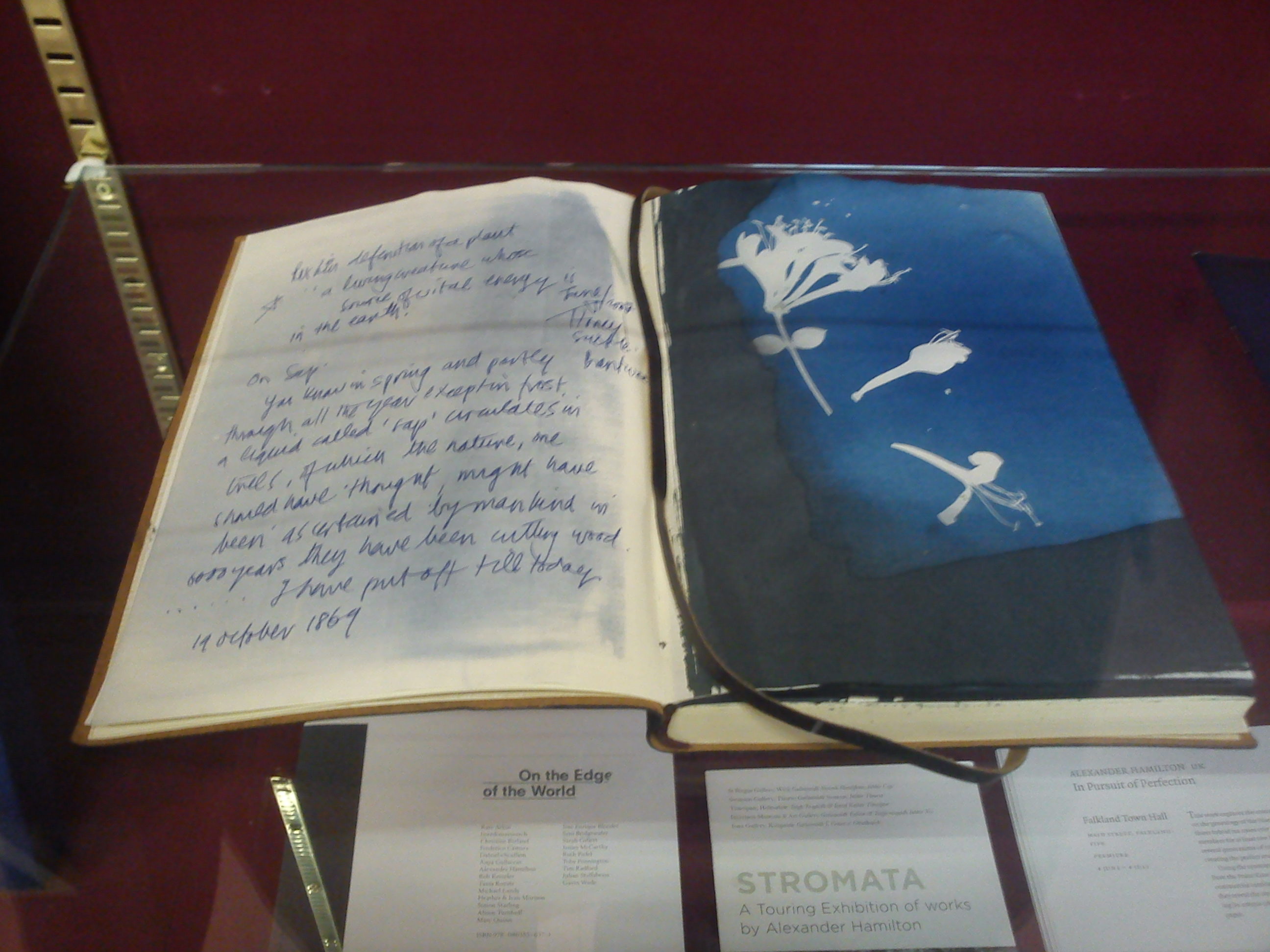
Alexander Hamilton’s notebook. Photo Chris Fremantle
Alt-photo at Edinburgh College of Art.
What art have I seen?
A Different Way of Working: The Prints of Wilhelmina Barns-Graham and St Ives Painting, at the Dick in Kilmarnock. Particularly interesting images of glaciers and broken trees.
What art have I seen?
ECONOMY at the CCA in Glasgow and Stills in Edinburgh.
My uncle wrote a book entitled God and Money.

His book is about the Italian Renaissance. I’ll send you a copy if you are interested (let’s just say you’ll owe me). These days fewer people believe in God, more believe in art, and money involves more in the way of belief. IS there a big difference between indulgences and Hedge Funds? But it’s too easy to slip into that trope.
David Haley says,
“…economy need not be limited to monetary concerns, but may carry the virtues and the values of efficiency, good management, good housekeeping, and dwelling correctly, or ecologically. And this meaning, also, imples the profoundly simple/complex aesthetic when describing the ‘economy’ of Shaker furniture, the profound simplicity of a Zen brushstroke, or the Bauhaus term, “the art of the highest utility”.
There are two parts to the exhibition Economy, one in Glasgow and one in Edinburgh. I saw them on pretty much consecutive days (I then got a e-flux announcement about “It’s the Political Economy, Stupid” at the Pori Art Museum in Finland). We in the arts need to acknowledge our complicity, even our role as the avant garde in global capital and mobility.
Economy has a subtitle – work, sex, life, enclosures, crisis, spectres, exodus. David would like the inclusion of the Project Row Houses – they might be in the life category. Theirs is a minimal contribution: a poster highlights the resistance to the encroaching gentrification of the Third Ward in Houston where the Project Row Houses are located. David would appreciate the elegance of 21 shotgun houses used, seven as afterschool clubs, seven homes for single mothers and seven for artists residencies plus an office. Check it out – its growing.
Irony is also a useful tool for exploring economics. Hito Steyerl film (which is also part of a survey at the Art Institute of Chicago at the moment) deserves time spent with it. The film follows Steyerl’s search for one set of bondage photos taken of her whilst she was in Tokyo studying film some 10 years previously. She doesn’t know the name or location of the studio, magazine, photographer or ropemaster. As the ingenue she is able to visit and explore this strange world. Everyone wants to help. They are proud to be asked.
What art have I seen?
In pursuit of the Question Mark – a retrospective exhibition at the Mitchell Library, Glasgow. A really packed exhibition of the work of George Wyllie.
Collapse
Billy Klüver reminds us of Jean Tinguely’s work on collapse in Artists, Engineers, and Collaboration Klüver-Billy-Artists-Engineers-and-Collaboration (published in Culture on the Brink: Ideologies of Technology, A Manifesto for Cyborgs. Bender, G. and Druckrey, T. (Eds) Dia Center for the Arts, Discussions in Contemporary Culture Number 9. Seattle: Bay Press, 1994).
Jean Tinguely came to New York City in early 1960. On seeing the city for the first time, he decided to build a large machine that would violently destroy itself in front of an audience in a theater, throwing off parts in all directions. A protective netting would save the audience. When the Museum of Modern Art invited Jean to build his machine in the garden of the museum, he asked me for help. I took him to the New Jersey dumps, which in those days were not covered with dirt. He found bicycle wheels, parts of old appliances, tubs, and other junk, which we hauled to the museum and threw over the fence into the garden.
Enlisting the help of Harold Hodges at Bell Laboratories, we built a timer that controlled eight electrical circuits that closed successively as the machine progressed towards its ultimate fate. Motors started; smoke, generated by mixing titanium tetrachloride and ammonia, bellowed out of a bassinet; a piano began to play and was later set on fire; smaller machines shot out from the sculpture and ran into the audience. In order to make the main structure collapse, Harold had devised a scheme of using supporting sections of Wood’s metal, which would melt from the head of overheated resistors. The whole thing was over in twenty-seven minutes. The audience applauded, and then descended on the wreckage for souvenirs. Jean called the event Homage to New York. During those three or four weeks of the construction of the machine I learned how to listen to the artist, and to give him as many technical choices as I could – as quickly as possible. And as Jean has said repeatedly since, it couldn’t have happened without our collaboration.
For information see http://www.moma.org/collection/browse_results.php?object_id=33838
What art have I seen?
The Artist and the Organisation: Artist Placement Group 1966-1979 at Raven Row. Extensive documentation of a significant number of placements in industry and public service including correspondence on setting up of placements, feasibility studies and reports as well as films and other documentation. Films from ‘I am an archive’ (see Laura Trevail’s website for more info).
What art have I seen?
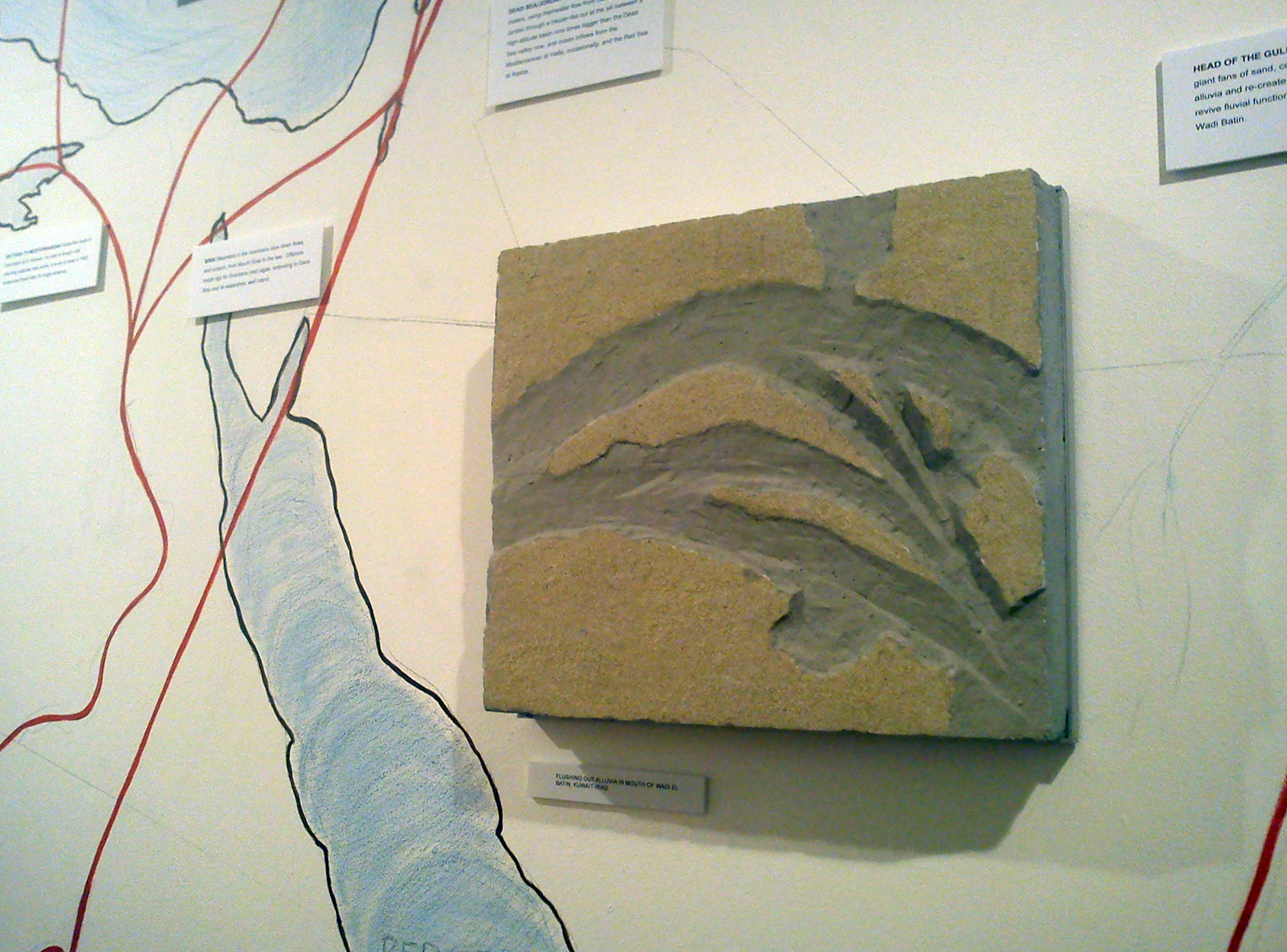
Detail of Peter Fend’s installation, Photo Chris Fremantle
Oilscapes at Peacock Visual Arts, Aberdeen

 CHRIS FREMANTLE
leave a comment