Failure

Beach structure. Photo Chris Fremantle
Simon Biggs and the CIRCLE (Creative Interdisciplinary Research in Collaborative Environments) have a day called Glitch’d: Purposeful Mistakes at Edinburgh College of Art next week. They say,
The glitch is the defect or malfunction; when technology misbehaves. Distinct from noise, which corrupts information, the glitch affects the decisions our technologies increasingly make for us, amplifying the outcome. This one day event, encompassing promenade performance, an intelligent search engine, technological demonstration, dance performance and manipulated light installation, explores how interactive media art projects can offer insights into the affects and effects of the glitch.
Info here.
Professor Gavin Renwick on “working with elders” 22 August, Ayr
ayr converses presentation/conversation
Be Strong Like Two People: Learning from the Elders of the Tlicho First Nation People in the North West Territories of Canada
Gavin Renwick, Professor and Canada Chair of Design, University of Alberta
Thursday 22 August 2013 : 6pm – 9pm : Ayr Auld Kirk Hall (Upper Hall)
Gavin Renwick, Professor and Canada Chair of Design at the University of Alberta, has spent more than ten years working with the Tlicho first nation people in the North West Territories of Canada on their land claim to the Canadian Government. Renwick was until recently Professor of Art and Policy at Duncan of Jordanstone College of Art and Design, University of Dundee, where he continues to be a visiting professor. His role with the Tlicho has been as a cultural intermediary assisting with the articulation of the understanding of land and inhabitation of the Tlicho, who are a nomadic people.
Renwick has regularly reported on key aspects of the thinking of the Elders, particularly around their relationships with young people. In his presentation, Gavin Renwick will explore the Elders understanding of the pressures on the young. First, the need to be “strong like two people”, which is a reference to the need for young people to be both strong in their own culture and strong in western culture. The second is the need to be “modern in your own language”, which clearly sets out one way to address the first challenge.
Gavin Renwick is originally from Motherwell. He was brought up among the last generation of Lanarkshire people who worked in coal, iron and steel. He has realised projects across Europe, as well as in Turkey and Canada. His present work utilises practice-led methods that place the practitioner-researcher as a cultural intermediary between indigenous and metropolitan culture. His applied and curatorial practice aims to facilitate cultural continuity for traditional communities. For the past decade he has been working between Scotland and the Canadian Northwest Territories, most recently for the Tlicho (formerly Dogrib) Dene community of Gameti as founder and coordinator of Gameti Ko, an incorporated society directed by a board of Elders.
The presentation/conversation will be chaired by Chris Fremantle, ayr converses co-founder with Lianne Hackett.
Following the presentation and Q&A, there will be the opportunity to converse with a glass of wine or soft drink. A small collection will be made towards venue hire and refreshments.
Please confirm your attendance by Friday 16 August info@ayrconverses.org.uk
New Economics for Artists
Harry Giles’ excellent twenty (?) questions on the cultural economy in relation to its own inconsistencies and in relation to certain other economics that we all might have experienced (4 months working for London Electricity in their call centre in Victoria in about 1990-1; 6 months working as an outdoor clerk for a firm of solicitors; 4 years working as an amanuensis for a paraplegic philosophy professor whilst at University; 10 weeks as an unpaid intern at the Cooper Hewitt Museum in New York one summer during University).

I wrote this brain-dump for Andy Field, who was asked to prepare a presentation on “how artists can think about new financial models for themselves and for audiences”. He collected 150 bits of advice, sold them for £1 each, and used the proceeds to pay a violinist to play music for the length of the presentation: hurrah for the meeting of form and content! I keep attempting to write something long and thoughtful on art and money and how it all fits together, or maybe organise a conference about it, or a piece of action-research, or… well, none of that has happened yet. Maybe it will. In the mean time, two very nice people recently reminded me that I’d written this, so I reread it, and it turns out I’d already said most of the things I’ve been thinking about. So here it is. it’s a start, anyway.
“New…
View original post 756 more words
The Patient as Person Full Report
In May Donald Urquhart asked me to do a presentation on his behalf at a conference called ‘The Patient as Person’ hosted at the Albertus Institute in Edinburgh. They have just published the full report here.
Along side other presentations on the policy context and the philosophical issues I presented on the physical environment and how Donald Urquhart creates human spaces in healthcare contexts. Obviously Donald isn’t the only person/artist/designer working this way or tackling these challenges, but it was very useful to focus on one practice and the key issues that one process of research and development has highlighted. What is the expression? “Other artists are available”?
Collaborate Creatively at Firstsite
Very much looking forward to being at Firstsite in Colchester on Wednesday morning to talk about collaboration. We have two excellent presentations, one from Lyndall Phelps and the other done jointly by Lawrence Bradby and Jevan Watkins-Jones – there’s loads of links and info on the a-n website here: News | a-n.
A Graphic History of the Gezi Resistance – Bianet / English – Bianet
Remarkable image A Graphic History of the Gezi Resistance – Bianet / English – Bianet.
They saved the hill. But can they save forgotten Scotland?
Dalmellington is one of a series of villages and small towns including Cumnock and New Cumnock, Auchinleck, Beith, Kilbirnie, Glengarnock, Drongen, Muirkirk, perhaps Patna and Tarbolton, certainly South as far as Dailly, which are part of a post industrial rural landscape which is distinctive in Scotland. It runs across Central Scotland and up into Fife.
Kenneth Roy’s short comment on the demise of Scottish Coal Ltd, just put up on the Scottish Review, highlights the undoubted determination of the people living in these towns: they value their places and fight for them.
Glasgow may be onto its fourth major international event next year, but the whole discourse of regeneration and creative cities has pretty much bypassed the issues of the post-industrial rural landscape. The development of Dumfries House and the associated new settlement of Knockroon are perhaps an element of a rural story, as are Booktowns, though as Roy notes Dalmellington was meant to be Scotland’s before Wigtown grabbed the mantle.
If Creative Scotland has a challenge today, it’s to develop a Place Strategy that speaks to this set of challenges.
Ghost of Water Row on RIAS shortlist
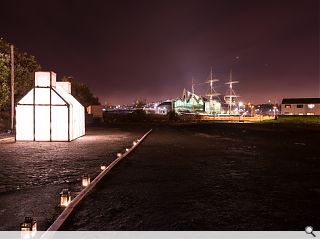
Edo Architecture‘s Ghost of Water Row has been shortlisted for the Royal Incorporation of Architects in Scotland’s Award, as reported in Scotland on Sunday. For more information.
Andy McAvoy of Edo said in an email,
What art have I seen?
Peter Howson‘s exhibition From Death to Life at the Maclaurin Galleries, Ayr
Open Studios Ayrshire 22-24 March
A group of artists has gotten together to organise the first Open Studios in Ayrshire over the weekend 22-24 March 2013. The brochure can be downloaded osabrochure2013.
Ideas for Ayr Beach
Lianne Hackett and I, under the banner of Ayr Converses, have been thinking about Ayr Beach. We’ve set up a Storify to enable us to pull together ideas and examples. If you have any, please feel free to send me a link or add a comment below.
Legacies of British Slave-ownership
UCL have just put a new database online which allows searching for owners of slaves by name and address. So put ‘Ayrshire’ into the search field and you’ll find the addresses in Ayrshire, the Plantations in the British Carribean, Mauritius and the Cape. The last item is a sum of money. It’s the compensation paid to the slave owners.
Ayr Common Good workshop
ayr converses (Lianne Hackett and Chris Fremantle) have organised a free workshop on Ayr Common Good for Saturday 8th December, 10am- 1pm, in the former courtroom at Ayr Town Hall. Please follow the link for more information.
Booking is required. Places are limited to 30 participants & will be allocated on a first come first served basis. Please email ayr converses info@ayrconverses.org.uk with “Ayr Common Good Booking” in the subject line.
BONFIRE: Open International Architectural Competition. Papa Westray. Orkney
Interesting brief – architecture of a bonfire. Deadline 12 December 2012.
BONFIRE: Open International Architectural Competition. Papa Westray. Orkney.
Scotland vs The USA
Scotland vs The USA: Who has agency in public art?
Panel session at the ISC Sculpture Conference, Chicago.
Moderator: Chris Fremantle
Panelists: George Beasley, Mary Bates Neubauer, Jana Weldon
Presentations can be found on issuu.
Artists’ fees: “The cost of labour must be paid for.” | News | a-n
Reposting the report Artists’ fees: “The cost of labour must be paid for” carried on a-n about the W.A.G.E. event in Glasgow earlier this week.
It’s a pretty good summary of the presentations, and once again highlights the real challenges of working in the visual arts. The Scottish Artists Union campaigns for better conditions and has guidance on Rates of Pay for workshops and residencies.
Corin Sworn highlighted the situation in Canada where CARFAC has secured legislation for exhibition fees – based on what was presented (which might be out of date) these would probably work out as about £750 for an exhibition is a public gallery with a turnover of less than £300,000 per year, and perhaps £1,400 for a larger institution. It’s adjusted for group shows, etc.
The principle is regardless of any budget for production, travel, per diem, installation, publication, the institution pays the artist in effect a copyright royalty payment for the right to use their work for the show. This applies to institutions, not (legally anyway) to self organised events. It’s not intended to hinder grassroots activity, although it does establish a principle to aspire to.
That principle seems like a sensible one on which to determine exhibition fees, i.e. not on how long did it take, was it new work or existing work, did the work take manual work to produce, etc. Simply the institution is gaining (financially as well as in terms of profile) from being able to present the artists’ work, it is literally using that work, therefore it should make a payment for the use of the work.
Interestingly Lise Soskolne had done an analysis in relation to one organisation in NY where the exhibition fees were costing the organisation 1% of turnover and adopting the CARFAC model raised that to 3%. Not a big difference for a respectful and appropriate recognition of the use of artists’ work by institutions.
Thanks to Corin and Charlotte for making this happen.
First people (not cars)
Yesterday evening at the annual Patrick Geddes Commemorative Lecture the audience was charmed into seeing the world a different way and recognising our own failures in the process. The lecture was given by Jan Gehl, an internationally acknowledged champion of urban quality focused on and driven by people and their well-being (rather than cars or egos).
In fact his critique of architects represented them as people who looked at the world from 3 kilometres up and dropped buildings into skylines. His counter was that the skyline was not as important as the way that the building meets the ground. In the analysis he offered us of Edinburgh, the topography and skyline are excellent, but the point where you move the human eye level you see the disaster.
His critique of traffic engineers was equally damning. In his analysis the past 50 years have been dominated by the motor car at the expense of everyone and everything else. In 2012 we need to make prioritising the car in public as unacceptable as smoking – that’s the level of challenge in effect Gehl was suggesting.
So much is true and in so many ways self evident, but the full ramifications of the analysis are wider and more comprehensive than you might think. For instance, having a Department of Walking, Cycling and Transport? Having the driver press the button at the junction to get permission to cross, rather than the pedestrian? Having newspaper articles about bicycle congestion and demands for wider bicycle lanes?
What was a shame was that there were only a couple of artists in the room (lots of architects and obviously a majority of urban planners), but I didn’t see people who really ought to have been there – no-one from the VeloCity programme for Glasgow, no-one from Ayr Renaissance, and I didn’t recognise anyone from the health sector.
There was a really interesting question at the end. The individual noted that Gehl had not used the word design once in his presentation. The questioner contrasted this with the Scottish Government’s consultation on a new Policy on Architecture and Place-making. Gehl basically said that he did two things. He (and his practice) worked on “programmes and Strategies” and these set the tasks for the designers. He (particularly in his academic life) worked on the in depth understanding of people and their experiences in public spaces. These two obviously complement each other, but in essence he is ‘bracketing’ the designers – by evaluating (and that was his word) what works and what doesn’t, and then inscribing it into Programmes and Strategies, he is driving the design agenda.
For me this demonstrated an important articulation of the value of operating between the academic and the practice, as well as everything else he said. It all seems so obvious when Gehl says it, but then you look around.
Maybe his books should be mandatory reading not only on urban planning programmes?
Collaborate Creatively
Workshop in association with World Event for Young Artists (WEYA) and a-n.
Nottingham, 12-3pm, 13th September 2012 open to participants in the WEYA event.
Presenters:
Drawing on his text for a-n Reflections on Collaboration, Chris Fremantle will explore with guest artists the principles and approaches to creating great collaborative relationships amongst artists and into other disciplines and contexts. Includes informal and facilitated discussion exploring how artists can realise their ambitions and a hands-on workshop highlighting contexts for innovation and guiding good practice.
Collaboration is one of those hot topics. Missions, Models, Money have had a whole stream of work around the issue over the past few years, Grant Kester‘s new book The One and the Many theorises the subject, and a-n has been tagging articles as ‘Collaborative Relationships‘ for about five years.
Donald Campbell 1942-2012 RIP

Donald Campbell, Garden Villa I Tatti, Gesso, tempera and graphite on panel
Donald Campbell was one of the best painters I ever had the privilege of knowing. He was also one of the most sensitive and intelligent people. He will be sadly missed.
W.A.G.E. – 7pm on 18 September, Glasgow

W.A.G.E. (Working Artists for the Greater Economy) are speaking at a public meeting at The Art School (New Vic) 468 Sauchiehall Street, Glasgow, at 7pm on 18 September on their ‘exhibition fees’ campaign.
There will be an introduction by Charlotte Prodger and Corin Sworn and an open discussion.
This event has been organised by Transmission and the Scottish Artists Union.
Circulate the poster WAGE event 180912
Nothing and Everything: The Influence of Buddhism on the American Avant Garde: 1942 – 1962
Buddhism emerges in various ways over the past 40 years, whether with Ginsberg et al or with Gary Snyder, or more recently with Mary Jane Jacobs amongst others. Ellen Pearlman has written a history of the early period of this development and she is in conversation in Brooklyn Rail here.
Making Policy Public – MAS CONTEXT

Vendor Power, Copyright Kevin Noble for CUP
The Center for Urban Pedagogy‘s Making Policy Public series is a standout project engaging marginalised interest groups with designers and communities. MAS Context provides and overview of the series here. Its a good description, though it doesn’t offer a critical commentary.
Thoughts on Sculpture in the Landscape
“Your head can be everywhere, but your feet have to be some place.” Peter Berg
The sculptures at Glenkiln outside Dumfries (several Moores, an Epstein and a Rodin) can be found because they exist on maps, even the AA Road Atlas. They are located on the side of a glen overlooking a reservoir because of the initiative of an individual – a patron and owner of a Scottish estate.
Is sculpture in the landscape anachronistic?
It’s not high on the agenda for public art development. That agenda, taken in no particular order, would probably include: interdisciplinarity, duration, design teams, publics, commons vs privatisation, spaces for dissent. It would be rooted in the APG rubric “context is half the work”. It might be driven by social or environmental concern.
I’m sorry I’m not able to attend the symposium Sculpture in the Landscape at Scottish Sculpture Workshop in August. The symposium proposes to address and define new concepts for outdoor public sculpture collections, focusing on the existing Lumsden Sculpture Walk. The brief for the Symposium is as follows:
SSW founder Fred Bushe, RSA OBE, established the Lumsden Sculpture Walk in 1985 in partnership with the local council. It was to provide a showcase for the work carried out by SSW artists, integrate SSW with the village of Lumsden, and become an arts destination and cultural site. Moving on three decades, SSW would like to address the current state of the site and the artworks, and look into ways of rejuvenating the walk for future generations. In doing so, we feel it is pertinent to explore contemporary critical thinking regarding public art, and consider how outdoor sculpture collections can become dynamic and relevant in the 21st century.
Item one on the Agenda: The construction of the public and private realms, the revealing of difference, the imagining of spectacle. These are all deeply underpinned by the complexity of modern overdeveloped societies and the greater complexity of ecological systems on which we are reliant. It’s creating work “within a ‘mesh’ of social, political and phenomenal relations” (TJ Demos). Interdisciplinarity is not sexy and desirable – it’s the necessary response to complexity. It’s the necessary relinquishing of ego when faced with innumerable unnameable interwoven challenges – think of the Flow Chart of the Declaration of Occupy Wall Street, and the adoption of anonymity, not just for personal safety, but also to foreground issues over personalities. In The Guide to This World & Nearer Ones (2009), Creative Time’s temporary public art project on New York’s Governors Island, Nils Norman is quoted as saying,
“I’ve been looking at the history of bohemian artist movements to find a possible place of dissention. Is Bohemia still a place where artists can experiment and develop strategies outside the mainstream? The normalising effect of the market makes this now almost completely impossible, and Bohemia has been instrumentalised by people who make direct links to ‘creatives,’ bohemian lifestyles and a new class of urban entrepreneurs through city regeneration. Where can alternatives be developed? Where is it possible to drop out and develop new languages and codes.”
Item two: Geometry. Numbers, algebra and other truths, which by their essential nature appear to stand outside time, provide a false sense of certainty in a world which is in a state of constant change. The use of geometry in architecture and art makes the world we construct for ourselves seem to have something to do with the unchanging ideal, whereas our lived experience is caught between on the one hand organised growth and on the other entropy. The architects’ angle (Libeskind) or curve (Gehry) may be generated in digital space and realised through CAD driven routers and saws, but in 50 or 100 years the angle and curve will have changed in response to the environment. Duration, maintenance, care – these are perhaps the more interesting challenges. Merle Laderman Ukeles’ Manifesto for Maintenance Art written in 1967 remains a provocation. In response to a recent Workshop on time, it seemed to me that artists involved in work in public have developed strong skills around spatial strategies and critiques, but the discussion of time is less nuanced – the time of the project, exhibition, residency is dominant. Hamish Fulton’s work NO TALKING FOR SEVEN DAYS is a challenge I’ve stared at for 10 years.
Item three: Training requirements. Firstly teamwork. If the question is interdisciplinarity then we need training. Who are ‘we’? We are in particular visual and applied artists. We are better networked, better collaborators, and have more social capital than we did in 1985, let alone in 1958. But we still arrive in a place (meeting/site) and think “What (from my sketchbook/back pocket) will I do here?” We might no longer think “Which piece of work in my studio can I plop down here?” We might now think “What is this place about and which of my tactics will engage with this place in the most interesting way?” How does our training equip us to fully engage within teams and with inhabitants (human and other)? Do we speak each others’ languages? Can the artists communicate effectively with the (landscape) architects? Do the architects understand collaboration? Can the hierarchies of professional status be set aside?
Item four: Who pays? Pre-enclosure, pre-agricultural improvements, common land provided subsistence for the majority of the population. Subsistence meant collecting firewood, grazing beasts and fowl, harvesting leaves, fungi, roots and fruits. The question of commons and enclosure (for which we can read privatisation) is as sharp now as it was then. It is sharp in Scotland because of the 2003 Land Reform Act (and a new tranche of funding for community land purchases has just been announced). It is sharp in Lumsden because when you stand in the village the hills around are owned by just three estates. It’s also sharp because the new territory that we have discovered in the past 15 years, the territory of the digital, is also moving quickly from being one characterised by commons to one characterised by enclosure. Your personality is being enclosed and value extracted from it by Facebook. As someone recently said to me, Graphic Designers spend their time paying for and learning to use the next new iteration of software from Adobe and Apple. The development of Creative Commons licensing, Open Source software (OpenOffice, WordPress, VideoLAN, Mozilla‘s suite, etc) are all more than just free – they represent the ‘subsistence economy’ of the digital era.
So to the most important part of the agenda, open to the floor: how does a footpath along the side of a road, interrupted by a Primary School, enable anything useful to be developed in response to these issues?
Posted to ecoartscotland.net

Art after nature: TJ Demos on the post natural condition, in Artforum (April 2012) is, as Suzaan Boettger pointed out, important because it represents a key moment demonstrating that ecoart is impacting on mainstream contemporary art’s discourses (maybe).
Perhaps more importantly, the piece concludes with the work of artists who are at this moment, as has happened at key points in the past, choosing to position the focus of their work outside the artworld. Artists such as Nils Norman, whose work Demos focuses on, as well as Fritz Haeg, Superflex, Marjetica Potrc, Art not Oil, Allora & Calzadilla and The Yes Men all engage directly with the biopolitical and the eco-financial (though the work of many of these can be seen in galleries and museums pretty regularly, e.g. Haeg’s Animal Estates 1.0 was included in the Whitney Biennial in 2008). It would be trite…
View original post 1,583 more words
New Growth Walking from Renton to Kilmahew, 9 June 2012
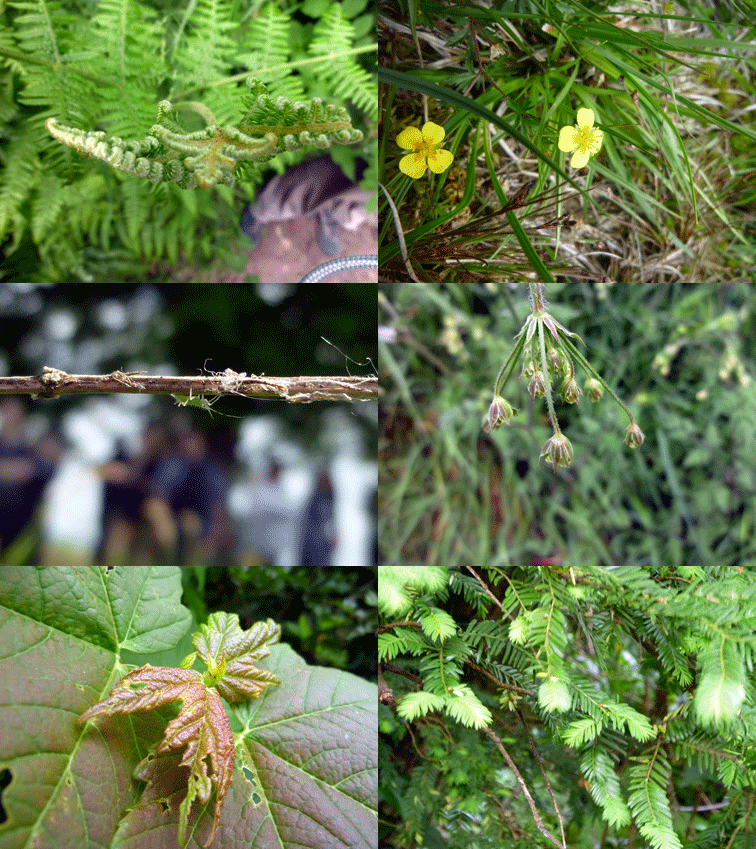
Invited to participate in the Invisible College.
Walked from Renton to Kilmahew.
Looked for new growth.
Thoughts on VeloCity
PAR+RS will be covering VeloCity, starting with this piece. VeloCity is an ambitious programme for Glasgow’s public realm leading up to the Commonwealth Games, 2014, and looking beyond. Glasgow has used key events (Garden Festival, 1988; European City of Culture, 1990; City of Architecture and Design, 1999.
Tim Rollins and John Ahearn
Spirit of the Bronx at Frieze New York – FT.com.
Tim Rollins and John Ahearn: the contradictions of earnest and ethically engaged artists interested in beauty being part of Frieze NY.
Precarious Workers Brigade Alternative Curriculum
- ARE YOU UNSURE WHAT JOB YOU WILL BE DOING IN 3 MONTHS?
- DO YOU FREELANCE BUT YOU DON’T FEEL FREE?
- ARE YOU ANXIOUS DURING THE DAY AND SLEEPLESS AT NIGHT?
- HAS THE CARROT YOU WERE PROMISED GONE OFF?
- DO YOU THINK YOU WILL NEVER OWN A HOUSE IN YOUR F*&%$£ LIFE?
If your answer to these questions is yes, then the Carrot Workers Collective/Precarious Workers Brigade have produced Training for Exploitation: Towards and Alternative Curriculum.
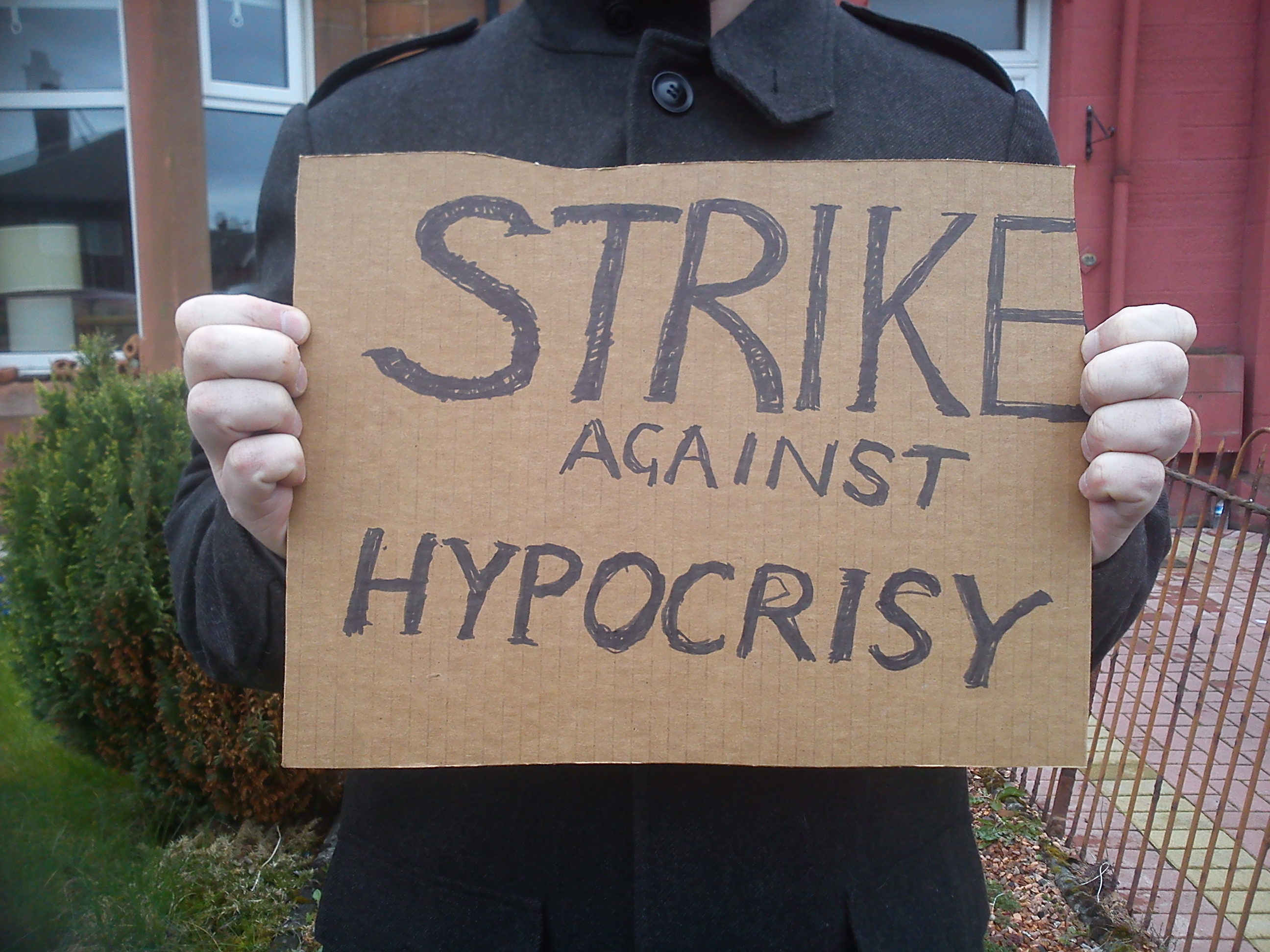


Management response to ballot on strike action
Fremantle Consultants: Response to call for Ballot on Strike Action
Fremantle Consultants rejects the accusation of hypocrisy levelled by the workers.
Fremantle Consultants manages a portfolio of work across producing, project management and research.
Fremantle Consultants is currently co-producing PAR+RS, Creative Scotland’s national public art development programme, project managing the Therapeutic Design and Arts Strategy for the New South Glasgow Hospitals as well as contributing to the Art, Space and Nature MFA programme at Edinburgh College of Art.
Recently, Fremantle Consultants completed a Visiting Researcher project with Gray’s School of Art, supporting the establishment of a new research cluster. Fremantle Consultants worked with a range of staff to develop research trajectories and reflect on key issues.
Fremantle Consultants provided project management services to NHS Greater Glasgow and Clyde assuring the delivery of the public art strategies for two new hospitals, the New Victoria and the New Stobhill. Working with 11 artists on a range of installations, Fremantle Consultants delivered the programme on time and within budget.
Fremantle Consultants produced a major DEFRA funded Climate Challenge Fund project working with a wide range of partners across England.
Staff of Fremantle Consultants are encouraged to engage with community organisations and give their time pro bono to Ayr Gaiety Partnership as well as the Scottish Artists Union.
In the current economically challenging context, Fremantle Consultants is successfully building the business and delivering quality and impact for clients. The cultural sector must focus on building capacity in the creative economy and innovating in the provision of services to clients.
ayr converses Cultural Hustings

ayr converses flyer April 2012
ayr converses hustings focused on arts & cultural regeneration in Ayr in the 2012 local council elections.
A full note of involvement is available here, and video of the event can be seen here
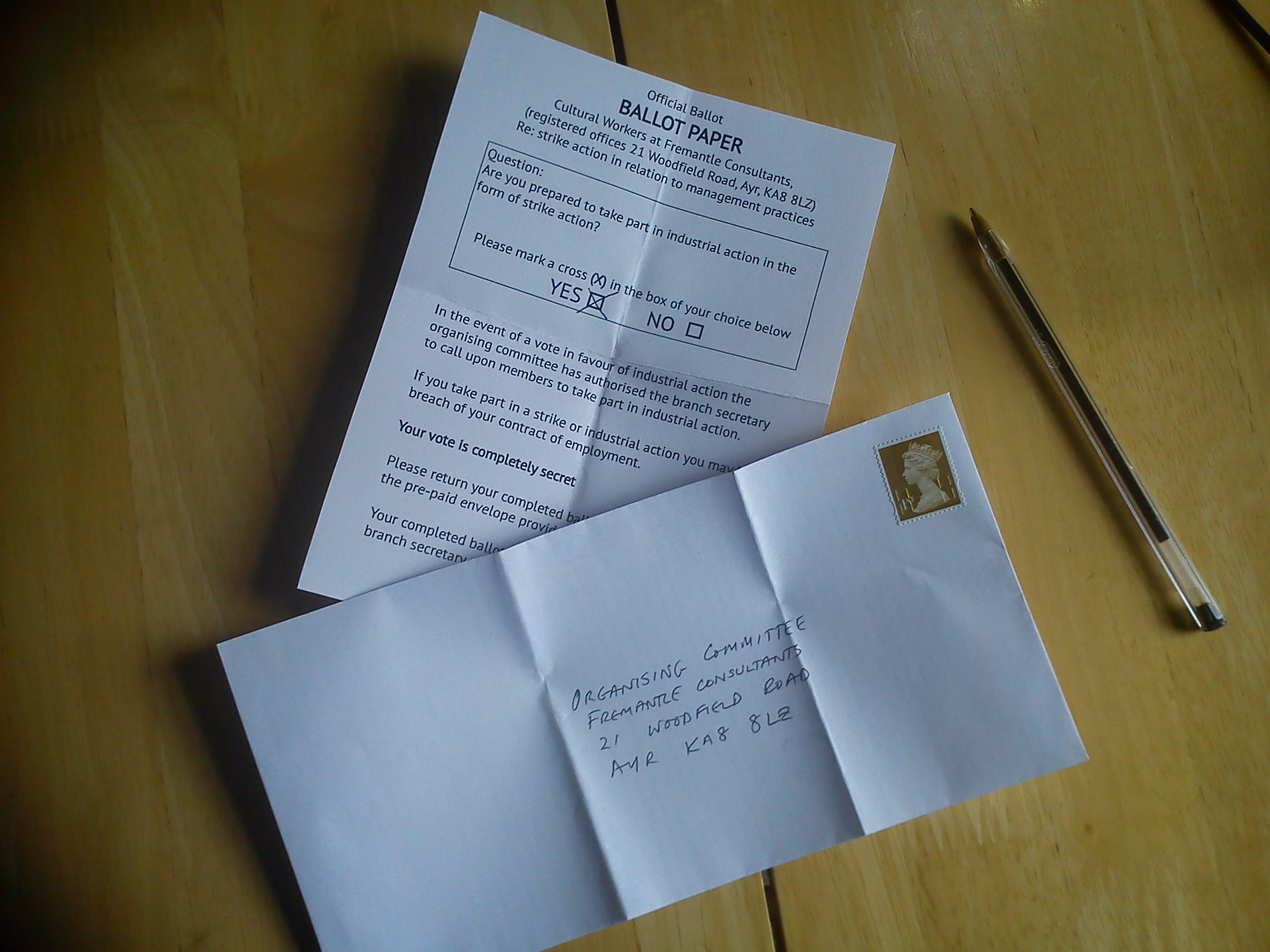
Notification of intention to ballot for strike action
The cultural workers of Fremantle Consultants have called a ballot on strike action. They accuse the management of gross hypocrisy.
This email dated 24 April 2012 constitutes formal notification seven days in advance of the ballot. The ballot will take place on 2 May 2012.
Cultural workers at Fremantle Consultants’ offices at 21 Woodfield Road, Ayr, KA8 8LZ, will be balloted.
Subject to the ballot, strike action will take place on Friday 4 May 2012.
This strike action is undertaken as a ‘wildcat’ strike, not associated with any Union.
The cultural workers at Fremantle Consultants have been in negotiations with management since 27 February 2006, during which time no resolution has been reached.
Fremantle Consultants are accused of:-
- Believing in the value of arts and culture for their own sake, the importance of aesthetics and fun, whilst simultaneously basing arts and cultural development on the social, health, mental health and environmental impacts.
- Promoting localism and grassroots activity whilst simultaneously working on massively centralising public service projects;
- Articulating and supporting commons based and alternative approaches to knowledge and creativity whilst simultaneously developing projects intended to utilise copyright to financialise artworks.
- Critiquing corporate capital whilst being reliant on the self-same systems professionally and personally.
- Challenging the roots and effects of precarity within the arts whilst utilising processes and procedures which reinforce precarious working.
Organising Committee
Notes
- Only workers at Fremantle Consultants are entitled to vote.
- Because there are less than 50 people entitled to vote there is no requirement to appoint a scrutineer.
- The ballot paper is attached strike ballot as required and has been agreed by the branch secretary.
- Unison’s guidance as set out in Unison Industrial Action Handbook (2009) has been followed.
Arts & Cultural Regeneration Hustings, 25th April 2012
ayr converses hosts an arts & cultural regeneration in Ayr focused hustings for the three Ayr ward candidates in the 2012 local council elections. Download flyer: ayr converses a5_final please distribute.
ayr converses is hosting an arts & cultural regeneration in Ayr focused hustings on Wednesday 25 April 2012 at the Foresters’ Hall, New Road, Ayr KA8 8EX. The hustings is from 8pm – 9.30pm. All those who wish to see South Ayrshire Council place greater focus on the arts and culture in the regeneration of our town are welcome to attend.
The aim is to hear from candidates – party political & independent – on how the arts & culture – including the creative industries – can act as drivers for the regeneration of Ayr and what will be their policies and practice for the arts & culture over the next five years. Each candidate who wishes to speak will be given a set time in which to speak. Members of the arts & cultural community including Chris Taylor of Hipshot Theatre, Laurin Campbell, the new YDance freelancer in South Ayrshire & Chris Fremantle of Ayr Gaiety Partnership & Public Art Scotland will be given the same set time in which to share their vision for the future of our town. The hustings will be chaired by Karen Murray of Newton & Heathfield Community Association.
ayr converses has invited all candidates who are standing in the three Ayr wards – Ayr North, Ayr West, Ayr East – and has copied the invitation to all candidates standing in the other five South Ayrshire Council wards. Parties have been asked to put forward a spokesperson to speak on arts, culture & economic regeneration. The same opportunity has been extended to independents. A good number of candidates have confirmed that they will attend and participate with all parties represented. Independent candidates have also confirmed that they will participate.
There will be refreshments by su casa after the hustings to give those participating time to meet & converse in a sociable setting. Those attending will be asked to make a small contribution to a collection towards the cost of hall hire & refreshments.
notes:
“A hustings event is a meeting where election candidates or parties debate policies and answer questions from the audience … voters can ask candidates about issues that are important to them.” Electoral Commission
ayr converses aims to facilitate communication between individuals and groups in the town of ayr with the aim of acting as an ideas bank + soundboard, strengthening community ties and furthering cultural and economic regeneration. The website, which will be launched end April 2012, is open source – with input it will become a repository of ideas, suggestions & positive proposals that will point the way forward for Ayr and inspire all those who love to live, work, study and play in the town + visitors to Ayr.
for further information, please email info@ayrconverses.org.uk
Funded PhD Opportunities
3 PhD Studentships (Reference IDEAS 12)
Grays School of Art, The Robert Gordon University, Aberdeen
IDEAS Research Institute for Innovation, Design And Sustainability
Closing Date: 9th April 2012
Applications are invited from excellent candidates for PhD studentships in the IDEAS Research Institute at The Robert Gordon University in Aberdeen. IDEAS is a multi-disciplinary research centre encompassing the disciplines of Architecture & Built Environment, Art & Design, Computing, Engineering and Environmental Science.
Theme: Creativity, Design & Innovation
Art in the Public Sphere: The Case of Feminist Manifestos
This PhD project will creatively contribute to the artistic and theoretical exploration of the unique interweaving of politics and poetics in this still under-researched genre of revolutionary discourse, the manifesto. The project will specifically address the contribution of visual art practice associated with second-wave and later feminist movements, focusing on lesser known British feminist manifestos produced in and since second-wave feminism, through the study of anthologised documents but also through archival research in libraries and special collections. One of the project’s aims is to not simply discover but also uncover feminist manifestos in unexpected forms and locations, in corroboration of the thesis that certain works of art, as well as the familiar written proclamations, may be considered as manifestos thanks to their reception, function and interpretation.
Dr Alexandra Kokoli: +44 (0)1224 263692, a.m.kokoli@rgu.ac.uk
Cultural Leadership, its role, processes and implications for cultural development
Applications are invited for a 3 year PhD to explore cultural leadership as a practice and its implications for social, cultural and economic development in a local and global context. Cultural leadership has emerged as a need that is sharply focused in particular in the fields of art and design. We do not sufficiently understand the practice of cultural leadership as it relates to art and design practices in particular in relation to coping with rapid change and increased levels of self organisation. This research will build on the AHRC funded Artist as Leader project (2006-8) initially mining this archive of 32+ in depth interviews with cultural leaders in Britain. The research will result in a framework for cultural leadership in Scotland that is informed by its rural culture. This research is timely because of the local initiatives in cultural development (City Gardens Project, related application for City of Culture 2017, national review of cultural delivery agencies, and emergence of new regional, lead cultural body: AB+).
The successful candidate will meet RGU’s criteria for eligibility and be able to demonstrate the potential to develop advanced research skills. They should hold a Master’s degree in Fine Art/Design, Art/Design History, Critical/Cultural Theory, or equivalent practice or policy experience. In the case of a practicing artist/designer or arts administrator, some experience in practice-led research would be an advantage. The prospective student should be highly self-motivated and have a keen and imaginative critical interest in the arts in contemporary life.
Professor Anne Douglas: +44 (0)1224 263647, a.douglas@rgu.ac.uk
Smart Textiles for Health and Wellbeing
Technologically enhanced textiles can respond to a range of physical and psychological health barriers, which have the potential to transform lifestyles. Smart textiles can help manage body temperature, incorporate antimicrobial properties, provide insulation, breathability, compression, re-shaping, moisture absorption, articulation enabling mobility, constrain movement and improve circulation. Current textile products designed for medical application often do not provide satisfactory solutions because they don’t address the full range of an individual’s needs, which includes both the physical and the psychological. In recent years a number of technical innovations have shown potential but have not been successfully applied to provide solutions that meet the needs of individuals. Current products are related to monitoring health rather than providing a more interactive system that builds a stronger connection with the wearer, which are both responsive and adaptive and take into account an individual’s emotional needs.
We are looking for a design graduate with technical expertise to undertake a PhD programme of research with the aim of understanding how textile and clothing solutions can be designed to improve the quality of life for individuals experiencing long-term medical conditions, which have a direct impact on their mobility, self-esteem and wellbeing. Through the application of advanced technology and design, this project seeks to explore new wearable smart clothing concepts with direct relevance to a range of mobility related health issues. The project will investigate a range of new technologies from micro-scale computing (speckled) to combined laser scanning and laser cutting, and new materials in order to develop advanced clothing concepts that can be used to alleviate the effects of long term debilitating conditions.
The project is suitable for someone with a first degree in product or textile and/or fashion design. They should also have some basic knowledge of materials science and computer based technologies.
This PhD research programme builds on the current work of the Molecular Imprinted Textiles (MIT) group (a project funded by the Scottish Academy of Fashion), a Scottish Govt funded project ‘Future Textile Visions’ (FTV) and an AHRC network application currently awaiting decision. The project will be headed by Josie Steed, Course Director for Fashion and Textiles, and Julian Malins, Professor of Design at Gray’s School of Art.
Josie Steed: +44 1224 263678, j.steed@rgu.ac.uk
Candidates for the studentship must have a high quality Honours Degree (preferably a First Class) or a Masters qualification (or equivalent) in a relevant discipline. Each studentship provides full university fees for UK/EU applicants and a tax-free maintenance allowance of £13,590 per annum for 3 years. Additional fee support may be available to students who are not UK/EU residents and who would normally be required to pay the full overseas postgraduate fee. The studentships start on 1 October 2012.
Applicants should Apply Online at http://www.rgu.ac.uk/researchdegrees/applicants/page.cfm?pge=26828. When applying, please click on advertised studentships and select IDEAS 12.
For further information on research at Robert Gordon University and in the IDEAS Research Institute, please see:
http://www.rgu.ac.uk/research/ideas
Informal enquiries may be addressed to potential supervisors or to the IDEAS Graduate School Leader, Professor Linda Lawton, + 44 (0)1224 262823/262473, email ideas@rgu.ac.uk
USUK Call for Artists

Image thanks to Coral Lambert
DEADLINE MARCH 15th 2012
The 13th USUK International Cast Iron Sculpture Symposium
To be hosted at Salem Art Works, Salem, New York and Scottish Sculpture Workshop, Lumsden, Aberdeenshire, Scotland, UK.
US Component: Friday 15th June – Sunday 1st July 2012
UK Component: Friday 7th July – Sunday 22nd July 2012
The 13th USUK Iron Symposium will take place for the first time at two venues: Salem Art Works (SAW), USA and Scottish Sculpture Workshop (SSW), UK. During each 15 day symposium, internationally selected artists will produce work in cast iron with experimental and traditional sand molds using a coke fired iron cupola furnace. In addition to artists’ presentations, panels and technical demonstrations, artists learn from each other by working together in the critically engaged environment created by the symposium and its unique sites. Highlights of the 13th USUK Iron Symposium include a public iron pour and sculpture exhibitions at Salem Art Works, in Upstate New York and an iron pour with live fire performances at Scottish Sculpture Workshop, in the UK.
Founded in 1996 by sculptor, Coral Lambert, the focus of the USUK Iron Symposium is to provide a platform for artists to explore and push the boundaries of the cast iron medium in contemporary sculpture. No previous casting experience is necessary; artists from different disciplines are encouraged to apply. Past participants and collaborators include land artists, paper makers, biologists, archeologists and architects.
Over the past 16 years, the USUK Iron Symposium has been hosted by the US and UK in alternating years including venues in New Orleans, Minnesota, Suffolk and Wales. In 2012 this symposium will take place in both the US and UK for the first time. Salem Art Works and Scottish Sculpture Workshop both offer unique settings and facilities to host this year’s symposium. For more information please visit their respective websites at http://www.salemartworks.org and http://www.ssw.org.uk
Both SAW and SSW will provide accommodations, studio space, equipment usage, technical guidance, consumables and equipment for the iron pour at the following rates:
SSW: £350* + materials
£206 + materials for students and up to one year after graduation
SAW: $700** + materials (food included)
*Internships also available for the UK component, please contact the SSW office for more information.
**Scholarships may be available for the US component, please contact the SAW office for more information.
Mold Materials will be charged per amount of individual usage. Travel to and from USUK Iron Symposium is the responsibility of the artist. Limited group transportation will be available from the nearest train, bus or airport.
Artists may apply to either the US component at SAW, the UK component at SSW or both, please specify your interest. Digital applications will be accepted via email. Please email USUK Director, Coral Lambert at lambertc@alfred.edu by the March 15, 2012 deadline with the following:
Name, Address, Resume, Statement of Intent/Proposed Project, 4 jpeg images of your work
Please note: All previous USUK Iron Symposium participants are invited to exhibit work for the USUK Iron Olympic Show to be held at Salem Art Works in June 2012. Please send an image of your work to the above email by the March 15th deadline. Thank you, we look forward to receiving your applications.
Four Funded PhD Opportunities
Tim Collins, Acting Head of Research, recently announced that Glasgow School of Art hasa number of studentships on offer.
There are two Studentships within the School of Fine Art.
Areas of focus could include:
Society and Environmental Art
Prof Timothy Collins [t.collins@gsa.ac.uk)
Additional supervisors include artists Ross Sinclair and Sue Brind, Justin Carter, and Clara Ursitti as well as Dr Ken Neil.
Art and Curatorial Practices
Dr Frances Mckee (francis@cca-glasgow.com}
Additional supervisors offering support in these areas include critics, artists and curators such as John Calcutt, Dr Ross Birrell and Dr Sarah Lowndes.
Photography, Painting
Prof Roger Wilson [r.wilson@gsa.ac.uk]
Additional supervisors include artists Prof Thomas Joshua Cooper, Dr Nicky Bird, and Stephanie Smith.
We have one studentship in the School of Design.
Areas of focus could include:
Design and Innovation
Prof Irene McAra McWilliam (I.McAra-McWilliam@gsa.ac.uk)
Additional supervisors offering support include designers Jimmy Stephen-Cran and Paul Stickley, Dr Gordon Hush and Dr Ben Craven.
Design for Health and Care
Prof Alastair Macdonald (a.macdonald@gsa.ac.uk)
Additional supervisors includes Dr Paul Chapman, and Dr David Loudon, there is also co-support available in the MEARU research unit.
We have one studentship in the Mackintosh School of Architecture
Areas of focus could include:
Place, Memory and Practice
Prof Chris Platt (c.platt@gsa.ac.uk)
Additional supervisors include Prof Brian Evans, Prof Thomas Maver, Dr Robert Proctor, Sally Stewart and Prof Florian Urban.
Mackintosh Environmental Architecture Research Unit
Reader Tim Sharpe (t.sharpe@gsa.ac.uk)
Additional supervisors include Dr Masa Noguchi Dr. Filbert Musau and Dr Raid Hanna.
An Ecology Of Mind | A Daughter’s Portrait of Gregory Bateson
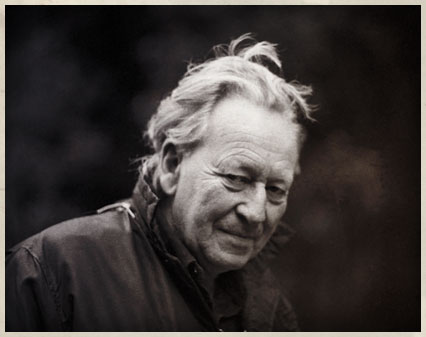
An Ecology Of Mind | A Daughter’s Portrait of Gregory Bateson.
There will be a screening and panel discussion of Nora Bateson’s film of Gregory Bateson,
Edinburgh School of Architecture and Landscape Architecture,
L1 Minto House, Chambers Street, Edinburgh
5.30 – 8pm on 23 February 2012
There will be a workshop on 24 Feb for students of any discipline, Masters level and above, at Edinburgh College of Art
Please email chris@fremnatle.org if you wish to attend the film.
This event is sponsored by the School of Architecture and the CORE research group.
Occupy Museums: MoMA

Occupy Museums meeting beneath Sanja Iveković's "Lady Rosa of Luxembourg" -
Professors, Artists, Workers, and Activists Rally Inside MoMA.
So the question is, are museums part of the problem? What is the problem?
The problem is social and environmental justice. The problem is massively complex and multi-facetted. The problem is multi- trans- and inter-disciplinary. The problem is simple: it’s the financialisation of everything from the value of bees to the value of education, from culture as gentrification to the environmental externalties (the unquantified impacts, ironically the one thing that needs financialised). It’s so complex that it cannot be summarised into one or two sound-bites.
As Brian Holmes’ said in his post ‘Culture Beyond Oil‘,
The secret is out: less than 1 percent of our planet’s population is destroying our world for their profit.
So why are museums part of the problem? and for museums read major arts and cultural organisations.
There are at least a couple of issues:
One is about the ‘career structure’ of the artworld where a lot of people work for free or minimum wage (in their studios or communities or wherever) and a few people become incredibly rich (sometimes the artists, always the dealers). The Scottish Artists Union worked with the Scottish Arts Council and the resulting report showed that a very significant proportion of visual artists make almost no money from their work and have to support their practice from other work. The economy of the visual arts is very challenging and individual artists have always been some of the most precarious workers.
Another is the increasing corporate involvement in the arts – this has always been a factor in the US and the Art Workers Coalition campaigned on this issue forty years ago. In the UK it was significantly encouraged under the Thatcher government. One of the effective lines of critique is offered by PLATFORM with their challenge to BP’s funding of the Tate (as well as other cultural ‘majors’). They argue that this is a form of social license to operate. They need many different forms of legal licenses to operate, but they also need social permission. Cultural organisations, especially the large ones like Tate Britain and the Portrait Awards, are very effective means to demonstrate good corporate citizenship. Good corporate citizenship is not just judged on the funding of cultural majors, it is also a question of actual citizenship across the world.
Designated Drivers
In relation to the current campaign against censorship and in particular the proposed SOPA & PIPA bills its worth considering Temporary Services‘ project Designated Drivers (link to pdf), in which they asked twenty artists and groups to “each put up to 4GB of their archives, research, films, videos, software, images, etc on USB drives” – the visitors to the exhibition were “invited to copy everything!”
What are the key aspects of well-being?
The UK Office of National Statistics is currently consulting on a framework and headline indicators for measuring well-being. This is an incredibly important development, intended in the long run to provide alternatives to simplistic measures such as GDP.
The consultation tests the assumption that the following domains add up to a sense of well-being (quoted in full because of the importance of this work):
Individual well-being It is proposed that this domain should include individual’s feelings of satifaction with life, whether they feel their life is worthwhile and their positive and negative emotions. That is, this domain will include only the headline subjective well-being measures to be derived from the new ONS survey data. Subjective measures would be included with objective measures in the other domains.
Our relationships This was chosen as a domain because it reflects many of the responses received during the national debate and because many theories of well-being report the importance of this area to an individual’s well-being. The scope of this domain is intended to be the extent and type of individuals’ relationships to their immediate family, their friends and the community around them.
Health Includes areas which were thought to be important by respondents to the national debate. An individual’s health is recognised as an important component of their well-being. It is anticipated that this domain would contain both subjective and objective measures of physical and mental health.
What we do Aims to include work and leisure activities and the balance between them, all of which were common themes in the national debate responses. In this domain there are likely to be measures of aspects of work and leisure activities and of work-life balance.
Where we live Is about individual’s dwelling, their local environment and the type of community in which they live. Measures will be sought which reflect having a safe, clean and pleasant environment, access to facilities and being part of a cohesive community. ONS has taken Defra advice on the indicators in this area.
Personal finance Is intended to include household income and wealth, its distribution and stability. Measures within this would also be used during analysis to address the concepts of poverty and equality mentioned in the national debate responses.
Education and skills Various aspects of education and life-long learning were mentioned during the national debate. The scope of this domain is the stock of human capital in the labour market with some more information about levels of educational achievement and skills.
Governance Democracy, trust in institutions and views about the UK’s interaction with other countries, all of which were included in responses to the national debate, are intended to form the scope of this domain.
The economy Is an important contextual measure for national well-being. The scope of this domain is intended to be measures of economic output and stock.
The natural environment Is proposed as a domain in order to reflect areas mentioned during the national debate such as climate change, the natural environment, the effects our activities have on the global environment and natural disasters. It is planned to include measures which reflect these areas at the national level. ONS has taken Defra advice on the indicators for this area.
If you then look at the measures, the issues become more troubling. For instance, whilst generic issues such as climate change are referenced, there is no measure around access to greenspace within everyday life – the natural environment is remote.
The fact that there is no reference to culture is deeply problematic given the substantial research in the Nordic countries which demonstrates that participation in cultural activities has an impact on lifespan.
Finally, there is no reference to any spiritual dimension as contributing to well-being, and whilst modern over-developed Western culture is largely secularised, to omit this area is to diminish the scope of the understanding of well-being.
Responses to this survey need to be made by 23rd January 2012.
Co-Producing PAR+RS

Creative Scotland has just formally announced that I have, along with Trigger (Suzy Glass and Angie Bual www.triggerstuff.co.uk) been appointed as Co-Producers for PAR+RS www.publicartscotland.com, Creative Scotland’s public art development project.
So I’ve got a provocative question to start the ball rolling, is public art a subset of visual arts or is it everything across all artforms that takes place outside the temples of art?
Creative Scotland’s press release is here.
The Oablib Effect

Linlithgow, Burgh Halls, 2009
Oablib is a town in northern Spain, near Bilbao. Formerly an important centre it had, in recent years, lost much of its purpose. Lacking the brashness and political connections of Bilbao it decided against a big, iconic “regeneration” spaceship, dropped down from on-high, and instead looked to the vigour of its local culture and built heritage to re-invent itself.
It has not looked back.
You are warmly invited to “The Oablib Effect”, a presentation by Malcolm Fraser, the award-winning architect. Q&A and conversation will follow, for which Malcolm will be joined by Morag Deyes MBE, Artistic Director of Dance Base, Scotland’s National Centre for Dance.
The presentation & conversation will be held from 6pm to 8pm on the evening of Monday 24 October 2011 in The Gallery, which is located in the Pavilion at Burns Cottage, Robert Burns Birthplace Museum, Alloway, close to the heart of Ayr town centre. Parking is available in the Burns Cottage car park.
Malcolm Fraser Architects have worked in and for ‘Oablibs’ all over Scotland, from Stromness to Berwick-upon-Tweed, and Malcolm would like to discuss how Ayr might discover its own Oablib Effect.
Following the presentation and Q&A, there will be the opportunity to converse with a drink and canapés by Su Casa, Ayr before a wrap-up session that looks forward to actions and future such presentations. A small charge will be made towards the use of The Gallery and refreshments.
Thanks to Robert Burns Birthplace Museum and Su Casa.
Would you kindly email your acceptance of this invitation by Thursday 20 October to Lianne Hackett who will produce a note of the evening with actions for the future.
If you have any questions or suggestions for participation, please contact Lianne Hackett on 07796466384.
AHM’s State of Play, Dundee
AHM‘s final State of Play event takes place in Dundee on Saturday 1 October.
As with previous events it will include a number of ‘One Minute Manifestos’. One of these has emerged through a collective process of writing initiated by Tim Collins and contributed to by a number of participants in the Values of Environmental Writing programme at Glasgow University.
Tim has asked me to post the manifesto and authorship, and to encourage anyone who broadly supports the manifesto, and is at the State of Play symposium, to come forward and share in the speaking of the manifesto.
“Who are we? Though the origins of this manifesto are the Values of Environmental Research Network conversations, this document is inclusive of all those who feel that the arts and humanities have a vital role in the effort to mitigate and prevent environmental damage.”
The Anthropo-scene Evolution
2011 saw the culmination of avarice that necessitates naming the human impact on all earthly things. In response we wish to reject humanity’s supposed dominion over nature and to take responsibility for wilful and excessive impact. Our intention is to constitute greater empathy between the world’s free-living things. As creative pragmatists committed to producing practical wisdom, we recognise a loss of humility and seek to reengage the aesthetic and the sublime, which provide interface and witness to spirit on earth. Cultural responses to the anthropo-scene realize that there are opportunities embedded in new constraints; but more importantly there is generative force amongst living things that must be engaged anew. We experiment with a new materialism and aim for new metaphysical purpose for the arts and humanities within the public domain.
Background
Draft1 scribed by Tim Collins (TC) with Reiko Goto, 18 June 2011, subsequently edited by Tom Bristow and Chris Maughan, with comments and encouragement from Aaron Franks and Chris Fremantle (CF). The AHM ‘State of Play in Scotland’ submission was initiated by CF. TC offered the first rough draft with proper word editing by Aaron Franks and Rachel Harkness, followed by strategic refinement by Rhian Williams, Kate Foster, Alistair McIntosh and Owain Jones. The full manifesto is a result of discussion that occurred on 17 June, 2011 with Aaron Franks, Owain Jones, Chris Maughan, Mike Robinson and Karen Syse. Tom Bristow and the ‘frog team’ were present in spirit if not in material form. The work was inspired and energized by presentations and dialogue with Alistair McIntosh and Gareth Evans all set within the wider context of the AHRC supported Values of Environmental Writing Network, organized by Hayden Lorimer, Alex Benchimol and Rhian Williams (2011).
Tango on the Border
This is the current state of UK Borders: turning back artists, writers, performers. There is a buzz of disquiet and anger, but it needs to become a torrent of vitriol against stupidity, bureaucracy and fear. The video was highlighted in a short piece on PAR+RS reporting on an event which took place during a walk along the (open) border between Scotland and England.
I wrote to my MP ages ago (I use the web site Write to Them which makes it easy) and got an “Its all perfectly reasonable” civil servant reply. I’m going to write again because the video and the writing is brilliant – more pointed and elegant than mine. You can also sign a petition and read more.

 CHRIS FREMANTLE
leave a comment