What art have I seen?
Don’t go and think about Dalston Mill as a whacky eco retro art project. Think of it as architects working very hard to imagine a future for us all. And bear in mind that they are sleeping in this structure, above the bar cafe, next to the seminar room and adjacent to the toilets.
The bus dropped me on Dalston Lane and I towed my wheelie suitcase over the uneven pavement. Leaving Liverpool Street and the skyscrapers we’d passed through Little Nigeria on Shoreditch High Street. I’d seen the main Radical Nature exhibition at the Barbican a few weeks ago, and Dan Gretton had said this “off-site” project was really worth seeing. I’d caught a glimpse of the mural you are meant to look out for and seen a black painted wooden wall with words hand painted in white saying Dalston Mill, but it looked closed. So thinking that there was another entrance I walked through a yard, caught sight of a scrubby patch of wheat, went through an opening in a builders temporary fence and wandered around. It was 2pm and a few people were casually doing stuff. One guy in a t-shirt and shorts was sweeping up fag butts whilst smoking.
Going to Nils Norman and Michael Cataloi’s University of Trash at the Sculpture Center, my mother’s comment “I saw this in the 70s” is still firmly with me. She’s got a point.
And the answer may lie in the blurb about the show Into The Open currently in Philadelphia. This was the official US representation at the 2008 Venice Bienniale of Architecture. The sixteen groups represented are at the cutting edge of thinking about the urban, the landscape, the recycled and the social. I immediately recognise Center for Land Use Interpretation, Center for Urban Pedagogy, Project Row Houses and Rural Studio as landmark initiatives. I have a collection of CLUI and CUP materials, the book Rural Studio produced on my shelves and I’ve been to Project Row Houses.
The blurb goes:
“Critics noted the exhibition’s unusually sober assessment of the challenges America faces, as well as the inspired attempts by grassroots architects to mitigate these conflicts.”
But I do have a problem, and it was hell of an easy to walk in look around and walk out – to do the artworld strut – and say “seen that”. I did end up talking to the guy clearing up the fag butts and he turned out to be one of the architects. I nearly voluntarily got roped into making dough, and I really should have (no strutting making dough) but in the end they were just getting organised and I was heading for a train. Vidokle does address this so directly and effectively: The Martha Rosler Library as well as the Video Store and the Night School are all about stopping (or tripping) the strut. And I wish the University of Trash and Dalston Mill had, in addition to the events programme, something which when you walk in off the street, sucked you into ‘the sober assessment of the challenges,’ whatever time of day it was.
Because in reality, these architects and artists have created a structure which is lightweight, adaptable, portable, generates energy, supports social activities, addresses questions of food and land use, and therefore embodies some very serious issues. And I loved the scarecrows with milk containers for heads. And I hope that as they take it all to pieces and move on, that they clean up the site, including the archaeological trash from the periphery, which has clearly been there longer than the three weeks of this exercise, and leave the site better than they found it, whether they have left us wiser or not.
What Art?

The unacceptable face of Britain
Aesthetic of European stag party culture
Blue Cowboys out of Newcastle rebranded to maximise market penetration take Gdansk by storm
Find them on youtube under the name StudioSzkic
Explore Polish bars
Tree climbing, table Squennis, arm wrestling,
begging bankers
Sexercise disco on a streetcorner in NY in PLish
Who is mixing the beats? They should be on iTunes as well.

What Art have I seen?
The University of Trash at the Scultpure Center
Art space become alternative pedagogical space. Quote “I saw enough of this sort of thing in the 70s.”
So are we revisiting the 70s? If so, why? And what is the difference between now and the 70s?
What art have I seen?
Socrates Sculpture Park, Long Island City.
What sticks in the mind?
Fifty bums raised in the air: yoga in the Park.
A giant doilly suspended in the trees
(Jennifer Cecere, Mom, 2009)
Looking across to Manhattan’s volume.
A series of physical challenges modelled on an exercise assault course
(Risa Puno, The Big Apple Showdown Spectacular, 2009)
A carnival wagon with artefacts displayed
(Dana Sherwood and The Black Forrest Fancies, The Ladies Society of Alchemical Agriculture, 2009)
A black barn of jig-sawed patterns
(Bernard Williams, Socrates Ply- Teck Barn, 2009)
A small garden, the most valuable space for urban-dwellers
(Jeanine Oleson, Retribution, 2009)
Socrates Sculpture Park reinvents itself as a cross-over public space between art and temporary amusement park. Away with formal sculptural concerns: roll up, roll up to the crazy summer Saturday on a field in the sun. Is it New York or is it somewhere in Kansas? Is it Little House On The Prairie or is it socially engaged practice? Even without the specific ‘dialogics’ intended to captivate the art audiences, Socrates is busy.
What art have I seen?
Art Sites in Riverhead. I noticed a sign saying art + architecture. It’s a gallery with an outdoor sculpture space that also seems to be involved in local green developments. The building looks like it used to be a light industrial unit and is really well converted, both the building and the landscape.
I’d have liked to see the exhibition Called to Action, curated by Lillian Ball, on Restoration projects.
Outdoors there was an interesting mix of large scale sculptures – some made of very permanent materials (steel)

and others clearly very temporary tent structures.
 The relationship of the tents to the ground, the way they protected an area of grass and weeds, was interesting.
There was a small patch of plants with a sign indicating that this was based on work done by Cornell University Extension programme: Weeds and Your Garden.
LANDWORKERS
Twice this week I have been confronted by the importance of thinking about the rural as a thing in itself, rather than by what it is not. The Scottish Government defines the rural in negative terms; it is that which is not urban. But, and it has to be said, sometime around now according to the UN Population Fund humanity is crossing a threshold into (statistically speaking) more than 50% of us living in cities.
And it is precisely at this point that it is increasingly clear that we need to pay attention to the cost of our beliefs, and our belief that the rural is backward, dependent and boring compared to the smooth, fast and creative spaces of our cities is one we need to question.
On Thursday 14th May 2009 the Geddes Institute at the University of Dundee, as part of the Annual Conference of the Royal Incorporation of Architects in Scotland held a symposium entitled Landworkers. We were taken on a journey into a space where the indigenous and the vernacular and the rural and the remote were foremost. I have a slight reservation even using the word rural in the context of work around the Great Bear Lake in the North West Territories of Canada, or of Samiland stretching across Norway, Sweden, Finland and Russia. Rural suggests the space of western agrarian cultures, not the space of travelling folk and nomads.
So I’d like to start by suggesting several things Scotland can learn from its own rural:
The international Organisation for Economic Cooperation and Development (OECD) recently reported that Scotland’s rural schools provide the best education in the world.
As noted previously, the result of more than 20 years of community development through the process of land claim on Eigg (amongst other remote Scottish estates) has resulted in the Eigg Trust introducing a renewable energy system which makes the island an exemplar. Moreover the fact that this renewable energy system incorporates a means to limit any individual from taking too much is something to be celebrated. It means that social and environmental justice are manifest in the infrastructure.
Rural Scotland also has the potential to generate 25% of Europe’s wind energy, as well as a very significant proportion of wave and tidal energy. In the context of climate change it is imperative, not that we cover every square mile of the Scottish landscape with wind turbines, but that we develop a robust politics to maximise the production of renewable energy by pushing all the technologies to commercial viability, and by re-designing and re-engineering the grid to support this. The key words for such a policy need to be a mixed economy of means across both technologies and scales – just as rural life is characterised by mixed economies and complex interdependecies.
This moves from the overused word ‘sustainability’ to the more imaginatively rich concept of a ‘stability domain’ as articulated by the eminent ecological artists Helen Mayer Harrison and Newton Harrison. A ‘stability domain’ is a region, whether a watershed, or another geographical entity, which achieves ecological and economic stability. In human terms this means having the necessary interdependencies, structures and limitors embedding social and environmental justice, for life to thrive. It also means ceasing to be dependent on the extraction of, and consuming of, limited resources beyond the carrying capacity of the ecology. We might also want to ask what a cultural stability domain might be?
If we want to challenge beliefs, then we might want to imagine the situation where our energy needs are met from the energies already in movement around the planet, rather than those embedded beneath our feet. I can understand why miners in St Helens in Lancashire are proud of their motto ‘Ex Terra Lucem’ and it’s a wonderfully resonant phrase, but we need a new motto.
These are all pragmatic and practical lessons we can learn from the rural, but we can also learn in a different way, and returning to the Landworkers symposium I want to highlight the cultural things we can learn from the rural.
Four, if not more, presentations focused on vernacular and indigenous projects:
Gavin Renwick working as cultural intermediary for the Dogrib in their land claim negotiations with the Canadian Government, andnow moving on to the process of designing and developing a new vernacular for housing in the new nation.
Juhani Pallasmaa creating a museum of nature and culture with and for the Sami.
Then two wonderful presentations flowing into each other by a process of playing ‘tag’ starting with Arthur Watson, handing on to Will Maclean, handing on to Fergus Purdie, handing back to Will Maclean handing on to Marion Leven.
Watson was talking about Cairn Gorm: Reading a Landscape in which he is collaborating with Maclean and Purdie, amongst others. Maclean then talked about the works Cuimhneachain nan Gaisgeach (Commemoration of our Land Heroes) on Lewis where he is collaborating on the fourth site with Leven.
These projects are more than just art in rural places. They speak to a very specific and different understanding: one the places priority on the vernacular and indigenous. T.S.Eliot and others were quoted on the relationship between tradition and innovation but Renwick provided some of the key phrases that structure thinking this through. The first, probably derived from reading MacDiarmid, in “Being modern in your own language.” The second is the dictum of the Dogrib elders which is to educate young people to understand both Western culture and their own traditional culture: “to be strong like two people”.
The cultural projects all demonstrate that it is absolutely critical in the context of rampant urbanisation to express the value (richness, complexity, duration, immediacy, experimentation and repetition) of the rural. And that the expressions of value and meaning we saw help us understand, if nothing else, that the rural is more than just a lower density of population.
The issue of the vernacular seemed quite opaque in the event. What is vernacular? Is it of the everyday? In relation to architecture it can seem like an aspect of the aesthetic realm or a stylistic device. But it struck me that the terrace I live on with 20 houses the same and two at the end which are larger (for the builder/developer and his family at a guess) also describes a vernacular – yes in the ‘character,’ but also in the economics. There is a real danger that the vernacular is a lifestyle choice rather than an aspect of imagining our ‘stability domain’. It seemed to me that the artists’ projects evidenced a clear operation within a complex idea of vernacular which comes back to Renwick’s ‘modern in our own language’ and ‘strong like two people.’
What art have I seen?
Irational.org doing a van conversion, so that it will run on vegetable oil, at the Monument in Newcastle.
The facts – 35 mpg, 70 mph, 65p a litre (more or less) and it is ‘carbon neutral’.
In other words the plants from which vegetable oil is produced take up carbon through photosynthesis as they grow. When the vegetable oil is combusted in the engine and the carbon released, it is then taken up again by the plants being grown for more vegetable oil, unlike fossil fuels which take millions of years to produce.
Not as good as the solar powered cars they race at the Alford Transport Museum, but more sustainable.
Originally posted 13 June 2006
What art have I seen?
The inauguration of the Howden Sculpture Sequence by John Maine.
What art have I seen?
Roger Hiorns Seizure project with ArtAngel

Visited this in November 2008
What art have I seen?
Centre international d’art et du paysage de l’île de Vassivière
Some images at Flickr
Vassiviere is listed on the ISC‘s web site as one of the few sculpture parks in France. It describes itself variously as ‘a centre for art and nature’, ‘art and the counryside’, and ‘a centre for land art’. It has a few internationally known artists (Goldsworthy, Pistoletto and the Kabakovs) and many French artists; I found a work by Brad Goldberg, who collaborated on Place of Origin, and work by Roland Cognet who had worked at SSW and seems to have had a one person show at Vassiviere,
This place is interesting; having come about as a result of a major hydro-electric scheme, it conceptually raises issues of our relationship to our environment and our tendency to manipulate it in order to extract benefit. It has real character, but it suffers from neither owning its history, nor clearly adressing its apparent mission.
It has a mixed bag of sculptures that make up the park – some the result of a sculpture symposium in the early 80s. More recent and jokey post modern works are also incorporated. The gallery seems to work in partnership with some high profile institutions like the Palais de Tokyo in Paris. The building by Aldo Rossi is striking.
But there is a lack of clarity – there are cornerstone international works, but I couldn’t discern a curatorial strategy. Likewise I guess that the works by French artists are significant, but I didn’t get a sense of a collection of work of significant French sculptors (or artists working in three dimensions on an outdoor scale). This would be a good project in itself.
The work by Samakh is a good response to a natural event, but the replanting of an area of forest to promote biodiversity is not radical.
Thinking about the work of Littoral in particular, but also of PLATFORM, and others involved in dialogic practices, there are so many ways in which this amazing place could speak of itself. Funnily enough it is Goldsworthy who draws attention to the drowned land, but for instance the larger ecological landscape is not drawn out.
But as it stands it clearly has a history of being a centre for sculpture during the second half of the 20th century, and is trying to redefine itself. Using the gallery to do this is OK, but in the end it remains in conflict with the permanently sited work which speaks of a previous project.
What art have I seen?
The Garden of Cosmic Speculation, Portrack House, Dumfries, by Maggie Keswick and Charles Jencks
What art have I seen?
Art About‘s WHAT HAPPENED HERE. I went into the Carnegie Library in Ayr on Friday afternoon and the entrance hall was covered in pictures with hand written comments. Very different from the Ayr Photographic Society’s annual exhibition in the Reference Section. This was clearly improvised and ad hoc. Rachel and Pamela have taken a selection of views of Ayr and photocopied them adding a question under the picture “What Happened Here?” You can add your name and contact details at the bottom.
Walking around the entrance hall people from Ayr have talked about where they have had ice cream and sun burn, where they have fights and kisses. Some talk about the historical significance of sites.
This is preparatory to some planned ‘public art’ event to take place during the Burns an’ a’ that Festival in May. Its interesting because I had just seen the Caravan Club at GI in Glasgow, with their post cards of various graffiti written and derelict sites around the UK. Rachel and Pamela approach is interesting because they are building an audience for the Festival work by getting people involved at this stage. More later.
What am I reading?
Participation, Ed. Claire Bishop, Whitechapel Gallery and MIT Press, 2007
What art have I seen
Half-Life by NVA and the National Theatre of Scotland
Collaboration
Oren Lieberman, at a dinner during Wendy Gunn’s Making Places workshops in 2002-03, offered an interesting analysis of collaboration. I was reminded of this and encouraged to actually note it down by Tony Beckwith (from Gunpowder Park) phoning up and asking me to remind him about it – I had offered Oren’s thought up during the Bright Sparks Seminar (9 March 2007).
So back to the point, Oren’s analysis of collaboration. He said there is Multi-disciplinary practice. This might be characterised by a group of different disciplines (architects, engineers, planners, perhaps even artists, sitting around a table, each addressing their area of responsibility within a project. Having them round the table is useful, but collaboration is functional. Then you have Interdisciplinary practice. I would understand this to be when the people around that table are interested in understanding each others roles, skills and tasks. I might further suggest that they draw on each others roles skills and tasks through interest. Finally Oren offered Transdisciplinary practice – when people change roles and start doing each other’s jobs. I would offer Michael Singer and Linea Glatt’s 27th Avenue Waste Transfer Station project in Phoenix Arizona as an example – as I understand it they had been employed as artists to decorate the building, found their were decorating a basically bad building and persuaded the commissioner to allow them to redesign the building as a public space which in the documentation, looks like the hanging gardens of Babylon (case study at publicartonline).
The first thing to say about Oren’s analysis is that it is not an increasing scale of good: Trans- is not better than Inter- which is not better than Multi-. They are different. Trans- is more difficult than Inter- which is more difficult than Multi-.
Given that they are more difficult, and probably in the context of any form of collaboration, we need to think about how to achieve collaboration. To achieve collaboration you cannot start around a table in an office. You can only do it by constructing shared experiences, relevant to the project and characterised by conviviality.
Here I would point at John Maine’s tactics at the beginning of Place of Origin (for more on this project follow this link). He insisted that we (himself, Brad Goldberg and Glen Onwin and myself) go on a road trip. We went to Lewis, via Clava Cairns and Assynt. Ostensibly we went to look at the interpretation centre at Callanish, but in fact we went to get to know each other and to develop a shared visual language. Interestingly, though John and I had been to Kemnay Quarry on a number of occasions, this road trip happened before either Brad or Glen saw the site. I suspect the result was that when they saw the site, at the end of the road trip, we all had a shared experience to interrogate it from. What was averted was each artist arriving at the site and immediately going into a singular “what do I do here?” and instead, what occurred was “what do we do here?”. I think this latter point may be very important – it certainly resulted in an amazing collaboration over 10 years.
Ivan Illich's Address to CIASP
Cut and pasted from http://ournature.org/~novembre/illich/
An address by Monsignor Ivan Illich to the Conference on InterAmerican Student Projects (CIASP) in Cuernavaca, Mexico, on April 20, 1968. In his usual biting and sometimes sarcastic style, Illich goes to the heart of the deep dangers of paternalism inherent in any voluntary service activity, but especially in any international service “mission.” Parts of the speech are outdated and must be viewed in the historical context of 1968 when it was delivered, but the entire speech is retained for the full impact of his point and at Ivan Illich’s request.
IN THE CONVERSATIONS WHICH I HAVE HAD TODAY, I was impressed by two things, and I want to state them before I launch into my prepared talk.
I was impressed by your insight that the motivation of U.S. volunteers overseas springs mostly from very alienated feelings and concepts. I was equally impressed, by what I interpret as a step forward among would-be volunteers like you: openness to the idea that the only thing you can legitimately volunteer for in Latin America might be voluntary powerlessness, voluntary presence as receivers, as such, as hopefully beloved or adopted ones without any way of returning the gift.
I was equally impressed by the hypocrisy of most of you: by the hypocrisy of the atmosphere prevailing here. I say this as a brother speaking to brothers and sisters. I say it against many resistances within me; but it must be said. Your very insight, your very openness to evaluations of past programs make you hypocrites because you – or at least most of you – have decided to spend this next summer in Mexico, and therefore, you are unwilling to go far enough in your reappraisal of your program. You close your eyes because you want to go ahead and could not do so if you looked at some facts.
It is quite possible that this hypocrisy is unconscious in most of you. Intellectually, you are ready to see that the motivations which could legitimate volunteer action overseas in 1963 cannot be invoked for the same action in 1968. “Mission-vacations” among poor Mexicans were “the thing” to do for well-off U.S. students earlier in this decade: sentimental concern for newly-discovered. poverty south of the border combined with total blindness to much worse poverty at home justified such benevolent excursions. Intellectual insight into the difficulties of fruitful volunteer action had not sobered the spirit of Peace Corps Papal-and-Self-Styled Volunteers.
Today, the existence of organizations like yours is offensive to Mexico. I wanted to make this statement in order to explain why I feel sick about it all and in order to make you aware that good intentions have not much to do with what we are discussing here. To hell with good intentions. This is a theological statement. You will not help anybody by your good intentions. There is an Irish saying that the road to hell is paved with good intentions; this sums up the same theological insight.
The very frustration which participation in CIASP programs might mean for you, could lead you to new awareness: the awareness that even North Americans can receive the gift of hospitality without the slightest ability to pay for it; the awareness that for some gifts one cannot even say “thank you.”
Now to my prepared statement.
Ladies and Gentlemen:
For the past six years I have become known for my increasing opposition to the presence of any and all North American “dogooders” in Latin America. I am sure you know of my present efforts to obtain the voluntary withdrawal of all North American volunteer armies from Latin America – missionaries, Peace Corps members and groups like yours, a “division” organized for the benevolent invasion of Mexico. You were aware of these things when you invited me – of all people – to be the main speaker at your annual convention. This is amazing! I can only conclude that your invitation means one of at least three things:
Some among you might have reached the conclusion that CIASP should either dissolve altogether, or take the promotion of voluntary aid to the Mexican poor out of its institutional purpose. Therefore you might have invited me here to help others reach this same decision.
You might also have invited me because you want to learn how to deal with people who think the way I do – how to dispute them successfully. It has now become quite common to invite Black Power spokesmen to address Lions Clubs. A “dove” must always be included in a public dispute organized to increase U.S. belligerence.
And finally, you might have invited me here hoping that you would be able to agree with most of what I say, and then go ahead in good faith and work this summer in Mexican villages. This last possibility is only open to those who do not listen, or who cannot understand me.
I did not come here to argue. I am here to tell you, if possible to convince you, and hopefully, to stop you, from pretentiously imposing yourselves on Mexicans.
I do have deep faith in the enormous good will of the U.S. volunteer. However, his good faith can usually be explained only by an abysmal lack of intuitive delicacy. By definition, you cannot help being ultimately vacationing salesmen for the middle-class “American Way of Life,” since that is really the only life you know. A group like this could not have developed unless a mood in the United States had supported it – the belief that any true American must share God’s blessings with his poorer fellow men. The idea that every American has something to give, and at all times may, can and should give it, explains why it occurred to students that they could help Mexican peasants “develop” by spending a few months in their villages.
Of course, this surprising conviction was supported by members of a missionary order, who would have no reason to exist unless they had the same conviction – except a much stronger one. It is now high time to cure yourselves of this. You, like the values you carry, are the products of an American society of achievers and consumers, with its two-party system, its universal schooling, and its family-car affluence. You are ultimately-consciously or unconsciously – “salesmen” for a delusive ballet in the ideas of democracy, equal opportunity and free enterprise among people who haven’t the possibility of profiting from these.
Next to money and guns, the third largest North American export is the U.S. idealist, who turns up in every theater of the world: the teacher, the volunteer, the missionary, the community organizer, the economic developer, and the vacationing do-gooders. Ideally, these people define their role as service. Actually, they frequently wind up alleviating the damage done by money and weapons, or “seducing” the “underdeveloped” to the benefits of the world of affluence and achievement. Perhaps this is the moment to instead bring home to the people of the U.S. the knowledge that the way of life they have chosen simply is not alive enough to be shared.
By now it should be evident to all America that the U.S. is engaged in a tremendous struggle to survive. The U.S. cannot survive if the rest of the world is not convinced that here we have Heaven-on-Earth. The survival of the U.S. depends on the acceptance by all so-called “free” men that the U.S. middle class has “made it.” The U.S. way of life has become a religion which must be accepted by all those who do not want to die by the sword – or napalm. All over the globe the U.S. is fighting to protect and develop at least a minority who consume what the U.S. majority can afford. Such is the purpose of the Alliance for Progress of the middle-classes which the U.S. signed with Latin America some years ago. But increasingly this commercial alliance must be protected by weapons which allow the minority who can “make it” to protect their acquisitions and achievements.
But weapons are not enough to permit minority rule. The marginal masses become rambunctious unless they are given a “Creed,” or belief which explains the status quo. This task is given to the U.S. volunteer – whether he be a member of CLASP or a worker in the so-called “Pacification Programs” in Viet Nam.
The United States is currently engaged in a three-front struggle to affirm its ideals of acquisitive and achievement-oriented “Democracy.” I say “three” fronts, because three great areas of the world are challenging the validity of a political and social system which makes the rich ever richer, and the poor increasingly marginal to that system.
In Asia, the U.S. is threatened by an established power -China. The U.S. opposes China with three weapons: the tiny Asian elites who could not have it any better than in an alliance with the United States; a huge war machine to stop the Chinese from “taking over” as it is usually put in this country, and; forcible re-education of the so-called “Pacified” peoples. All three of these efforts seem to be failing.
In Chicago, poverty funds, the police force and preachers seem to be no more successful in their efforts to check the unwillingness of the black community to wait for graceful integration into the system.
And finally, in Latin America the Alliance for Progress has been quite successful in increasing the number of people who could not be better off – meaning the tiny, middle-class elites – and has created ideal conditions for military dictatorships. The dictators were formerly at the service of the plantation owners, but now they protect the new industrial complexes. And finally, you come to help the underdog accept his destiny within this process!
All you will do in a Mexican village is create disorder. At best, you can try to convince Mexican girls that they should marry a young man who is self-made, rich, a consumer, and as disrespectful of tradition as one of you. At worst, in your “community development” spirit you might create just enough problems to get someone shot after your vacation ends_ and you rush back to your middleclass neighborhoods where your friends make jokes about “spits” and “wetbacks.”
You start on your task without any training. Even the Peace Corps spends around $10,000 on each corps member to help him adapt to his new environment and to guard him against culture shock. How odd that nobody ever thought about spending money to educate poor Mexicans in order to prevent them from the culture shock of meeting you?
In fact, you cannot even meet the majority which you pretend to serve in Latin America – even if you could speak their language, which most of you cannot. You can only dialogue with those like you – Latin American imitations of the North American middle class. There is no way for you to really meet with the underprivileged, since there is no common ground whatsoever for you to meet on.
Let me explain this statement, and also let me explain why most Latin Americans with whom you might be able to communicate would disagree with me.
Suppose you went to a U.S. ghetto this summer and tried to help the poor there “help themselves.” Very soon you would be either spit upon or laughed at. People offended by your pretentiousness would hit or spit. People who understand that your own bad consciences push you to this gesture would laugh condescendingly. Soon you would be made aware of your irrelevance among the poor, of your status as middle-class college students on a summer assignment. You would be roundly rejected, no matter if your skin is white-as most of your faces here are-or brown or black, as a few exceptions who got in here somehow.
Your reports about your work in Mexico, which you so kindly sent me, exude self-complacency. Your reports on past summers prove that you are not even capable of understanding that your dogooding in a Mexican village is even less relevant than it would be in a U.S. ghetto. Not only is there a gulf between what you have and what others have which is much greater than the one existing between you and the poor in your own country, but there is also a gulf between what you feel and what the Mexican people feel that is incomparably greater. This gulf is so great that in a Mexican village you, as White Americans (or cultural white Americans) can imagine yourselves exactly the way a white preacher saw himself when he offered his life preaching to the black slaves on a plantation in Alabama. The fact that you live in huts and eat tortillas for a few weeks renders your well-intentioned group only a bit more picturesque.
The only people with whom you can hope to communicate with are some members of the middle class. And here please remember that I said “some” -by which I mean a tiny elite in Latin America.
You come from a country which industrialized early and which succeeded in incorporating the great majority of its citizens into the middle classes. It is no social distinction in the U.S. to have graduated from the second year of college. Indeed, most Americans now do. Anybody in this country who did not finish high school is considered underprivileged.
In Latin America the situation is quite different: 75% of all people drop out of school before they reach the sixth grade. Thus, people who have finished high school are members of a tiny minority. Then, a minority of that minority goes on for university training. It is only among these people that you will find your educational equals.
At the same time, a middle class in the United States is the majority. In Mexico, it is a tiny elite. Seven years ago your country began and financed a so-called “Alliance for Progress.” This was an “Alliance” for the “Progress” of the middle class elites. Now. it is among the members of this middle class that you will find a few people who are willing to send their time with you_ And they are overwhelmingly those “nice kids” who would also like to soothe their troubled consciences by “doing something nice for the promotion of the poor Indians.” Of course, when you and your middleclass Mexican counterparts meet, you will be told that you are doing something valuable, that you are “sacrificing” to help others.
And it will be the foreign priest who will especially confirm your self-image for you. After all, his livelihood and sense of purpose depends on his firm belief in a year-round mission which is of the same type as your summer vacation-mission.
There exists the argument that some returned volunteers have gained insight into the damage they have done to others – and thus become more mature people. Yet it is less frequently stated that most of them are ridiculously proud of their “summer sacrifices.” Perhaps there is also something to the argument that young men should be promiscuous for awhile in order to find out that sexual love is most beautiful in a monogamous relationship. Or that the best way to leave LSD alone is to try it for awhile -or even that the best way of understanding that your help in the ghetto is neither needed nor wanted is to try, and fail. I do not agree with this argument. The damage which volunteers do willy-nilly is too high a price for the belated insight that they shouldn’t have been volunteers in the first place.
If you have any sense of responsibility at all, stay with your riots here at home. Work for the coming elections: You will know what you are doing, why you are doing it, and how to communicate with those to whom you speak. And you will know when you fail. If you insist on working with the poor, if this is your vocation, then at least work among the poor who can tell you to go to hell. It is incredibly unfair for you to impose yourselves on a village where you are so linguistically deaf and dumb that you don’t even understand what you are doing, or what people think of you. And it is profoundly damaging to yourselves when you define something that you want to do as “good,” a “sacrifice” and “help.”
I am here to suggest that you voluntarily renounce exercising the power which being an American gives you. I am here to entreat you to freely, consciously and humbly give up the legal right you have to impose your benevolence on Mexico. I am here to challenge you to recognize your inability, your powerlessness and your incapacity to do the “good” which you intended to do.
I am here to entreat you to use your money, your status and your education to travel in Latin America. Come to look, come to climb our mountains, to enjoy our flowers. Come to study. But do not come to help.
Remember Saro-Wiwa
Remember Saro-Wiwa, the Bus, the first Living Memorial by Sokari Douglas Camp

I’m working with PLATFORM on this major public art project. I’ve been involved since July and this is the day of the official launch.
Producing and Project Managing > Remember Saro-Wiwa
Sokari Douglas Camp – Sweeping
Sculptures by Sokari Douglas Camp at
Camberwell College of Arts, London
26 July – 13 September 2006
Nigeria comes to London. Well actually Nigeria and London have been together for many years. Sokari Douglas Camp CBE! Sokari Douglas Camp is an artist, and more precisely a sculptor. Sokari Douglas Camp lives in London. Sokari Douglas Camp was born in Nigeria, and more precisely in the Niger Delta. We need to be precise to avoid confusion.
The exhibition Sweeping is a group of recent work across a range of scales.
Positioned on the forecourt of the College, and visible to passers on the Peckham Road, is Asoebi Women (2005), made as part of the Africa05 season and shown at the British Museum. Of course its also the eponymous ‘water feature’ for Ground Force – thus essentially and at once Nigerian and British.
Chimamanda Ngozi Adichie, in Purple Hibiscus, describes the women at Christmas in rural Nigeria: “They all looked alike, in ill-fitting blouses, threadbare wrappers, and scarves tied around their heads.” (p91) This sheds a light across the work, one confirmed by Sokari in the text in the catalogue. Poverty and making do are key.
Inside the Gallery are two larger than life size works – a pair of figures, Accessories Worn in the Delta (2006), and a single figure Teasing Suicide (2004). Various other smaller scale works are also included – at least one of these is a maquette, but all stand on their own.
Sokari Douglas Camp works in welded metal. She is immensely skilled as well as provocative and reflective in her work. She addresses Britain and Nigeria, Peckham Road and Port Harcourt. The exhibition is full of life and death.
The statement offered with the exhibition illuminates this.
‘Sweeping is about management, order, facing up to the truth. As we sweep, we whisper things to our chores – I think I do that with my sculpture. I work on things that disturb me, take ordinary experience and turn it into a surreal picture. But life is surreal.’ (Press Release)
But this statement is more interesting if you read it in the catalogue. It goes on:
‘…and women take it in their stride. We tolerate the most extraordinary things.’ (Catalogue)
The last statement, missing from the press release, adds a completely new, feminist perhaps, dimension. It becomes less ‘art world’, less distant, more present, more personal.
The process of making sculpture is about telling, or perhaps admitting, the truth. What results from telling the truth as you make art is a new understanding – a heightened awareness.
The Bus, the maquette for the Living Memorial to Ken Saro-Wiwa states ‘I accuse the oil industry of the genocide of the Ogoni’ Its a very unsubtle statement. Other works in the exhibition open up the personal psychological experience in much richer ways. The Bus speaks to the public shared space. It asks “Which bus are you on?”
The figure, Teasing Suicide, that confronts you as you enter the gallery is holding an AK47 pointing in its mouth. I interpreted it as a female figure. I interpreted the pink paint covering the head and shoulders as the consequences of squeezing the trigger. But the work is also one of the most beautiful. Sokari Douglas Camp is immensely skilled at working with metal, and the imagery cut into the body of the figure is just stunning.
The large pair of figures, also I think female, entitled Accessories Worn in the Delta, are loaded down with AK47s and ammunition. They face each other, but they are like caryatids rather than in a personal confrontation.
One of the smaller works, the Coca-cola Ladies (2004) also is a curious configuration. A group of perhaps eight tall figures of women surround a slightly more vulnerable figure in the centre of the group. The figures are made from mild steel, the head dresses red, crushed and cut coke cans. The eight are linking arms, and the whole assemblage is moving purposefully. There is almost a praetorian sense to the group. Making sculpture out of found materials such as coke and beer cans has become a ‘traditional’ activity in Africa, but the psychological strength of this work is huge.
Sokari Douglas Camp’s work is infused by her cultural inheritance. There is no possibility of failing to recognise the colours, patterns and shapes in the work. The short film Sweeping, perhaps just a ‘study’ of the idea, highlights the action focusing on repetition and pattern in the dust. In the background is a house. The front wall of the house made from concrete blocks pierced with a simple repeating pattern – you know – the sort also used for garden walls. In that, as much as in the patterns left in the dust by sweeping, you can see the importance of the cutting and drawing through the steel.
Each work contains a psychologically complex situation – standing, protecting, confronting, crying, killing – genocide. They are personal responses to human experience. My instinct is that the human experience is rooted in Nigeria, and it stands as a challenge to London – Nigeria is conflicted, but Nigeria is strong. It also asks the person in Peckham “Have you experienced anything like this?” to which the answer is probably “Yes.” Just as the Bus, and PLATFORM’s whole remember saro-wiwa project, aims to make what happens in the Niger Delta a reality to people in London, so all Sokari’s work seems explore the idea that ‘ We tolerate the most extraordinary things’.
John Latham
Several years ago I made a pilgrimage to Livingston to visit the Five Sisters, a bing on the edge of the town. I understood it to be a major, unsigned, piece of land art associated with that elusive artist, John Latham.
I documented the work of art on a slide film. Although I did not climb on the work at the time, I did view it from a number of perspectives. That documentation resides in the archive of the Scottish Sculpture Workshop, with no associated texts of explanation.
I was caught up in myths, in part of my own making, that surround Latham. I connected some limited knowledge of the Artists Placement Group (APG), through picking up that there was a connection between Latham and these large bings, legacies of an industrial landscape in the Lothians, to the land art of artists such as Smithson. I assumed that Latham had been involved in the shaping of the Five Sisters.
I have since discovered that the connection between Latham and the bings in the Lothians is of a different sort. Latham had proposed the re-imagining of the bings as monuments. His work involved re-conceptualising the bings as valuable aspects of the landscape, rather than as huge problems.
His work consisted of photographs and plans. This work was exhibited as part of a survey at the Tate in 1976.
John Latham developed work in response to the bings that mark the landscape of the Lothians. This work asked us to consider the bings as other than simply blots on the landscape. This work related the bings to other major man-made landscape monuments.
Latham neither engaged in the physical shaping of post industrial landscapes as American artists were doing, nor did he engage in the form of work of other English artists moving out of the gallery during the same period through strategies such as walking.
The former entered marginal post industrial spaces and used the processes that had scarred them to shape them again. The re-shaping of the landscape also implied a re-valuing of those landscapes.
The latter adopted a ontological position: exploring what aspects of being can be shared with others. This exploration of the nature of individual human experience and the limits of sharing was interpreted through an ethic of take only photographs and leave only footprints.
Latham’s work is of a different order again. His work proposes that we can choose to see the landscape differently by an act of will. This is made easier if it is undertaken in the context of a broader reading of man’s marking of the landscape.
His work related to the bings, and other projects undertaken with Steveni under the heading of the APG have had a very significant, if little documented, impact on the visual and other arts in Scotland.
David Harding, founder of the Environmental Art programme at Glasgow School of Art, amongst others, acknowledges the seminal importance of Latham’s work.
It is timely to highlight the work of Latham, Steveni and the APG. Their archive is being given to the Tate this spring (2005). It is proposed that works relating to Scotland should be revisited.
© Chris Fremantle 2005
Postscript
For a coherent and researched discussion of Latham’s work in Scotland see Craig Richardson’s article for Map Magazine Autumn 2007
What art have I seen?
Manchester Piccadilly – This City Wall
Len Grant and Phil Griffin
What art have I seen?
Launch of Phase I of Arthur Watson’s work at CairnGorm Mountain. Great to see this project coming to fruition. I still think it is a shame that Winifred isn’t part of it: pacem.
I think I first went to meet Bob Kinnaird in March 2001.
It all started with a phone call from Judi Menabeny, then the visual arts officer for Badenoch and Strathspey (?). Bob had contacted her looking for help to develop the arts as part of the development of the funicular. At that time the Funicular was a big story attracting a lot of negative press. Anyway, Judi called me and I went over to see Bob. I was immediately struck by the landscape – who wouldn’t be? But to me it was the bulldozed airstrip that you can see from 10 miles away. That is the first visitor experience.
Quickly we set aside the idea of the sculpture park on the mountain, and looked to do something that addressed the relationship between the organisation and its context. Clearly Bob’s thinking about the living mountain has developed in the process as well.
What art have I seen?
Climate Change: Cultural Change at the Globe Gallery:
Michael Pinsky, Peter Rogers and Helen Mayer and Newton Harrison.
I’m evaluating this project.
David Harding
At the end David Harding quotes from Bertolt Brecht, About the Way to Construct Enduring Works.
It seems relevant
1.
How long
Do works endure? As long
As they are not completed.
Since as long as they demand effort
They do not decay.
Inviting further work
Repaying participation
Their being lasts as long as
They invite reward.
Useful works
REQUIRE PEOPLE
Artistic works
Have room for art
Wise works
Require wisdom
Those devised for completeness
Show gaps
The long-lasting
Are always about to crumbleÉ.
…..
2.
So too the games we invent
Are unfinished, we hope;
And the things we use in playing
What are they without the dentings from
Many fingers, those places, seemingly damaged
Which produce nobility of form;
And the words too whose
Meaning often changed
With change of users.
3.
Never go forward without going
Back first to check the direction.
Those who ask questions are those
Whom you will answer, but
Those who will listen to you are
Those who then ask you.
Who will speak?
He who has not spoken.
Who will enter?
He who has not yet entered.
Those whose position seems insignificant
When one looks at them
Are
The powerful ones of tomorrow
Those who have need of you
Shall have the power.
Arts and Communities
The Scottish Parliament’s Enterprise and Culture Committee is undertaking an Inquiry into Arts in the Community.
The remit for the Inquiry is “To investigate the funding, organisation and policies relevant to community arts in the context of the overall strategy for culture in Scotland.”
This sits in parallel with the Cultural Commission announced by the Scottish Executive and headed up by James Boyle. I am not at all clear how they relate to each other. On the other hand your local MSP may be on the Enterprise and Culture Committee.
This is a unique opportunity for anyone involved in arts in the community to make their case to the Scottish Parliament.
It is clear that there is a real need to highlight the complex and multi-faceted character of arts and communities work. This is all to often characterised as a bit of mudrock or quilting in the village hall.
In reality it involves professional artists and groups of often excluded people working together to strengthen their communities and articulate their views. It manifests itself in drama and music, public art and creative writing.
All those involved in participatory and socially engaged practice need to make their experiences known through this process. The Committee and our MSPs need to understand that there are a huge number of examples of excellence in this field, but that they have a different dynamic and a different set of characteristics from excellence in the classical high arts.
Art Futures
Concerned about the position of the artist in the Cultural Review? Sensing increasing marginalisation? Worried about your ability to become a social worker?
Support artfutures and the campaign to value visual artists as artists.
Carron, Ravenscraig, Glengarnock

Starting at the only remains of the Carron Works, looking at the stone tower with carronades in the gateway. Finding the blue gate (a triumphal arch) from the Edinburgh International Exhibition of 1886. Going to the cemetery and seeing family graves, crying.
Through Ravenscraig without stopping (Gavin was not there to ground us).
Ending in Glengarnock, seeing Lorna’s gate, finding all the different bricks telling a story of industries drinking in the Masonic Lodge.
Photos by Chris Fremantle, Anne Douglas, George Beasley
Tim Rollins
The Civil Arts Inquiry currently being undertaken at the City Arts Centre, Dublin, by it’s new Director, Declan McGonagle, is an innovative piece of social/arts development.
One of the treasures on the site is the transcript of a talk given by Tim Rollins – ‘Art in the building of the beloved community’. I had not come across Rollins before, but he is clearly one of the real practitioners of arts in communities. It seems to me that he is interested in the same radical agenda as Rob Fairley and Room 13 in Caol Primary School in Fort William, Scotland.
Tim Rollins talk, sadly without visuals though he refers to the slides he is talking about, conveys his energy and enthusiasm. It demonstrates the need to work slowly, and to be present over a long period of time. It also highlights the importance of pushing very hard. Inspirational.
Interestingly he talks about two phrases – ‘what if?’ and ‘why not?’ He outlines the background to these – Martin Luther King Jnr. used them to focus his argument about the American left during the Civil Rights period. The danger of ‘what if?’, according to King, was that it stopped you doing things. The attitude required is ‘why not?’.
I had picked up on ‘what if?’ and ‘why not?’ from the work of Helen Mayer and Newton Harrison, American environmental artists. They use in their work a dialogue between the ‘witness’ and the ‘lagoonmaker’. They use questions and phrases such as ‘what if?’, ‘why not?’ and ‘if not here then somewhere else’ in the Dragon, as means to challenge communities and bureaucracies.
Ross Sinclair: Scotia
An open letter to whomsoever it may concern regarding: Scotland – A brief and fractured introduction to the history of the 1983 – 2083
A satirical essay by Ross Sinclair in which Scotland becomes a theme park has always stuck in my head. It seems to me to sum up so much of contemporary culture – a classic.
Agricultural Change
The Cultural Documents of the Foot and Mouth Crisis one of Littoral’s projects. Agricultural change in the UK is the biggest issue facing contemporary society. What are you doing?
Millennium
Trebuchet at Portsoy Photo Judy Beasley
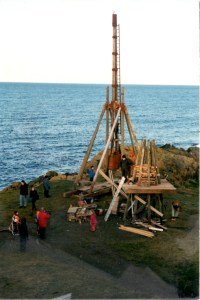
Trebuchet at Portsoy – Photo Judy Beasley

 CHRIS FREMANTLE
1 comment