What art have I seen? Rothko in Firenze
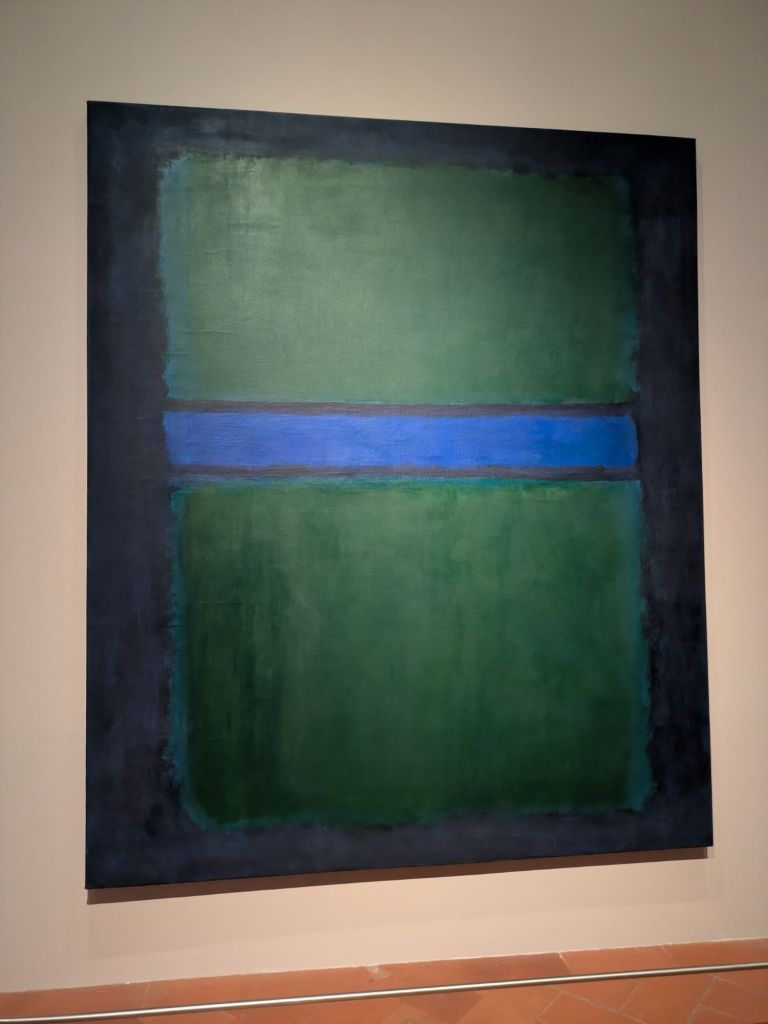

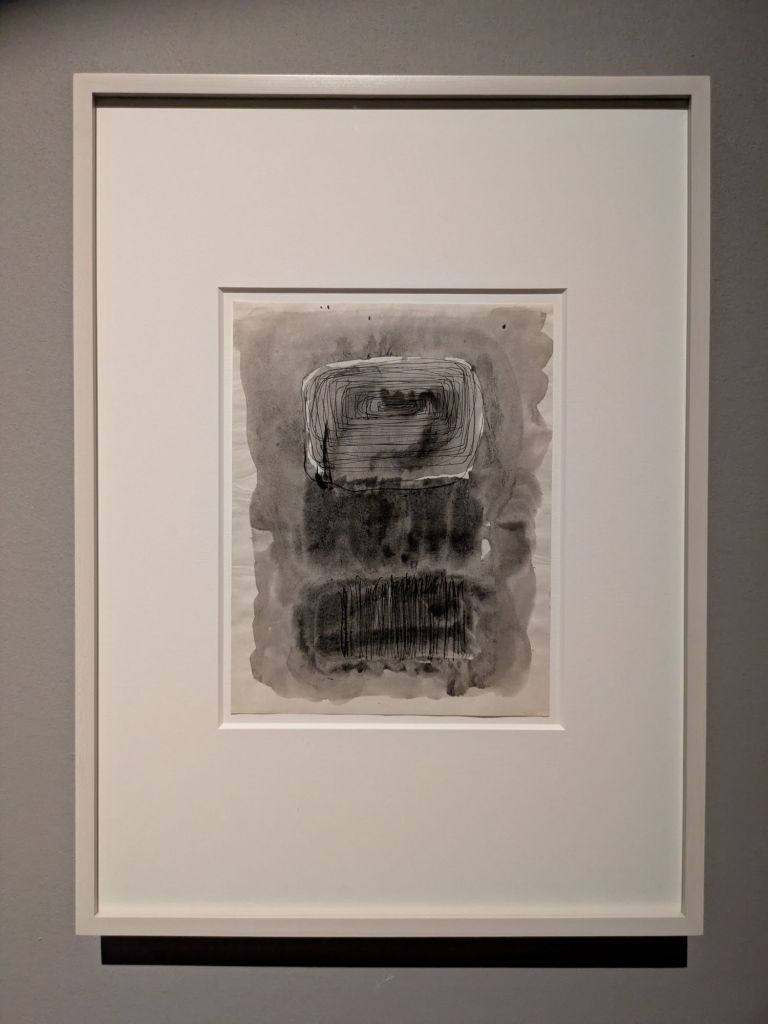
Photos are terrible – sorry – but they provide a slight reminder.
Fascinating to see early works and to understand that Rothko was largely self-taught. The journey from figurative works through surreal symbolism to what we recognise is striking.
Rothko and Albers within a few days of each other is also fascinating. Two such different artists.
If you take one of the definitions of an artist being something to do with deciding when something is finished, then in some ways these two couldn’t be more different. With Albers’ ‘Homage to the Square’ experiments, finished is not really to do with the expressive surface. There are surface decisions – brush or palette knife – and there are decisions which leave the weave of the canvas more or less visible. It is particularly clear from watching one of the films that the focus of decision making is on the colours and the sizes of the squares. With Rothko the ‘when is it finished?’ decision is clearly when the juxtapositions are ‘right’. In both there is intuitive judgement, but the resulting point of decision is different.
However both are concerned with the ways in which colour operates on us as humans. Albers’ was conducting one sort of experiment, which has a degree of reproducibility perhaps. Rothko was experimenting in a different way. However both are involved in experimenting in ways that artists do.
Anne Douglas and Nil Gulari have written about artists’ forms of experimentation as part of a project Anne and Kathleen Coessens led called Sounding Drawing. This brought together musicians and visual artists concerned with improvisation and its role in experimentation. When you combine experimentation with improvisation you exclude the idea that the experiment is to prove anything – there can’t be a hypothesis to be tested.
Douglas and Gulari quote Coessens saying “Artistic creativity and, by extension, artistic research focus the possibility of infinite variability within acts of representation and interpretation.” Both Rothko and Albers are clearly using variation, Albers more systematically, but both vigorously reject representation as a ‘purpose’.
Coessens goes on to say, “If research in general is to deal adequately with human society, it needs to embrace those aspects of knowledge production that deal with human subjectivity and relationships, not as phenomena to be deduced and re-harnessed within human control, but open-endedly, as part of a process of creative construction and interpretation that is relative, specific to context and value-driven” (Coessens et al., 2009).
Douglas and Gulari suggest in addition to representation and interpretation, an experiment can also be to create an encounter. Both Albers and Rothko understood their works in terms of encounter: that standing in front of the work, something happens – the surface becomes animated for the viewer in particular ways. Like going into a darkened room and waiting for your eyes to adjust, so with these works, your eyes adjust in the encounter.
Douglas and Gulari argue that Improvisation is a useful way to think about artists’ experiments.”Improvisation offers a way of engaging in forms of inquiry that are situated and contingent and that nonetheless seek new ways of understanding experience by transcending what is already known.” and they go on to point out that this form of seeking to go beyond what is already known is distinct from what happens in other forms of research, saying
“Innovation is expected in scientific experimentation by each new insight displacing what was previously known.” These experiments aren’t experiments that can be improved upon. They are Ali’s experiments which are rerun every time some spends time in front of the works. The experience is new each time.


leave a comment