What art have I seen? Father Country I Do Love You
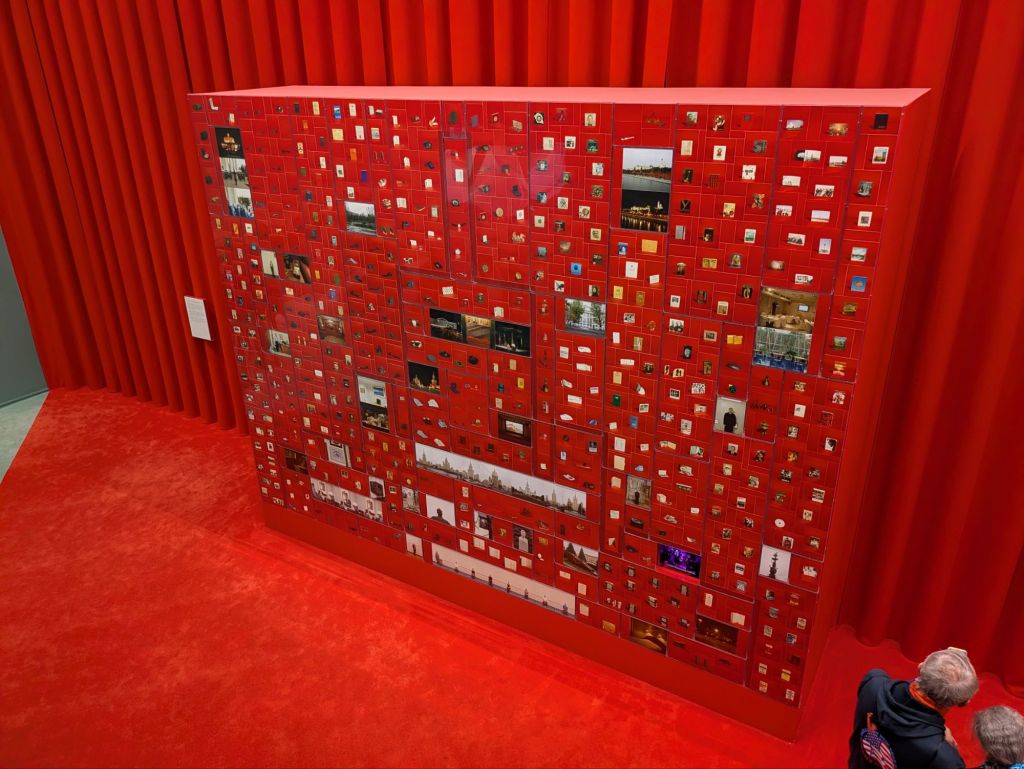
Taryn Simon at Guggenheim NYC.
I’ve been trying to make sense of this exhibition, reading reviews in The NYT (thank you Anne for gifting me them!), Hyperallergic, the Guardian.
The following quotes track the challenge:
From Sasha Weiss in the NYT 14 Sept, published before the exhibition opened:
“The project became huge and fractal: biography as butterfly effect. On one level it was the story of one man’s life; on another it was a wild alternative history of the American security state, and the thousands of people, institutions, animals and objects caught in its net.”
“…Simon, a photographer whose practice stands at the intersection of journalism and conceptual art…”
“Is this really our world, or a bizarre simulation of it? At the same time, there is a rigor and a precision to the images and their captions: They’re rooted sturdily in a set of facts.”
On the other hand we have Jason Farago also in the NYT this time on 29 October.
“This show has pictures of real strength and surprise, but they’re submerged in a mock-paranoid mapping of recent American history riddled with banalities, affectations, off-key jokes and literal toys. She cannot get out of her own way, and no one at the Guggenheim — which commissioned the work, and has now acquired it for its permanent collection — seems to have helped her.”
“You will have noticed the tone: connecting the dots, unmasking the truth. These photographs, the show wants us to believe, are not just images, but evidence — shot in the cool style of courtroom exhibits, or stock photography. These extended wall labels are not just texts, but disclosures…”
“In other words, Simon’s cloak of privacy over her agent is a MacGuffin of the most classic Hitchcockian vintage — a performance of protective anonymity, to invest each photograph with the frisson of a political thriller.”
and
“The supposed disclosures assign to the pictures an assumption of credibility that has been draining away from photography for well over a century, and that is now, with the arrival of computational imagery from artificial intelligence, very close to death. But if all the pictures here are true — corroborated through the extended texts — then we don’t have to ask if any one picture is good.”
These two – for and against – provide such a useful dialogue with each other. The first resulting from interviews and even dinner draws us into the orbit and intention of the artist, their approach and practice. The latter interrogates the work as it is experienced in the gallery, and also the framing provided by the museum – the article starts by highlighting all the aspects of scale
“For the New York-based artist Taryn Simon, the challenge of making a photography exhibition has regularly been expressed in metrics: this many years of research, this many miles traveled, this many images, this many texts….
Count how many photos: over 1,700, plus the videos and sculptures too. Clock how many years: almost 10.”
I think art needs to bring us into a different relationship with the world as we experience it. Walking through the exhibition I knew almost all the events that form the substrate of our reality as Americans over the past 70 year, all of my lifetime. Many I remembered vaguely when I encountered them. Each is told from the perspective of this one individual, but also from the perspective of one or more other people caught up in these dramas. The episodes are often told through bizarre collections – mini archives. But we revisit our lifetimes in ways that make what was News into human experience in all its complexity.
Farago seems to argue that Simon is using too many devices of faux objectivity but I’m not convinced that this isn’t properly problematising these stories that we have experienced as News items…
What it is doing has ethical dimensions which News organisations might bodyswerve. The Hyperallergic review focuses on the ethics, observing that no-one is held responsible – everything is a product of the system. But that isn’t the most complicated ethical aspect.
No review has mentioned the section of the exhibition involving the lived experience of one or more people who were subjects of child sexual abuse shared on social media – an aspect of the past decades that
The most problematic is interviewing the parents of the agent being tracked through these events – the parents both have Alzheimer’s. Whilst the Weiss interview makes much of Simon’s asking permission for interviews, it does seem beyond any conventional bounds…
Updated 1 Nov, 2 Nov


leave a comment