What art have I seen? Trembling Museum and Silent Archive

Two ambitious exhibitions which basically challenge territories and disciplines.
Trembling Museum at the Hunterian aiming to unsettled the ethnography collection of Glasgow University by bringing it under the glaze of Eduard Glissant and into relation with contemporary practices.
The most interesting thing was the idea of threadyness, that the emergence of jazz and blues and hip-hop are all grounded in partial memories of cultures in parts of Africa where people were transported from into slavery. Something really powerful about that cultural continuity, potential becoming something new but still also connected.
Silent Archive at Royal Botanic Gardens Edinburgh brought a number of artists into relation with aspects of archives, both of specimens and collections but also of for example endangered species. Works were grouped around issues, the palm cut down to enable the restoration of the Palm House, endangered species, species grown industrially and the industrial production processes.
Both exhibitions were perhaps not only across practices and disciplines, but maybe deep mapping, exploring power relations, ‘archives’ in the Foucault sense of “the fundamental formations that determine what is seeable and sayable as history.”
Interestingly both were problematic in their associated interpretation. Trembling Museum had a reading room, but the narratives of individual objects tended to fall back into their conventional disciplinary forms. So items from the ethnography collection were still accompanied by ethnographic texts.
So curious that having taken Glissant as a guide, none of his concepts, particularly opacity, were employed. At the object level everything reverted to clarity and specificity. As noted above some actual ‘interpretation’ or allusive storytelling was evident (thready connections), but the powerful metaphor of volcanic trembling didn’t result in the promised confusion of ethnography and contemporary art, let alone a confusion related to life, a full working out of blurring (Kaprow) as a form of opacity (Glissant). It was Gill, my otherr half, who pointed this out.
At RBGE Gill overheard a lot of frustration at the interpretation too, though in this case because it wasn’t adjacent to works – curatorial keeping space for the work meant hunting for the interpretation. That in turn was only lists of creator, title, date, material, lender. All text was accessible via QR codes. There is maybe more work to think through the digital physical relation.
What art have I seen? In the eddy of the stream
Cooking Sections and Sakiya’s exhibition at Inverleith House in the Royal Botanic Gardens Edinburgh is as good an example of putting the wellbeing of the web if life first – the challenge Helen Mayer Harrison (1927-2018) and Newton Harrison (1932-2022) set themeselves in the early 70s and which is now clearly the challenge for all of us.
Cooking Sections “is a practice that examines the systems that organise the world through food, and how food can be used to explore, trace and advance climate justice.” Sakiya “is an academy, a residency programme, a research hub, and a farm located in Ein Qiniya, a small agricultural village seven kilometres west of Ramallah, in Israeli-occupied Palestinian territory… By grafting local traditions of self-sufficiency onto contemporary art and ecological practices, Sakiya seeks to create new narratives around relationships to land, knowledge-production, and commoning.” (Sakiya are also working with Arts Catalyst and have a residency opportunity at the moment.)
Cooking Sections have been working in Scotland and in particular on the Isle of Skye for some years now – Emma Nicolson first worked with them on the Climavore project when she was the Director of Atlas, and she has curated this in her role of Head of Creative Programmes for the Royal Botanic Gardens Edinburgh. This enduring connection is significant.
The exhibition “…draws attention to the breakdown of ecosystems through the removal of plants and the ensuing long-term harm to people, communities, and other species.”
There is an important set of proposals around commoning which directly relate to Newton Harrison’s On the Deep Wealth of this Nation, Scotland. Where that work proposes understanding the soil, water, air and forests of Scotland as commons that we are dependent upon and asks for a ‘commons of mind’ to commit to putting back more than we take out, the proposals around commons in this exhibition include that the whole intertidal zone of Scotland should be established as a commons and that a Scottish Office for Commoning should be established. This proposal needs published as a full page pull out in the Highland Free Press or another widely distributed publication.
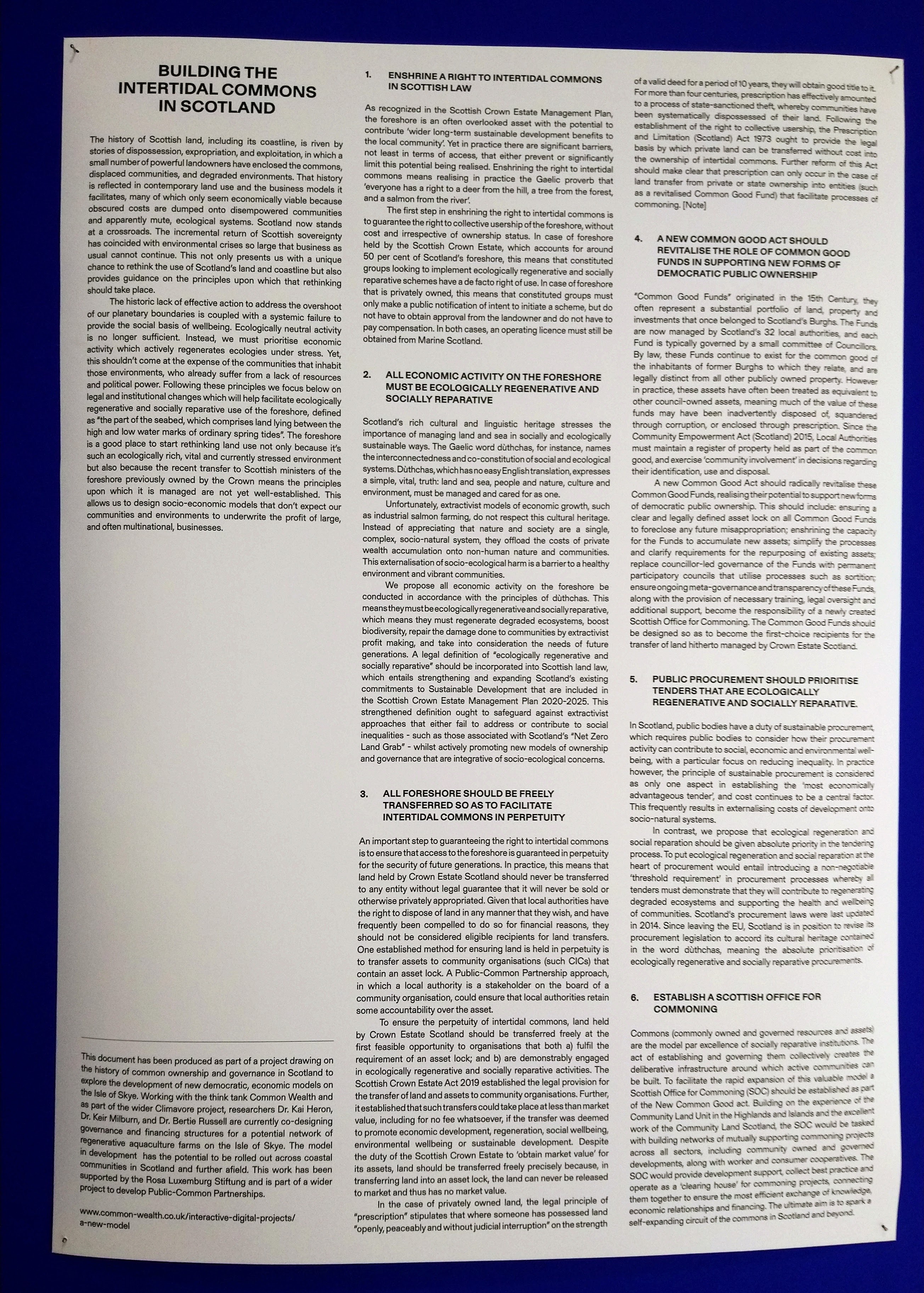
This forms one part of a series of installations focusing on salmon and forests, mussels and muscles, oysters and terrazzo. Each reveals an aspect of an ecology and a different way of imagining exchange and reuse rather than extraction. Some like the work on seaweeds and shellfish is being developed to a functional scale to offer alternatives to industrial fish farming which is destroying coastal waters in the Highlands.
Deborah Bird Rose talks about the two violences of colonialism – the violence to people and the violence to the environment. Sakiya’s installation focuses on the violence to the environment done by British colonial rule of Palestine even before the imposition of the state of Israel. The British colonial administration ruled that a large number of culturally significant plants were weeds to be exterminated. The main display is of botanical specimens of 33 plants, their cultural significance and their ecological role. Another remarkable creation in the exhibition is a carved wood frieze of these plants, reminiscent of a plaster cornice. Throughout Inverleith House we can hear singing. The installation in the final room echoes through the whole space, lamenting ecological and cultural loss.
In the eddy of the stream judiciously uses whimsical and suprising installations as well as scientific data (highlighting what we know as well as what we don’t know) and beautifully crafted elements – these works hold the challenging evidence of human ignorance of and violence to ecosystems in a way that draws us into careful attention through an experience that is rich and rewarding.


 CHRIS FREMANTLE
leave a comment