What art have I seen? Tomás Saraceno In Collaboration: Web(s) of Life
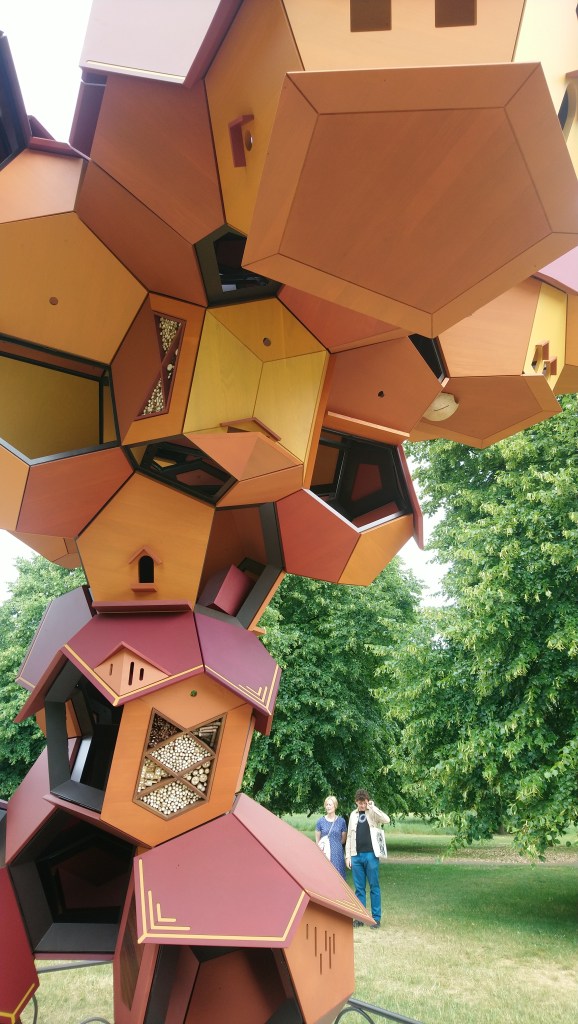
Three groups of work:
Cloud Cities: Species of Spaces and Other Pieces the outdoor sculpture above features homes for 23(?) species. This has a second indoor element including a play room for kids that adults can’t enter.
Indoors, a film installation about Extractivism and the green economy which is focused around the Manifesto for an Ecosocial Energy Transition from the People of the South (which will be read aloud to you if you hop on one of the stationary bikes outside and peddle).
And the other inside element is arachnophilia, an installation comprising various webs created in Berlin by spiders who live with and in the Saraceno studios. No spiders travelled to the UK, just vitrines of webs.
When I first saw the Cloud Cities I thought ‘here we go’ but by the end I was completely absorbed by the intelligence and aesthetic of this exhibition. It speaks to exchange and the importance of understanding the ecosystems of which we are part. My conclusion on the Cloud Cities is that they are like a circle in geometry, wholly different from any circle in real life. The Cloud Cities are like a 3d catalogue, a sort of habitat or IKEA display of all the forms of inhabitation we could include to enable a multi-species coexistence.
Also saw the Alchemy show at Thaddeus Ropac and the Sarah Sze installation The Waiting Room at Peckham Rye.
What art have I seen? Faith Ringgold
The activism sits alongside the storytelling. The humanity alongside the anger. The imagination, the stars of the lights on the bridge, the girl floating.
The consistently acknowledged involvement of family in the making of various of the works, particularly the influence of Faith Ringgold’s mother, must be pretty exceptional in contemporary art.
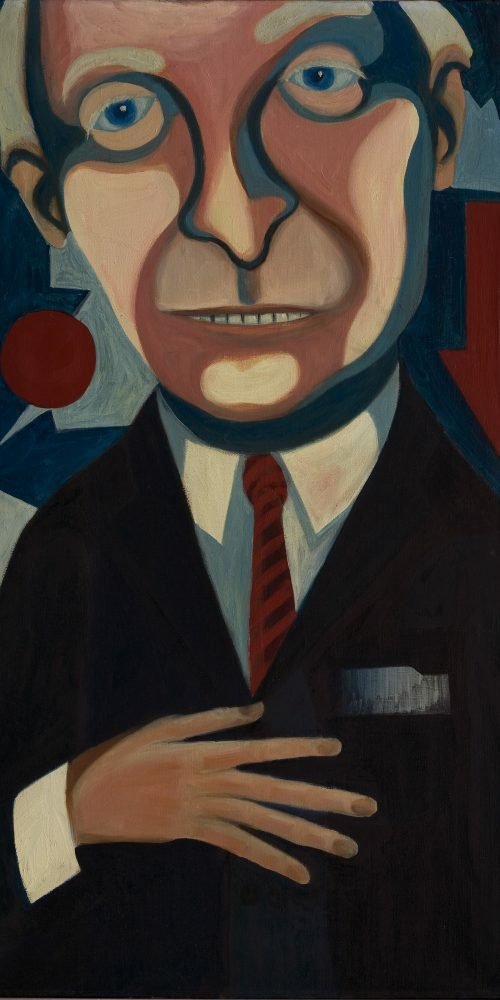
American People Series #6: Mr. Charlie, 1964 (from Faith Ringgold’s website)
What art have I seen? Mastaba by Christo & Jeanne-Claude
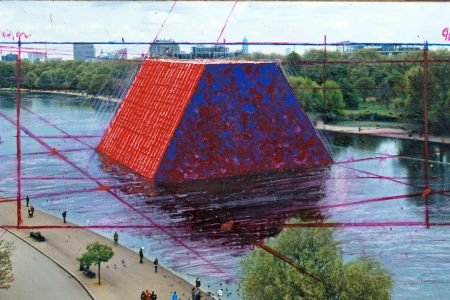
The Mastaba on the Serpentine, works related to barrels in the Gallery, other works at Stern Pissarro.
Curiously the Mastaba floating on the lake is more like the 2D works in the Gallery than you expect – it has an unreal quality, perhaps because of the formal geometry and the colour too. All the earlier proposals going back to the late 60s are yellow, red and orange, but this is maroon and purple. Maybe more complementary to the greenness of Hyde Park?
There is definitely a Dada streak in this, the absurdity of this large form, just as there is a Dadaism in wrapping things.
Mies van der Rohe said art addresses the conditions of the time – his were industrialisation and mass production. Christo and Jeanne Claude’s work has a curious relation both to industrial and post-industrialisation, but the temporariness – here now, gone in September – reveals more. Temporary abnormality sensitises us to the normal.
Christo clearly denies any political intent but this monumental structure composed of oil barrels is a reminder of our, as Brett Bloom calls it, petro-subjectivity.

 CHRIS FREMANTLE
leave a comment