What art have I seen? from Pushkin Museum
A Literary Landscape in Russian Art at the Robert Burns Birthplace Museum in Alloway. A selection of prints and drawings by students (who have done residencies at the Pushkin Museum perhaps a little like Hospitalfield?). Quality classical drawing and printmaking skills on display from early 20th Century to present day.
Energy Cities and Cultural Development

 Walk Among The Worlds by Maximo Gomez. Photo: Alain Sojourner http://alainsojourner.com/nuit-blanche-toronto-2014-walk-among-the-worlds/
We’ve never been to a conference on the cultural and creative industries at a University that didn’t have someone providing a theoretical critique of the subject. On 1st October Robert Gordon University and the City of Aberdeen co-hosted an event which drew on the experiences of other energy capitals to understand cultural and creative industries development. Pacem critique, this was a morning full of insight into the sorts of strategies, policies and actions that make a difference to cities and see the arts thrive as part of their communities. It benefited from specific experience of being a European Capital of Culture (something Aberdeen aspires to) and it was a good renewal of the process of building a culture and arts development agenda for Aberdeen.
The subtitle was ‘Global Energy Cities and Cultural Illumination’ but the real point is that…
View original post 1,922 more words
What art have I seen? Losq, Bechers and The Nakeds
Nemora at the Fine Art Society, Juliette Losq’ black and white ink and watercolour scenes of post apocalyptic greenworld overwhelming our cities. These paintings extend space through devices such as infiltrating a fireplace or surrounding a grandfather clock and also replacing its face. For all those attempts to question the frame and break out of the container (like the plantlife evoked in those overlooked and unplanned spaces behond retail parks) it was the framed work Scumsucker (2011) which resonated the most reminding me of the space in which John Wallace’s Cinema Sark was exhibited a year ago during the first Environmental Art Festival Scotland: the undercroft of the M6 as it crossed the river Sark defining the border between England and Scotland.
Bernd und Hilla Becher at Spruth Magers. I wonder who decided on the composition of the groups of 9 images in particular? Was it the Bechers? The groupings are very subtle.
The Nakeds at the Drawing Room. Ought to have been inspiring and provoking in the way their Abstract Drawing exhibition was. Perhaps the failure is exemplified by a success. One of the standout pieces is Fiona Banner’s block of red text on a page (a print from Arsewoman in Wonderland I think). The text is a verbal description of a woman in a porn film. The description creates a clear sense of the artist’s eye travelling over and exploring the image (presumably frozen on a screen). It’s deeply personal and distinctive. It’s in no way salacious – quite the opposite – it wouldn’t make it into a volume of erotica. But the rest was in danger of sameness failing to extend vigorously into enough different spaces of drawing the human body. The are too many pieces that feel like sketches off the studio floor – the two small pieces by Beuys feel like that, though the Warhol drawings are revealing. But there are none of Gormley’s drawings using his own semen or any Duchampian work made with naked bodies and paint. Egon Schiele is at the heart of the thinking, but in a way he dominates the aesthetic too much and the conception not enough. The aim of the exhibition, to explore the space between the nude and porn, is really interesting but the curation doesn’t really stretch it enough. Schiele obviously made work for distribution as porn, so did Turner. I wonder who else did as well?
Arts & Health: Economics and the dangers of Randomised Control Trials
Couple of really interesting presentations and discussions at the ESRC funded Arts, Health & Wellbeing Research Network meeting in London. Unfortunately this was the last event in the series, but I’m sure that a longer term programme will emerge, especially when it was noted that there have been some 200 participants of which approximately 50 have been Phd students.
The first interesting area was a presentation by David McDaid on health economics and how that field interacts with research and decision making. We know that decisions about healthcare are made on the basis of efficacy and cost, but McDaid unpacked some of the basics for us. He highlighted that when looking at the economics of any decision about healthcare we need to understand:
- the cost of inaction;
- the cost of action (and here he pointed out that understanding project or programme costs is very difficult and arts organisations can be quite opaque about their costs. Costs also need to include in-kind costs absorbed by partners.);
- The cost effectiveness of the action in comparison to other potential actions;
- levers for maximising value (ie how to maximise the money spent by working on uptake and participation).
In terms of the cost of inaction he highlighted three areas to consider:
- Cost of every visit to the GP (which in the figures he showed was about £45 per appointment);
- The higher cost of attending Accident and Emergency;
- The even higher cost of hospitalisation.
- In parallel with this are the informal care costs (ie how much is the family bearing factored at hours times the minimum wage), and the out of pocket costs for the individual for treatments or lost earnings.
Some really interesting challenges emerged in response to McDaid’s framing of the economics through the example of ‘arts on prescription vs. individual therapy sessions.’ Firstly, why these are presented as alternatives when in many cases they might be complimentary? Secondly why reduced contact is presumed to be good when there are circumstances where greater contact with healthcare workers is the good outcome. To which David responded, “These are all good points, but the model of decision-making in healthcare economics is simplistic.”
On the back of McDaid’s presentation were two evaluated project case studies, one using reading with people with chronic pain, and the other using arts on prescription for people with depression and anxiety. Both were really significant, but looking at them through the lens McDaid had provided, you’d note:
- the need to focus on efficiency of delivery, maximise participation, understand operational finances and share models;
- be prepared to scale up from projects to programmes.
The afternoon presentations focused on the perceived weaknesses of two Randomised Control Trials recently published. Without trying to rehearse the details, some interesting points emerged which suggest that using Randomised Control Trial (the gold standard for evidence in healthcare decision-making) to prove the value of arts interventions is not something to be undertaken lightly.
Arts interventions need to be understood as “complex interventions” as defined by the Medical Research Council and interestingly this means that any “complex intervention” should,
- Start with a theory;
- define which ingredient(s) essential;
- include process analysis.
In terms of theory, healthcare is looking for the ‘theory of change’ that the study is going to test, but that ‘theory of change’ requires the practitioners (not just the researchers) to be very clear about their practice, and to deliver that practice in a consistent way in relation to the theory. (This clearly links to the ongoing development of a qualification in participatory practice by the ArtWorks programme in Scotland, jointly funded by the Paul Hamlyn Foundation and Creative Scotland.)
Perhaps one of the characteristics of any theory of change in the arts is the fundamentally voluntary nature of participation in that change. It’s one of the problems pointed out with Randomised Control Trials – people get selected to participate in the arts randomly. This is slightly problematic, particularly when you’re asking someone to engage in creative activity or even singing.
The point about defining essential ingredients is important – process-based work is often about context, empowerment and empathy as well as specific activity, but it’s extremely difficult to study more than one factor.
Finally the process analysis is important, on one level because that might a way to balance the attempt to define the essential ingredient, but also because timing and pattern are important in experiential work, e.g. participants are often interviewed for the baseline and then interviewed at the end of the programme, precisely the point where they might be feeling a sense of loss of an activity that had been enjoyed. Even a Randomised Control Trial is subject to such factors: not only what questions are you asking, but when are you asking them.
There was reference made to another Randomised Control Trial focused on singing, to be published imminently, which was ‘successful.’ It will be interesting to understand how this was constructed. But going back to McDaid’s point, scale may be critical because at least one really good, well evaluated, project was unable to engage with the Clinical Commissioning process simply because it’s too small (and most arts & health organisations are small even in the cultural sector, let alone in relation to healthcare).
The understanding of “complex interventions” in the medical literature bears further scrutiny and some references were suggested including Marchal (2013) (and Yin (2009) on “systematic case theory”).
Theo Stickley started the morning by offering an imagined scenario around the trajectory from the materialist understanding of healthcare that characterised the 20th Century through a transition to an holistic understanding of healthcare that could characterise the 21st Century. Whilst it’s important that the practitioners delivering arts in healthcare are well trained and professional, that they can articulate clearly their theory of change, as well as the economics of their interventions, the belief that the Randomised Control Trial is the way to prove the value might genuinely jeopardise what makes the arts distinctive from other interventions. We must become more articulate about the characteristics and values of our artforms and forms of intervention to ensure that they have equal status with the economics and the criteria imposed by the methods of research.
Only one speaker said, “and the art produced in this project was good too. We were proud of it.”
Presentations can be found here.
The Scot who burned down the White House

 Burning of the White House by British forces, 1814
The Scots have had had a remarkable impact on American history. Less well-known is the Scot who burned down the White House and inadvertently helped inspire the American national anthem, a “mad, romantic, money-getting” Cochrane.
View original post 833 more words
What art have I seen? Louise Hopkins
Linlithgow Burgh Halls – great space and a nice chance to see a range of Hopkins’ reworking of everyday objects such as maps and fabrics.
Whose space is it anyway?

Maria McCavana and Bill Breckenridge, Waiting Room, CAMHS Gorbals, 2013. Photo Alan McAteer (with permission)
You can’t easily go and see the work that Maria McCavana and Bill Breckenridge did for the Child and Adolescent Mental Health Service (CAMHS) unit in the Gorbals. It’s not that we might not particularly want to visit a CAMHS unit. It’s not that it isn’t public space (of course it’s not a gallery, not that sort of public space). It’s real public space, public service space (NHS space) where people sit and wait whilst their children and young people attend sessions with clinical psychologists and therapists. You really can’t just wander in and have a look at the art.
This is a problem for arts and health projects. The public places in which they are often to be found aren’t public in the same way as a park or a street or even the atrium of a big hospital.
But these spaces matter. And it’s all the more important that as a professional community we are able to see what colleagues and peers are doing, hear how it works and learn from these projects.
Maria McCavana, artist, and Dr Lindsey MacLeod, Clinical Psychologist specialising in child and adolescent mental health, shared the process and results of the work in the CAMHS unit in the Gorbals and also previously at the Knightswood Centre (now demolished and therefore even less accessible). They talked about their interests and motivations as well as the lessons learnt.
This event was part of UZ Arts’ programme for the Fringe (for background on UZ see the end of the piece). Maria participated in UZ Arts’ residency programme in Sri Lanka this year, and UZ are interested in how the lessons can be transferred to artists in Sri Lanka for the benefit of the patients, families and carers. Creative Therapies, the Glasgow based art (in the broad sense) therapies organisation, provided organisational support and structure and the project was funded by the Yorkhill Children’s Foundation.
The brief for the project was focused on the users of the space, the clients, having an influence on the design of the space, actually to give them a sense of ownership. Lindsey said, “We asked young people to make their mark on the building.” The brief also asked that, “the space should be interesting, but not too interesting (ie not overwhelm the kids on the spectrum or over stimulate the children with ADHD).”
It was refreshing to hear the concerns from the perspective of the clinician:
That colleagues and teams are busy (and a project such as improving a waiting area is on top of an already full workload). Service delivery on a day to day basis is the priority.
That as a clinician, maybe more so in mental health services, you need to be very confident to entrust your patients/clients into the hands of someone outside the NHS.
That if it wasn’t some of the clinicians’ “cup of tea,” did that really matter? This led onto a really interesting discussion around evaluation.
Of course we assume that evaluation is important. But what exactly are we evaluating?
Is the space improved? Yes the space is improved, but it would have been improved with fresh paint, new carpets and new furniture. What did the ‘art’ do? Actually the art made it more specific, more interesting. The waiting room is now a nicer, more comfortable waiting room, but its also now an interesting waiting room rather than a generic one. It’s got funny bookshelves where each book fits into its own slot.

Maria McCavana and Bill Breckenridge, Waiting Room, CAMHS Gorbals, 2013. Photo Bill Breckenridge (with permission)
It’s got an amazing sculptural bush of individual letters sticking out in all directions (top image). The signage has been sorted out to reduce visual clutter.

Maria McCavana and Bill Breckenridge, Waiting Room, CAMHS Gorbals, 2013. Photo Bill Breckenridge (with permission)
But let’s be clear, you wouldn’t reproduce exactly this scheme in all the CAMHS waiting rooms across Glasgow. It’s not designed to be literally reproducible. It’s designed to be distinctive. The approach used is definitely reproducible.
Who benefits and how? The brief was drawn up through consultation with staff and users. McCavana and Breckenridge proposed a residency-based approach working with nominated patients/clients of this CAMHS unit. They did a series of workshops over an extended period. McCavana and Breckenridge designed the workshop process and all the activities, and there is a clear development from the workshops to the installed project. If I’d been involved in the workshops, I’d recognise my contribution in the space.
Like many artists interested in participatory and co-creative work, McCavana is articulate about the need to change power relations, to give voice to those who don’t normally have a voice. We’re not talking about art therapy – that’s something different. Grant Kester, one of the key writers on participation and collaboration says,
“In the most successful collaborative projects we encounter instead a pragmatic openness to site and situation, a willingness to engage with specific cultures and communities in a creative and improvisational manner … , a concern with non-hierarchical and participatory processes, and a critical and self-reflexive relationship to practice itself. Another important component is the desire to cultivate and enhance forms of solidarity… .” (The One and The Many: Contemporary Collaborative Art in a Global Context, Duke University Press, 2011, p125)
The discussion following the presentation raised some other issues, including the important role of the ‘host’ in doing this sort of residency based work. This is something that the Artist Placement Group highlighted in the late 60s but continues to be an issue. If an artist is going to work in a context, especially one where there is an existing community, it is essential that someone in that community acts as a host, doing those things a host does. This includes doing the introductions but also discretely making sure that the artist doesn’t step on toes. It means making sure that the artist is included in community activities where appropriate, but also protecting the artist from internal niggles and ongoing wrangles. A member of the audience pointed out that when this works well the host becomes a co-creator of the process.
The other subject that was raised from the floor focused on the extent to which these sorts of projects involving artists in healthcare buildings are actually patching up bad architecture. There was some feeling in the room that this was the case. Of course the specific projects that had been presented were work done in older buildings, but…
What is distinctive is the participatory and co-creative process that artists are using. Although some of the younger architecture practices also do this, the larger more established ones, particularly doing public sector work, are not. Nor would it be easy for them to, given that they are embedded in the supply chain, usually employed by the main contractor, not even the client.
What is also distinctive is the blurring of art, design and architecture. This project could have been done by a young design or interior architecture studio. It’s not the art specifically that makes this distinctive, rather it’s the turn to participation and co-creativity.
There were other good points made from the floor which I haven’t covered here, but the overriding one is that we need more presentations like this, and more time for the ensuing discussions.
==
UZ Arts is an international arts charity based in Glasgow. We create our own work and collaborate with artists and producers who wish to work across art forms and across borders creating work outside conventional arts venues – often in public space.
We commission artists and support the development of their work through residencies, hothouses and collaborating as their producers or co-producers. In the last 3 years we have commissioned over 60 artists in 8 countries but with more than 50% of the work being made in Scotland.
Much of the work we make or support is sited . That is to say site specific – made for a particular place or site located – made for a particular type of location.
Some of the artists we work with engage with the public either as a source of inspiration or as collaborators in the delivery of their work
What art have I seen? Jupiter Artland

http://www.jupiterartland.org/_assets/media/media/-108.jpg
Jupiter Artland – very much appreciated Jessica Harrison’s gruesome reworkings of found ceramic
mantlepiece ornaments using epoxy and nail varnish. You walk into the upper exhibition space and see what you take to be a suite of traditional ceramic figurines and it takes a moment to realise that they have been Tarantinoed. Someone else referenced the Chapman Bros.
What art have I seen? Matisse and Information
Matisse Drawing with Scissors, the complete lithographic series from Verve magazine, and also the Information show that forms part of Generation. Both at Paisley Museum and Art Gallery. Didn’t get to the Tate for the Matisse show – is this a substitute?
The historical part of Information is revealing and the documentation is interesting. The best of the new crop is the piece with the coat check tickets.
What art have I seen? Mark Neville
There is a sequence of film in black and white with no sound where we simply, through the use of a camera mounted on the side of a vehicle moving through a settlement, see what the soldiers see – kids making finger guns to shoot at them, a woman smiling, men studiously ignoring the passing vehicle. We see lots and lots of stands selling vegetables (even in b&w the eggplants stand out shiny and dark). Some people are caught really close up as they pull their scooters over to let the vehicles pass. The normality of the scene is constantly challenged by the shadow of the 50 cal machine gun mounted on the top of the vehicle tracking over everything.
The artist and photographer Mark Neville spent time in Helmand Province, Afghanistan, with 16 Air Assault Brigade in a project organised by firstsite in Colchester and the Imperial War Museum. This exhibition at the Imperial War Museum comprises large format photographs and films he made whilst there.
Mark uses a very high speed film camera, usually used for documenting science experiments, which means that even from a moving vehicle the image is really clear.
The still photographs also exhibited involved taking a large format camera and flash unit normally used in fashion shoots out on patrol (I can’t quite imagine how this worked, but I believe it knowing Mark’s commitment to his process). Kids, a man slaughtering a goat, nothing that looks like a patrol in a war zone (a soldier carrying a case of Irn bru) except what you see in peoples’ eyes – suspicion and uncertainty.
What art have I seen? Carl Andre

Dan Flavin Institute. Photo Chris Fremantle
Currently at the Dan Flavin Institute in Bridgehampton you can see an exhibition of cards and letters that Carl Andre sent to Sol LeWitt (press release here).
It’s pretty clear that they must have shared a sense of humour as well as an aesthetic.
There is on sequence of instructions for painting landscape (a card divided into a grid of six boxes -three by two – in each box is the name of one colour paired with the names of one of six other colours. Down the side of the card is written the word foliage). Following the instructions should lead to works which might remind you of works by Joseph Albers.
There’s another set of 16 cards each, in sequence, with three lines of the biography of Spinoza pasted onto them.
There’s a set with different materials’ polar curves (something to do with algebra), again cut out of a University textbook. 
This pretty much demonstrates a number of LeWitt’s Sentences on Conceptual Art such as “Irrational thoughts should be followed absolutely and logically.” Sorry not to be here for part 2 in the winter featuring Andre’s poetry.
What art have I seen? Robert Motherwell
Robert Motherwell the East Hampton Years 1944-1952 at the Guild Hall in Easthampton.
Selection of works starting at the point when Motherwell was still caught between Surrealism and Cubism. Some of the works are truly beautiful, and in places you catch glimpses of realism – a shadow under a shelf – you’re not sure if its you’re imagination. Sad they razed his house in 1985 (bad decade).
What art have I seen? New Parrish
The new Parrish Art Museum just outside Southampton, designed by Herzog and de Meuron (of Tate Modern fame), is at once a challenging and also quite subtle piece of architecture. It aspires to sit in the landscape like the epitome of an agricultural building: larger maybe, more overtly using the materials of agricultural architecture such as sterling board and exposed concrete. It’s very different from the quiet neoclassicism of the old Parrish. Sitting on a basically rectangular plot next to Route 27, the relationship to landscape dodges the otherwise generic retail architecture that prevails along every highway in the US. On the other hand the relationship of the car parks, oak trees and swales at the back of the building is good, and the quality of wildflower meadow also successfully differentiates this space from commercial, municipal and domestic lawns. Fritz Haeg and the Harrisons would be pleased to see this, and perhaps it will slowly change the wider landscape.
Inside the overhanging roof creates a quality of light recogniseable from the best architecture in places with such strong summer sun.
The spaces suit Maya Lin and Denis Oppenheim, both with works installed this summer. Maya Lin’s explorations of aspects of landscape at different scales are compelling, whilst Oppenheim’s proposals for splash buildings are fun and funky, but keep your attention.
The building doesn’t seem to serve traditional painting quite so well. It is perhaps too austere for William Merritt Chase’s works on show.
It’s quite an achievement for a small town (albeit with access to considerable wealth) to have produced a space which will be considered alongside the best small art museums in the world. But with great wealth comes great responsibility and it would be interesting to hear how this institution engages with all those who are excluded. It looks like it might have good environmental credentials, but it needs good social ones beyond the conventional work with schools – where’s the residency with the hispanic migrant working community that services the domestic and gardening needs of the Hamptons, or works with isolated older people in the winter?
Arts and Health discussions in August
There are two opportunities in Edinburgh in August to hear artists talking about working in healthcare (I’m going to be moderating the second of them). Both will touch on mental health contexts, but the second event will particularly focus on them.
Art and the Healing Environment
Sunday August 17th 1.30 – 2.30. Princes Room, Bonhams. Free entry.
The session will be Chaired by Dr. Donnie Ross, an ex-hospital consultant and medical director, and ex-chairman of Grampian Hospitals Art Trust, who also describes himself as a shed-builder, writer and artist – and who writes:
‘….the NHS is about healing but the elements of wholeness, compassion and creativity have been squeezed out by technology, rationality and hard economics …… there should be an intellectual and emotional dimension to hospital art projects which extends beyond the acknowledged essential and valuable putting of nice pictures on walls ….. to give the movement longevity & durability in the face of changing political and economic circumstances.’
Speakers:
Jan-Bert van den Berg – Director of Artlink, Edinburgh
Trevor Jones – Director of Art in Healthcare
Alexander Hamilton – Lead commissioned artist for Dignified Spaces at th New South Glasgow Hospitals
Robin Williams – Gallery manager at Edinburgh’s The Gallery on the Corner
Ian Rawnsley – Artist and exhibitor in this year’s show
and
Artist as Healer: The relationship between art and the health service
Summerhall Festival 2014
21st August 18.00
Free
How can art contribute to our health? What part can it play in the clinical process? What are the issues for artists and producers working in healthcare contexts?
Join Artist Maria McCavana, Producer Chris Fremantle and Dr Lindsey MacLeod, Consultant Clinical Psychologist specialising in Child and Adolescent Mental Health, as they discuss the role that artists can play in the creation of modern healthcare environments and the impact these can have on the patients that use them.
—
I’d also recommend the other UZArts discussion which will focus on Human Rights,
Artist as Activist: The relationship between art and social change
Summerhall Festival 2014
22nd August 2014 18.00
Free
UZ Arts Director and Director of Sura Medura Artist Residency centre, Neil Butler in conversation with Sri Lankan artist and human rights activist Chandraqupta Thenuwara about his life and work. A leading peace activist before, during and after the Sri Lankan civil war, Thenu worked with Neil Butler on the 2007 concert ‘Sing for Peace’, which brought together prominent Tamil, Sinhalese, Burgher and Muslim singers to share the same stage. Thenu has continued his work as a human rights activist in post-war Sri Lanka, maintaining a constant critique of the Sri Lankan war and its aftermath. Thenu will be visiting the UK as UZ Arts Artist in Residence in Glasgow, living and working in the city throughout August and September
What art have I seen? Last To Win
Went to Laboratorio on West Nile Street for coffee and art. So appropriate for the Commonwealth, Last To Win brings some memorabilia from Italy to Scotland relevant to this specific moment. Apparently in the late forties the Italians had a special black jersey for the rider who came last in each stage of the national cycle race. Just to further explore the good humoured stereotype I can imagine that Chris Biddlecombe must have spent quite a long evening drinking grappa in the bar in Genoa where these treasures normally reside. I can see the owner behind the bar grizzled and smiling, wide as he is tall, telling Chris about the various objects on the walls, and then slowly being charmed into the into the idea of lending them to Scotland as a reminder of trans European connections and the joy of losing.
Historical example of an artist in residence in a medical school
Beth Carruthers kindly highlighted this fascinating report by Pam Hall on her residency in the Faculty of Medicine at Memorial University of Newfoundland and Labrador in 1997-99. It’s interesting reading and in key respects still very relevant.
What art have I seen? Radical Geommetry
Radical Geommetry at the Royal Academy is pretty quiet on a Saturday afternoon. I came because I’m interested in Carlos Cruz-Diez and his use of colour and optical effects (but the largest piece is in a room where you can’t stand back far enough to appreciate it). Anyway the reviews have tended to be concerned in whether South American abstraction was derivative or an interesting thing in itself. If this is derivative then what becomes of Jim Lambie when you are looking at Otero’s Colourhythm 38 of 1958?
But that might be unfair because Soto’s maquette for a mural (1952-53) probably became something like the piece of cast concrete public art outside Charing Cross Station in Glasgow – very dated. Could and should that sort of work be revitalised in the way Alex Frost has with mosaic (another 70s public art classic)? Yet the concerns of these artists (abstraction, interaction) remain relevant today, the aesthetic largely retains its power and South America has gone on contributing to ideas of what art can be (eg Ala Plastica, Grupo Etcetera).
Turf
2014 Turf tagging – Programs – Slought
2013 Turf Twinning | firstsite
2010-12 Calendar Variations – On The Edge Research
1994 Endangered Meadows of Europe :: Helen Mayer Harrison and Newton Harrison
1988-89 Sod Swap – David Nash
1971 Calendar – Allan Kaprow
1969 Grass Piece/No Grass Piece – Lee Lozano
1503 Great Piece of Turf – Albrecht Dürer
What art have I seen? Various in Edinburgh
Scottish National Portrait Gallery including the John Byrne portraits and then the Scottish National Gallery of Modern Art for more of Generation. Didn’t see all of it but Charles Avery’s drawings, Graham Fagen’s student flat as set, Lucy McKenzie, and of course Douglas Gordon’s 24 Hour Psycho, all reward attention.
What art have I seen? Katie Paterson
Katie Paterson at the Ingleby Gallery – I saw the Fossil Necklace at the Wellcome earlier this year. I was interested and happy to see more provocative work particularly in relation to time and movement through space.
Beautiful aphoristic/absurd statements cast in silver on the walls seem to be ideas of which no other form can exist.
The History of Darkness was also stunning when held up to the window with the Edinburgh skyline behind – Edinburgh seen through the black of deep space many light years in the distance/past.
And all the letters death notifying the death of stars posted to somebody in west London over a year – affecting and conceptual art.
What art have I seen? Alison Watt
Alison Watt at Perth Museum and Art Gallery. The two rooms contain works from art school (Glasgow in the 80s) to 2014. The most recent piece has an almost photographic tonality and gloss to it. The interpretation is good, drawing out the renaissance (Titian), neoclassical (Ingres) and modern (Fontana) reference points.
Tom Boland’s 2014 West Highland Way Race Report
We had the privilege of being base camp for Tom Boland and his support team as he did his 5th ultramarathon – running the West Highland Way – if you’re interested he’s written about it,
“Let me embrace thee, sour adversity, for wise men say it is the wisest course.” – William Shakespeare
22h29m, 47th Place
“Why?”
It’s a question that most people inevitably ask when they find out that I run Ultras.
Continue reading here, 2014 West Highland Way Race Report.
What art have I seen? Jim Lambie
Jim Lambie’s exhibition at the Fruitmarket, part of Generation, includes classic work Zobop (the floor) and Shaved Ice (the mirror ladders). I think I recognised both Rainbow Rising and Deep Purple in Rock in Stakka (the albums gaffer taped together with the images taped out leaving only the background colours visible). By chance I saw Zobop in Transmission in 1999. It’s still a great piece of work, drawing attention to the smallest details in the space in which it’s installed. It’s definitely sculpture, but it could be painting too.

What art have I seen? Jimmie Durham
An older man with shoulder length grey hair wearing a bad suit sits behind a battered office desk. Someone appears from off screen left and puts a watch on the desk in front of him. The man picks up the stone on the desk and hits the watch repeatedly until it breaks. At one point he shifts his grip from one handed to two handed enabling him to hit the watch more accurately. When the mangled watch eventually spins off the desk he reaches down, opens the drawer of the desk and pulls out a stamp pad and date stamp. He then pulls out a pad of paper. He date stamps the paper, pulls a pen out of his pocket, signs the paper and hands it to the person who put the watch on the table in the first place. They have been standing looking into the corner of the room (as if instructed so that their photo can be taken by a security system. They didn’t watch their watch being destroyed). They leave. Meanwhile the man behind the desk rapidly puts the pen back in his pocket and the stamp pad and date stamp away in the drawer. He assumes his former position. Another person steps forward, this time with a dust buster. It’s hard to break a dustbuster with a stone, but the procedure is repeated. The dustbuster is beaten with the stone until it spins of the desk. The stamped and signed paper is handed over. Slowly the area surrounding the official becomes littered with the remains of things brought to him for processing.
Jimmie Durham’s Traces and Shiny Evidence, currently at the Parasol Unit, is one of the most powerful groups of work you’re likely to see. The video work described above is entitled Smashing and was made in 2004.
The whole ground floor is an installation that, for me, answers the question, what would be the form of a contemporary ‘political garden’? Gardening can be a political act. It has been in the case of other artists such as Ian Hamilton Finlay, and was for some in the pre-American and French revolutionary period. This garden (albeit actually an installation in a gallery with no living things included) takes its cue, according to Durham, from an observation by the writer and philosopher Walter Benjamin, “that the rainbow colours in a thin film of oil on a puddle of rainwater are the best sign of modern times.”
Plastic pipes in bright colours span the room connecting oil barrels which have been gone through a ‘respray’ process with that particular sort of paint used on cars modified by boy racers that changes colour depending on where you are standing. Thick puddles of automotive paint spill out of the barrels and puddle on the ground. Other parts of cars (bonnets from Renaults, boot lids from Audis) lie scattered around. Skeletons of animals and birds are trapped in the spilt paint, or lie in corners having been repainted in rainbow colours.
You could accuse Jimmie Durham of being didactic. You’d be hard pressed to interpret these works as anything other than an indictment of our fossil fuel and consumer culture.
The third work that makes up the exhibition is much more ephemeral and strangely beautiful. Large sheets of white paper cover the upper gallery walls. They are loosely patterned with charcoal ‘drawings.’ These have an extraordinary three dimensionality and character. You can make out everything from small mice to large bears, all curiously beautiful and at once precise. If you watch the ‘film of the show’ in the foyer, you realise these have been made by taking children’s soft toys, shaking them in a bag of charcoal dust, and them throwing them at the paper. In the context of the other works, these shadows take on a resonance with the shadows left on walls after the atomic bomb dropped on Hiroshima.
London LASER reflections
The two other speakers at the London LASER took us on a tour of the edge of two different human experiences.
Los Ferronautas, who are currently working with Arts Catalyst, took us on a journey of exploration of the railroads of Mexico, largely abandoned post the neoliberal-driven privatisation in the mid 90s. An extensive passenger network now lies in ruins because it was not ‘financially viable’. It only provided a means for Mexicans to get around their large and mountainous country. Somehow you know that the automotive industry had something to do with this. Los Ferronautas built a hybrid vehicle (SEFT1), an “abandoned railway exploration probe” that could travel on road and rail, and used this to explore what remains of the network. They found that it also acted as a “transmitter of stories.” In parallel they explored the visual representation of the network including early 20th Century paintings celebrating the engineering (initially exported from Britain and Ireland).
Cristina Miranda de Almeida took us on a journey around our increasing hybridity as the internet of things emerges. She explored the emerging interval space between ‘here and there’, ‘you and me’, the past, present and future, different scales and durations. She started with the beautiful analogy of data emerging from under water (behind a screen) to become part of our everyday lives, quoting Manuel Castells saying that soon computing will be paint on the walls.
For me the real moment of joy was when she show an image of a CAD rendering of a building entitled ‘spam architecture.’ As I’m sure we all have, I’ve notices the ‘flows’ of subject lines in my spam folder and wondered what could be done by exploring the patterns that lie in amongst this waste material. The way Alex Dragulescu has worked with this aspect of ‘big data,’ turning it into a proposal for architecture, put a big smile on my face.
We also had a good, if too short, discussion on multi-, inter- and trans-disciplinarity which I found really helpful in pushing my thinking further, so thanks to those who asked really good questions. My presentation is below. Thanks again to Heather Barnett for putting the programme together and continuing to make the London LASERs well worth the trip.
What art have I seen?
Causeway might have been about events from 100 years ago, but it spoke to political activism today, and connected back to Robert Burns’ own politics (remember the unsubstantiated story that Burns might have been involved in gun running to the French Revolutionaries?). The conversations could have been happening amongst any group of serious activists, such as on the Rainbow Warrior or amongst WTO or G8 protestors.
Activists will eventually come up against the questions the Suffragettes were facing in 1914 when, 10 years after the formation of the Women’s Social and Political Union, and forty years after the first Suffrage organisation in Britain, nothing was changing. Politicians were prevaricating. Activists were being told to go home and mind the children.
Frances Parker, Lord Kitchener’s niece) and Ethel Moorhead (an established artist) had already burnt down a stand at Ayr Racecourse. They had broken windows, trashed police cells and had both been in prison and had both been force fed. They were ‘turbulent’.
Victoria Bianchini and David Overend (writer and director/producer respectively) and Pamela Reid, Annaliese Broughton and Jamie McGeechan (aka Little Fire) (the performers), drew out the commitment through the reimagined experience of cycling 38.9 miles from Glasgow to Alloway, through the arguments about what can make a difference, what is legitimate protest, how to achieve social change.
The personal relationship between Parker and Moorhead was evoked beautifully. It was sharply drawn through Moorhead’s guilt at leaving Parker in the hands of the nightwatchman when they were caught with the bombs at the Cottage. Parker was put in Perth Prison and particularly brutally force fed when she went on hunger strike. Moorhead’s trauma on seeing Parker’s bruised and battered body when they were reunited was powerful stuff, as was Parker’s statement to the Court.
Parker and Moorhead wanted equality (as did Robert Burns in his time). It is The Establishment that’s the enemy, as it was 250 years ago when Burns wrote ‘A Man’s A Man For All That’, as it was 100 years ago for the Suffragettes, and as it is now for Occupy. And Burns Cottage (not the man himself) was a symbol of The Establishment, of The Club that privileged men.
Vote ZA! Another Slovenian perspective

A guest post by Donald Urquhart
In May 1991 I was painting in my studio in Glasgow when there was a knock at the door. It was Andrew Nairn of the Third Eye Centre (later the CCA) with an invitation to an opportunity he was the UK selector for. Would I go to Yugoslavia in October for four weeks to join a colony of international artists making art on the Adriatic, all expenses paid?
Not the toughest decision to make, so before long I was put in contact with the organiser, Matjaz Gruden. I found out the area I was going to was the northwest bit of Yugoslavia called Slovenia. I fully admit to having had only a basic knowledge of Yugoslavia at the time; Tito, Dynamo Zagreb, and that was about it.
In a bit of basic research I found out a wee bit more about Slovenia, through which…
View original post 1,247 more words
MerzBarn

The Chicken Shed near MerzBarn on the Cylinders Estate near Elterwater in the Lake District (Photo Chris Fremantle)
When you visit the MerzBarn at Elterwater, now being cared for and developed by the Littoral Trust, you realise that Kurt Schwitters may have “ended up in Langdale like a piece of flotsam on the currents of a world war,” but it is a remarkable place and his presence is distinctive. Schwitters is also somewhat of a Trojan Horse. Living as an artist refugee he painted landscape scenes and portraits whilst simultaneously working on a new Merzbau (Schwitters called these works Merzbau which translates as ‘Merz buildings’. He called this work specifically MerzBarn. Merz is a word Schwitters found in the process of making a collage in 1919). On the one hand he conformed to a Lake District stereotype, and on the other he steered the direction of 20th Century Art.
You can see there are some serious tensions embodied in this landscape. It was necessary in the mid 60s, and probably in the terms of the time correct, to remove one whole wall of the Barn and take it into a museum to be preserved. Thus the ‘art’ bit of the Merzbarn is now in the Hatton Gallery in Newcastle. The analogy might be the Elgin Marbles: something conceived of as a ‘whole’ (art and architecture) that has been separated. Art, sometimes the legacy of great cultures, is political, but is often managed by people who are unwilling to acknowledge the political dimension as ‘present’ rather than historical.
So outside the MerzBarn each year Littoral organises an event where the names of all the artists included by the Nazi Party as Entartete Kunst Degenerate Art (including Schwitters and more than 100 others) are read out and then written in chalk on the wall of the MerzBarn. This symbolic act might seem curious standing outside a tiny barn on an estate in Cumbria, rather than perhaps in a square in Berlin or at the Museum of Modern Art in New York, but the symbolism of the last place a refugee artist worked is rich and powerful (and draws other artists to work there now).
The avoidance of politics in art were replayed in the Schwitters in Britain exhibition at the Tate last year where it was clear that the curators focused on the paintings with only nods to the other media such as the sound poetry and the Merzbau. The curators of the contemporaneous Duchamp exhibition The Bride and the Batchelors at the Barbican succeeded in creating a space for works across multiple media including dance and performance, sound, set design and visual art. The curators at the Tate chose a different trajectory, offering what was really a conventional exhibition of paintings with some contemporary art tacked on the end (not that Provost and Chodzko’s contributions were negligible). But the positioning of contemporary art in the exhibition inevitably pushed the works by Schwitters into the past in a way that the construction of a multi-media environment at the Barbican brought Duchamp, Cage, Cunningham, Johns and Rauchenberg into the present. A different trajectory was created by the reconstruction of the MerzBarn in the courtyard of the Royal Academy in London as part of the Modern British Sculpture show.
The Langdale landscape is in a constant state of flux: a dialogue between human and non-human agencies. It was the non-human agencies that necessitated the removal of the ‘art’. But the way the Littoral Trust is imagining the site conceives of the MerzBarn (the original barn with the missing wall reinstated) in a state of flux. The circumstances at Elterwater are open to that process of change, where the part of the work in the care of the Hatton is ‘preserved’. The Littoral Trust brings its 30+ years of knowledge and work as a social and political art organisation to the development of the MerzBarn. In addition to events to honour the memory of artists called ‘degenerate’ by the Nazi Party, there is an art making and outdoor education programme for children and young people – and of course Schwitters’ Merz works, his use of found waste materials, and his ‘painting with nails’ approach are a Trojan Horse in the context of conventional primary school art.
As the Armitt Museum (which has its own collection of Schwitters’ works from his time in the Lake District) website says in describing the first Merzbau, “It was unfinished because it was unfinishable; it was environmental and engulfing in scope, but its significance was that it marked the birth of installation or conceptual art that we see today.” In the capable hands of the Littoral Trust the state of unfinishedness is an asset and an opportunity.
What art have I seen?
SxSW (Christine Borland, Dalziel+Scullion, Graham Fagen) at the Maclaurin Galleries in Ayr – another part of the show I saw at Gracefield. Also saw the small sculpture show drawn from the collection with some lent works.
Suffragettes and Burns Cottage
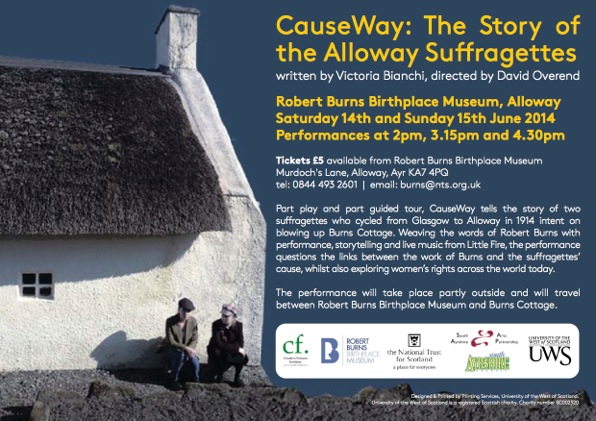
I don’t know how many of you are aware that Lord Kitchener’s niece was a Suffragette and that she and another Scottish Suffragette cycled down to Alloway and attempted to blow up Burns Cottage in 1914? David Overend and Victoria Bianchini have developed a new promenade performance work which you can experience in Alloway on Saturday 14th and Sunday 15th June 2014. You can get tickets from the Robert Burns Birthplace Museum.
London LASER 04 programme announced

London LASER 04
Tuesday 17 June 2014
6.30 – 9.00pm (registration from 6pm)
University of Westminster, Fyvie Hall, 309 Regent Street, London W1B 2UW
The fourth London LASER for 2014 hosts Rob La Frenais in conversation with Los Ferronautas, Cristina Miranda de Almeida on the Internet of Things, and Chris Freemantle on art and science collaborations in medicine and ecology.
The event is free but booking is essential: londonlaser04.eventbrite.co.uk
Los Ferronautas (Ivan Puig and Andres Padilla Domene) will be in discussion with Rob La Frenais, curator, about their project SEFT-1 Abandoned Railways Exploration Probe: Modern Ruins 1:220. Between 2006 and 2011, the artists travelled across Mexico and Ecuador in the SEFT-1 (Sonda de Exploración Ferroviaria Tripulada or Manned Railway Exploration Probe) exploring Mexico’s abandoned railways: http://www.seft1.com. This iconic railway infrastructure now lies in ruins, much of it abandoned due to the privatisation of the railway system in 1995, when many…
View original post 409 more words
What art have I seen?
Christine Borland, Dalziel+Scullion and Graham Fagen at Gracefield Arts Centre in Dumfries.
What art have I seen?
‘Life & Invitation& Vapour in Debri&’ at The Modern Institute.
What art have I seen?
The Arrival of Spring new works by David Hockney at Annely Juda. The charcoal drawings are masterpieces, where the ipad drawings are interesting, striking, etc.
What art have I seen?

Rosnes Benches, Dalziel + Scullion, 2014, Otter Pool, Dumfries and Galloway (Photo: Chris Fremantle)
Rosnes Benches. Took Jana Weldon, Senior Public Art Project Manager for Scottsdale in Arizona, to see some of Dalziel + Scullion‘s Rosnes Benches in Dumfries and Galloway yesterday. She also came in a heard presentations from the MFA Art Space and Nature at Edinburgh College of Art earlier in the week.
The team including Dalziel + Scullion, Kenny Hunter, Wide Open and Jim Buchanan have done a fantastic job realising this project – thirty benches are installed in clusters across the Dark Skies/Biosphere area of Dumfries and Gallowa, but they look like it’s been there for a long time. The benches themselves are really comfortable. They skim beautifully between being surfboards on land, referencing cup and ring marks, a bit hippy but really elegantly done. They speak of a different relationship with the trees, birds, rivers, peat moss, boulders and other elements around them.
Reflections on Health Hackathon
Hacking health in Glasgow (tempted to make a joke about smokers). Sunday evening 6pm. After 48 hrs at The Hub on the banks of the Clyde. Lots of very dried out sandwiches, empty red bull cans and laptops. Blog posts are always better with pictures. Sorry I didn’t take one of empty pizza boxes.
But seriously, ten really interesting and pretty diverse approaches to making a difference to health in Glasgow through playing with data. Ten teams all hoping for £20k to get their project off the ground.
The presentations that really worked showed us something in prototype – it was more compelling and somehow we believed that they could deliver. And WOW was the pitch important! Paint a picture in the mind, show us something that looked plausible. Don’t get lost in the tech.
The point was to use open data to innovate. Sometimes that’s making a connection that no-one else has yet made, a bit leftfield. So my two takeaways were:
- once you have an idea, look again at all the datasets available and see if there is a way to add value.
- don’t forget the physical environment that you’re focused on – the smartphone isn’t the only interface with the city.
- and it may seem really obvious but definitely ask the people involved what their challenges are. It’s very compelling when you see the challenges faced by professionals, communities and interest groups being taken into account.
There were strong arguments to support at least half of the pitches, and if you didn’t win it doesn’t mean we weren’t impressed. Some of these projects would make my life better, so I really hope they come through.
This is part of the TSB Future City Demonstrator, You can find my blog in preparation for the Health Hack blog-for-open-glasgow-health-hack-v2.
What art have I seen?
Abstract Drawing at the Drawing Room. http://drawingroom.org.uk/exhibitions/abstract-drawing
What art have I seen?
Deutsche Borse Prize at the Photoprapher’s Gallery particularly Jochen Lempert exploring pattern and complexity but also Richard Mosse making landscape military.
What art have I seen?
C, an exhibition at the Edinburgh Centre for Carbon Innovation by MFA/MA Art Space and Nature. Yanli’s manifest anger, the sound of breathing, Christina’s clouds moving across the atrium, Javier’s black cubes emerging from amazing geology, ‘designer’ algae in the cafe, a 3D 3 question graph.
What art have I seen?

View of Reclaimed. Photo Chris Fremantle
Reclaimed: The Second Life of Sculpture at the Briggait, Glasgow
and then Broth Mix screening at the Kinning Park Complex (with a discussion afterwards)
What art have I seen?
John Singer Sargent watercolours at the Museum of Fine Art Houston. I went with Donna Glassford.
The quarries at Cararra, Bedouin in the middle east, harbours around the Mediterranean, Venice, gardens in Firenze, vagrants and other artists, Tommies at the end of the war.
Sargent was an outstanding society painter, but this exhibition of watercolours is so much more inspiring. Watercolour is a particular skill and you will never see better, but there is a fascinating compositinal judgement – a harbour seen through a row of trees, the underside of the Rialto.
Also interesting that this exhibition is of works held by the MFA Boston and Brooklyn Museum. It represents the work shown in two shows at Sargent’s New York dealer (1909 and 1912) which were both bought ‘in toto’ by the then Brooklyn Museum Director.
Scottish artists bring nature into healthcare presentation
My presentation for the Global Alliance for Arts & Health is now on slideshare.
Science and Art Commission
Outstanding opportunity to **write your own brief** as artist/curator in residence at the new Labs block (incorporating Pathology, Genetics, Microbiology and Blood Science) on the New South Glasgow Hospitals site.
How can data impact on health?
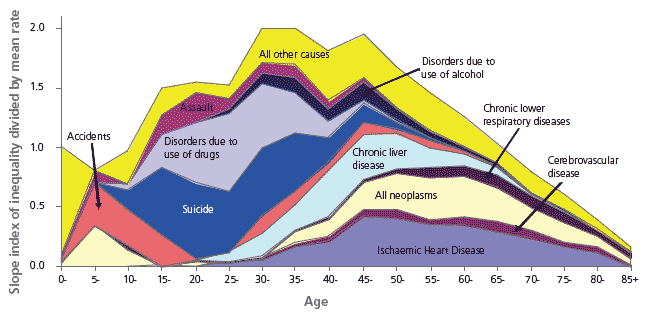
Can you think of a way to improve the health of Glasgow? Do you think that the environment impacts on the health of the people living in the dear green place? More and more data derived from monitoring all sorts of things is available – do you think that data could make a difference? Can you imagine how? If you are a health professional the third of Open Glasgow’s Hackathons. If your idea is good enough you could get £20,000 to develop it.
The team asked me to write a piece to stir up thinking about data and health – you can read it below. And it looks like I’m going to be on the judging panel which should be fun.

 CHRIS FREMANTLE

leave a comment