
Google sets itself against ‘two cultures’
Eric Schmidt, Chief Executive of Google, has hit the nail on the head. C. P. Snow‘s two cultures continue to exist embedded in the educational system in the UK, though perhaps less in Scotland. In his McTaggart Lecture at the Edinburgh Festival (full text on the Guardian website) he highlighted the major innovations (photography, computers and television) that were developed in the UK. He went on to say,
“The UK is the home of so many media-related inventions. You invented photography. You invented TV,” he said. “Yet today, none of the world’s leading exponents in these fields are from the UK.”
Of course there are two points to be made: one Scotland has a particular role in this history, and the critique is a challenge to politicians and policy makers, educators and innovators here. Secondly, his analysis predicates that the important exponent is the corporate entity rather than the individual creative person.
But these are two minor quibbles. Schmidt’s argument is more fundamental and important because he wants to challenge the cultural divide. His lecture is a catalogue of key historical figures who demonstrated excellence in both the arts and the sciences, and his particular focus is on the Victorian period: James Clerk Maxwell the published poet; Lewis Carroll the mathematics tutor at Oxford. Perhaps Modernism and the apparent association of ‘Victorian values’ with a recidivist conservative agenda is an oversimplification that needs to be challenged so that we can see again a period when the arts and the sciences were interwoven.
But, not that I want to harp on about Scotland again, Scotland also has a particular history in educating polymaths and a particular pedagogical tradition of valuing the generalist. Young people in Scotland learn within a system that is designed to see them take a range of humanities and sciences until they go to University, and even in University, the first year is designed to encourage broader study (I ended up doing joint honours in English and Philosophy because I had to choose an extra subject in first year and took Moral Philosophy).
So, value the generalist interested in both arts and sciences, and re-appraise the Victorians for exemplars. I’ve been reading a biography of Keir Hardie, a man at the centre of radical agitation at the turn of the century.
Annandale Observer – News – 21st August 11

Merz, Sanquhar
Models and Metaphors: David Ruston at Merz in Sanquhar, Dumfries & Galloway
Images associated with the show at the Herbert on Flickr
Get a message from Simon Beeson on Facebook that he’s headed south after his annual pilgrimage to Edinburgh. Sorry to miss us. He says he stopped in Sanquhar to see David Rushton’s Merz exhibition – he provided a postcode. David Rushton was involved in Art & Language and now lives in Edinburgh. Curious, so on Sunday head East to Cumnock and then South East (intentionally overshooting to the Drumlanrig Cafe in Thornhill for good pizza and coffee) to Sanquhar. Just off the main street around a corner is a smallish, previously industrial, building. Simon had said something about lemonade.
David Rushton’s studio and exhibition space, called Merz, presumably in homage to Schwitters, is just fantastic. It has all the mod cons including a basement studio, an attic to sleep in, a wall that swings out to reveal a kitchenette, and a toilet and shower tucked at the other end. All of these are pushed as far to the edges of the building as possible, in Rushton’s description, to make the most space for exhibiting, perhaps 800 sq. ft. maybe less. There is a woodburning stove at the end of the gallery next to the desk.
He has temporarily installed Models and Metaphors – a show he had in Coventry – in this space.
I haven’t wrapped my head around the work yet, except for the piece (all the works are 1/24th scale vignettes) of a fictitious Pripayat Cultural Centre with major conceptual art works installed. This exhibition opened on 26th April 1986. It was immediately irradiated in the Chernobyl disaster, instantly making conceptual art once again of no financial worth.
What is the importance of art? Is its importance financial? Rushton clearly thinks not if he imagines irradiating his own generations’ best work. He also thinks not, if he chooses to locate himself in Sanquhar. But it is a brilliant place to be. And this is a brilliant space. And brilliant things are going to happen in it.
The only press coverage I could find was in the local paper Annandale Observer – News – 21st August 11.
Without question the most interesting things happen on the edge, in the rural, where it’s least expected.
10 Rooms: Artists Take Over

Do you recognise this building in Ayr?
Holmston House used to be the Social Work HQ in Ayr, and before that was a purpose built ‘poor house’. It’s up for sale, but is going to be used over the ‘Open Doors’ weekend 3/4 September for a creative intervention – as far as I understand there will be five rooms, one each for artists to hang work, and five rooms, one each for artists to make site-specific installations on the theme ‘Buildings in Ayrshire.’
This isn’t my project, but I did think (making a mental leap) of the Artists’ Rooms and wondered what if Gordon Matta Clark was doing a room? What if Joseph Beuys was doing a room? Michelangelo Pistoletto? Marina Abramovic? (I’ve linked to pictures of the specific works in my mind’s eye).
Please feel free to add your own suggestions/links…
Art + Design Opportunities at NSGH
Creative Scotland: Find out about Art + Design Opportunities at NSGH.
The commissions in the New South Glasgow Hospitals Therapeutic Design and Art Strategy are beginning to be advertised. Ginkgo Projects, who I’m working for on this, together with Brookfield and NHS Greater Glasgow and Clyde are holding an event for artists and designers to find out more.
The event takes place from 5.30-7.30 on Tuesday 19 July at the Pearce Institute, Govan Road, Glasgow.
I’ll be describing the way that Donald Urquhart, Will Marshall and I developed the Strategy around the patient pathway and bringing the landscape into the building. I will outline the projects, but I’m going to focus on skills and competencies – the ability to collaborate closely with architects & landscape architects; to work within the framework of interior design to challenge and develop exciting projects; to engage and persuade the wider team including commissioning managers, hospital staff, clinicians, amongst many others.
The projects have been developed so that they can be tackled from a wide range of practices from the strongly authorial through to the participatory and engaged.
I’ll flesh this out and explain more about the process on the 19th.
Policy intervention renews free University movement
The Copenhagen Free University existed from 2001 to 2007 as a radical pedagogical artistic project. The aim was to reclaim power and undermine the ‘knowledge economy’.
“We wanted to turn the tide. We took power by using the available means: a mattress became a residency, the bedroom a cinema, the living room a meeting space, the workroom an archive, our flat became a university. Opening our private space turned it into a public institution. The Copenhagen Free University was a real collective phantom, hovering.”
The Copenhagen Free University was abolished for the same reasons it was established: it is as important to abolish power as it is to take it.
Recently, members of the Copenhagen Free University received a letter from the Danish Government,
“In December 2010 we received a formal letter from the Ministry of Science, Technology and Innovation telling us that a new law had passed in the parliament that outlawed the existence of the Copenhagen Free University together with all other self-organised and free universities. The letter stated that they were fully aware of the fact that we do not exist any more, but just to make sure they wished to notify us that “In case the Copenhagen Free University should resume its educational activities it would be included under the prohibition in the university law §33″. In 2010 the university law in Denmark was changed, and the term ‘university’ could only be used by institutions authorised by the state. We were told that this was to protect ‘the students from being disappointed’.”
As a result a statement (available here CFU Statement) has been issued,
“We call for everybody to establish their own free universities in their homes or in the workplace, in the square or in the wilderness. All power to the free universities of the future.”
A number of independent radical projects have reposted the statement as an act of solidarity including,
The University for Strategic Optimism
Please repost the statement.
Fear and Loathing in the West Highlands

Norman Shaw’s Nemeton lives up to Alastair McIntosh’s stated approach to writing, “In the absence of 300 micrograms of LSD, how can I trip them out?”
This is gonzo academic writing at its best: faeries, faerie hills (a nemeton is a sacred space in the ancient Celtic religion), second sight, Ossian, standing stones (Callanish in particular), Masons, shit socks, Psilocybin (magic) mushrooms, hazel nuts, the nuts of knowledge, salmon, poaching, patrols for poachers, Christianity, damnation, the second coming, the Jacobites, superquarries, peat, and of course Beuys.
Shaw documents visually and in text a series of journeys to explore specific nemetons, sites in the West Highlands where our world and the dream- or otherworld are connected. These journeys are deeper explorations of previous experiences: Shaw, a son of the Manse, grew up in Lewis and Dingwall amongst other Highland communities. Revisiting sites with the specific objective of researching their existence as meeting points brings him into contact with everyday Highland life as well as with the other world. Cycling, driving and walking through the Highlands in the heat and the rain, in fog and on clear days, sometimes in company and sometimes alone, the journeys are psychological as well as physical explorations.
Nemeton is a rumination on the nature of reality, West Highland reality, which is distinct from other realities, just as Hunter S Thompson’s West Coast reality is an alternate reality. Just imagine three cycles dumped outside a café in a community hall on Harris.
“My bike has a crucifix for handlebars, with a wooden Christ having from it. His legs form the two forks holding the front wheel. Thus Jesus forms a kind of figurehead for the trip. Roineval will be our Holy Mountain, our Calvary. The bike becomes our cross to bear, dragging it round the roads of Harris, whilst simultaneously being steered by Christ, whose humiliation haunts the moors and glens of the Hebrides – a voice crying in the wilderness. A fine twelve-pointed pair of red deer stag’s antlers form Eddie’s handlebars. The deer is a symbol of time and a symbol of love. Time the deer is in the wood… It also symbolises the surplus of deer that roam the sporting estates of the post-clearance highlands; or the horned god Cerrunos, hermes trismegistus – often depicted as Moses with horns (as in Roslin chapel, for instance). Lee’s bicycle is steered by the skull and jawbones of a basking shark. His bike is an appeal to the maritime history of this place, of fish-based economies and a hearkening back to old Atlantis or even Tir Nan Og.” (p.100).
Shaw makes a compelling argument that our post-modern imaginary, breaking down assumptions about cause and effect, disrupting the linear narrative, exploring the circular, is fundamentally more suited to developing an understanding of dimensions beyond those accessible to the sciences of physics and imperial(ist) histories.
There are contributions from others including Murdo Macdonald, the Professor of History of Scottish Art at the University of Dundee as well as the artists Eddie Summerton, Lee O’Connor and Tommy Crooks.
At the heart of this book is a rumination on nature and the spiritual. Shaw belongs in the long lineage of researchers into the otherworld or dreamworld of the Scottish Highlands. What is distinctive about this research, done in the context of contemporary visual arts (as broad as that method can be), is the acceptance of the participation of the researcher in the world. Other texts describe things learnt or things found. This text shares experiences of the research. In this text the spiritual is not other, studied objectively, but rather immanent, studied subjectively. The altered states of this text confront head on the haptic, the liminal, and the full complexity of the Highlands: damnation at the second coming, the schadenfreude of village life where failure eviscerates incomers. Fear is visceral.
Why this book is self-published I cannot for the life of me understand, but you can get a copy direct from the author email nshaw777@gmail.com or write to 2 Inzievar Courtyard, Inzievar Woods, Dunfermline, Fife, KY12 8HB.
Dr Norman Shaw
Born in 1970, grew up in the Highlands.
MA (Hons) in Fine Art, University of Edinburgh (1993)
MPhil in Art History, Edinburgh College of Art (1994)
MFA in painting, Edinburgh College of Art (1996).
PhD in Fine Art, University of Dundee (2004)
Taught Art History and Fine Art at Edinburgh College of Art and the University of Edinburgh, before lecturing at the University of Dundee.
Exhibits widely in group and solo exhibitions, nationally and internationally. Outputs include drawing and painting, printmaking, writing, sound, video.
Exhibitions include ‘Window to the West’ (City Art Centre, 2010), ‘Prints of Darkness’ (Edinburgh Printmakers, 2010 (touring)), ‘Highland’ (RSA, 2007), ‘The Great Book of Gaelic’ (An Lanntair, Stornoway, 2002 (touring)), ‘Calanais’ (An Lanntair,1996 (touring)).
Research and practice is multi-disciplinary and polymorphic. Major source is the Scottish Highland landscape; its natural and unnatural histories, mythologies, mysticisms and psychogeologies; tempered by a unique visionary iconography which draws on an expansive range of influences.
Visual research ranges from drawing and painting to printmaking and installation. Influences and obsessions range from prehistoric megalithic culture and Pictish art to early medieval British insular art; and from the early northern renaissance to the northern romantic tradition; William Blake, the Celtic revival, surrealism, neo-romanticism, psychedelia, and occult, subversive and ‘outsider’ art, marginal, alternative and hidden histories. Draws heavily on music-related artforms such as record covers and paraphernalia.
Judy Chicago in Conversation

Wednesday 15 June, 6-7.30pm. £5 (£4). Hawthornden Lecture Theatre, Scottish National Gallery, The Mound, Edinburgh
Judy Chicago is best known for her seminal installation, The Dinner Party (1979), a landmark of feminist art that symbolically presents a world history of famous women, and now in the Brooklyn Museum. In this special evening talk, the artist discusses her new book Frida Kahlo: Face to Face (Prestel), co-authored with Frances Borzello, and her career with Patrick Elliott, Senior Curator at the Gallery of Modern Art. Judy will be signing copies of this publication and the definitive book about The Dinner Party (Merrell).
Advance booking recommended. Tickets cost £5 (£4) and are available from the Information Desk in the Gardens Entrance of the Scottish National Gallery or by calling 0131 624 6560 between 9.30am-4.30pm with debit/credit card details.
Arts as Medicine
Three days of events organised by Jackie Sands, Arts & Health Co-ordinator at NHS Greater Glasgow and Clyde, highlighting the first class work going on in the field in Glasgow including:
Christine Borland on her recently completed Cast from Nature as well as her new project with medical students where she will work with students to explore ‘ways of seeing’ typical in visual arts and examine differences between this and ways of looking and seeing in medicine;
Marek Dominiczak, Professor of Clinical Biochemistry and Medical Humanities, University of Glasgow and leading light in the Medical Humanities;
Clare Simpson and Mark O’Neill, Glasgow Life, on Art, Health and the Commonwealth City;
Suzy Wilson on performance and the training of medical students;
Anne Moore, Grampian Hospital Art Trust and Donna Briggs, Artist, Artroom Project at Roxburghe House, Aberdeen;
Mary Hepburn, Consultant Obstetrician with Artists Sharon Goodlet Kane and Belinda Guidi, Art in Hospital on representation in the context of women and health (interesting link with one of the core themes of Suzanne Lacy’s research and the Working in Public Seminars);
Nadine George, Work on the Human Voice;
Events require registration here.
Gil Scott-Heron / Graham’s post
Graham Jeffrey also posted in response to the news that Gil Scott-Heron had died – he found some great film, which as he says, demonstrates the man’s greatness.
Gil Scott-Heron
Gil Scott-Heron, RIP
1949-2011
Gil Scott-Heron, my brave and brilliant friend – Jamie Byng, Observer
Open Academy Ulaanbaatar

Jay Koh and Chu Chu Yuan of the international Forum for InterMedia Art has recently announced Phase II of the Open Academy in Ulaanbaatar.
Open Academy Ulaanbaatar is an art and cultural resource development programme and phase 1 took place in 2008 – 09. Workshops will be conducted from late May to July, followed by projects led by local participants that will take place till early October.
There will be 4 projects organised around the following categories:
- Project involving cross-sectoral collaboration amongst Ulaanbaatar residents, with ideas grown and negotiated between collaborators
- Project that emphasises practical execution of arts and cultural management knowledge gained from OAU
- Project that explores local historical and culturally relevant themes, to connect the past with present through practices, narratives, networks and/or structures
- Project on urban/rural ecology, to explore durational creative engagements with the ecology of communities whose livelihood depends on the land.
The workshops are open to all residents in Ulaanbaatar and all projects are led by local participants and selected through an open call process by a local panel. Workshop facilitators for Phase 2 are Chu Yuan, Jay Koh, Defne Aryas, Burka Arikan and Richard Kamler.
Open Academy has been carried out in Hanoi, Hue, Mandalay and Yangon since 2003 by international Forum for InterMedia Art (iFIMA). Open Academy Ulaanbaatar is supported by Prince Claus Fund from The Netherlands. enquiry: ifima@gmx.net
Ai Weiwei


Ai Weiwei is only the most recent of a significant number of Chinese Dissident imprisoned or controlled. Late last year Lui Xiaobo was awarded the Nobel Peace Prize although unable to collect it because he continues to be imprisoned. Wikipedia provides a list of names.
The University of Local Knowledge
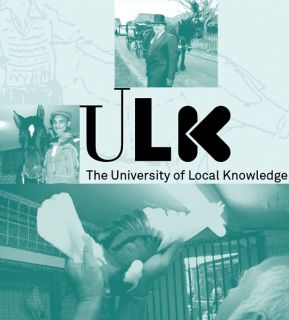
Suzanne Lacy speaks (Thursday April 28, 7-9 pm, at LACE – Los Angeles Contemporary Exhibitions – 6522 Hollywood Blvd, Los Angeles 90028) on her recent project in Bristol, England entitled The University of Local Knowledge, its process of engaging with over 300 Knowle West residents, and screens a selection of video “texts” in this first presentation in Los Angeles.
Founded during the great depression in the early 1930’s, Knowle West is a small community in the southwestern English city of Bristol. Residents were relocated from run-down council estates (housing projects) to Knowle West to work in surrounding tobacco and bag factories. Eighty years later these factories have been redeveloped into urban lofts, but nearby Knowle West residents face unemployment, stereotyping, and limited access to higher education.
Lacy worked with two art organizations in Bristol-the Arnolfini Gallery and the community-based Knowle West Media Center to produce an art project that brings together three spheres of knowledge: the arts, the university (University of Bristol), and Knowle West Residents.
Knowle West Media Center staff and artists worked with Lacy to “map” Knowle West by recording 1,000 video pieces, called “texts” in this project, ranging from 30 seconds to 4 minutes each. Through extensive discourse with community residents, these texts were assembled into categories, or “courses” on a website to portray the “University” through the eyes of its residents. The site features “courses” on rabbit hunting (animal husbandry), raising children as a teen mom (adolescent psychology), growing organic vegetables (agriculture studies) and how to maintain classic cars (mechanical engineering).
The University of Local Knowledge was funded in part by the Department of Cultural Affairs for the City of Los Angeles, The Arnolfini Gallery, and the Knowle West Media Centre.
Postcards to Japan
Express your support to the people of north east Japan by sending original A5 art work postcards.
After the major earthquake and tsunami in north east Japan on 11th March 2011 power supplies, land lines, mobile phone networks and internet access went down, making it extremely hard to contact family and friends to find out if they were safe.
The post office were quickly up and running again and in many cases the first news that loved ones were safe was by postcard.
Inspired by the wonderful impact postcards can have, we would like to invite artists and poets to send tangible messages of support to communities affected by the devastation by making A5 size original artwork or poetry postcards and posting them to:
“POSTCARDS TO JAPAN”
Ukishima Net,
Iwate, Iwate, Iwate,
028-4423,
Japan
We will collate all the postcards received into an exhibition to tour venues in north east Japan. There is no deadline, but if we have as many cards as possible by the end of May we can start putting on exhibitions. We also hope to publish a catalogue of the postcards received. Any profit made from the sale of catalogues would be donated to recovery projects in north east Japan.
Please look out for updates on http://www.ukishima.net If you have any questions please e-mail info@ukishima.net
Scottish Artists Union Hustings
This event organised by the Scottish Artists Union took place at the Lighthouse in Glasgow. Some information can be found here.
Common Perspectives event
Common Perspectives are organising a lecture, discussion and film screening at the Pearce Institute in Govan Saturday.
1.30pm – 3.30pm
Sat 19th March 2011
Free Admission
Guest Speaker:
Ailsa McKay, Professor of Economics, Glasgow Caledonian University
Screening & Discussing:
Sylvain Froidevaux
“Onesimus Paradox and the Basic Income as A New Economy Alternative”
Slavoj Zizek at the RSA
“First As Tragedy, Then as Farce: The economic crisis and the end of global capitalism”
Making a Difference –
“Tae Sail On Them Is No Their Fate – Stories from the Fight Against Poverty in Scotland”
Part of the 2011 Glasgow Reshuffle…
The Pearce Institute
840 860 Govan Road
Govan
Glasgow
G51 3UU
0141 445 6007
0141 440 1937
Ayrshire Poetry Slam 16th Feb, 8pm
Su Casa coffee house, The Lorne Arcade, (off the High Street) Ayr … Entrance £4 (£3)
The contest to find this year’s Ayrshire Slam Champ is on. Rhymers, rappers and rhapsodists welcome. Purveyors of verse blank, verse blue or verse bleezin – all are welcome to take part.
Everyone will go up to the mic twice. For three minutes each time. Judges will score for poem, for performance and for audience reaction. The three highest scorers go into the final on the night. There they will have three more minuutes to perform the poem that will win them the glory, the fame, the laurels of the victor … and a small amount of money!
Under 18s welcome tho we can’t edit content or language content!
The winner will also qualify to take part in the Scottish Slam Championships at The Mitchell Theatre on March 4.
If you’d like to take part please contact robin.cairns@btconnect.com
or you can call rosie on 01292 520543
Call for Hints and Tips on public art
Following on from the my last post, PAR+RS has announced the collaboration on the development of a short publication series entitled Hints and Tips: four books (one for artists, one for project managers, one for contractors, one for inhabitants) of hints and tips on public art. All contributions will be permanently recorded on the PAR+RS web site and an edited selection will form the printed editions.
Heaven for the opinionated, ambitious, vocal, frustrated, determined, elliptical… and subtle people working in public… I’m thinking about my numerous bugbears, rants and offers of unsolicited advice.
Go to Hints and Tips · Reflections · PAR+RS for a detailed brief.
Education Special
Critical Network has highlighted some key creative approaches to resistance and education… Art e-bulletin #101 – Education Special.
“We are not very good at love.”
Fascinating programme on BBC Radio 4 yesterday (Mon 24th Jan) on the various factors making Glasgow one of the unhealthiest places to live. The programme discusses de-industrialisation (comparing with other parts of UK and Europe including Poland and Moravia), ghettoisation, genetics (not generally considered to be important), drink, drugs, violence (as the apparently default Glaswegian response) and Thatcherism as factors impacting on health. Conversely the programme considers the problems associated with infrastructure focused regeneration, culture and the question of hope. Drawing on expertise from the Glasgow Centre for Population Health and the Centre for Confidence and Well-Being (“We are not very good at love.”), this excellent programme discusses the impact of childhood experiences and dysfunctional upbringings amongst the key factors.
“The sleeping giant of philanthropy” | The Art Newspaper
Very interesting article (albeit with a very US focus) on the ways that artists deal with their estates through trusts and foundations. The article highlights the very specific challenges where works of art form part of the assets of the trust or foundation.
Some of these are very well known (Andy Warhol, Pollock-Krasner, Henry Moore, etc) but there are also lots of new ones emerging. Some are structured to give grants whilst others focus on research and collections.
“The sleeping giant of philanthropy” | The Art Newspaper.
and the report (in two volumes) is on the Aspen Institute site.
State of Play Manifesto performance – Central Station Video
Video of contributions to the AHM ‘State of Play’ Symposium last year including Philip Schlesinger’s ‘Very Short Introduction to current Scottish Cultural Policy’, as well as Ruth Barker’s and Jimmie Durham’s amongst others … including mine, manifesto performance.
Working Well: People and Spaces
The New South Glasgow Project received the go-ahead from the Scottish Government in December.
Reading

Chinua Achebe‘s lecture on Nigeria, politics and the role of the artist at Cambridge University’s Centre for African Studies, reported in the Guardian:
“We have endured a terrible failure of leadership – not just individuals, but a whole class of potential leaders, from which I do not absolve myself. The role of the intellectual is difficult. We should live by what we preach and we should speak out. In that way we always seemed to be superior to our former western leaders. For them, writers and painters just had to write and paint and keep out of politics. Leadership in all its forms is a sacred trust in a democracy, almost like an anointed priesthood.” Guardian 13 Dec 2010
See also Ken Saro-Wiwa’s comment on the nature and purpose of art.
Student sit-ins at 20 UK Universities
The Slade Occupation is working with the Lab of Insurrectionary Imagination.
The email that came yesterday said,
They are planning 3 days of alternative education, art, activism and disobedience this weekend, from Friday night 3rd to Sunday 5th December. The Laboratory of Insurrectionary Imagination will be supporting this and we are calling on all art activists friends to take part in this act of creative rebellion against the cuts in the UK… Its going to be a great space for planning, discussing, plotting the next steps of what looks like a rising movement in this country, but one that needs our collective radical imaginations …. pass on and proliferate xx
you could either:
1) Propose a workshop/event/ talk/ performance/action/installation/ that you could contribute to the weekend ( a short description of it, what you need space and time wise etc )
2) Write a statement of support to the occupation – esp from international artists etc .. would be great
3) Just turn up with your body and rebel soul
please email your ideas to me at John@labofii.net and sladeoccupation@gmail.com
Some info on other sit-ins assembled by Martha Rosler (the US is excited by what’s going on in terms of resistance in the UK):
Cardiff – http://www.guardian.co.uk/cardiff/2010/nov/25/cardiff-students-occupation-lecture-theatre
Cambridge – http://www.defendeducation.co.uk/
Edinburgh – http://www.bbc.co.uk/news/education-11839216
Essex – http://www.facebook.com/pages/Essex-University-in-Occupation/158415970868102?ref=ts&v=wall
Leeds – http://occupiedleeds.wordpress.com/
http://leedsunioccupation.blogspot.com/2009/01/leeds-university-occupied.html
London South Bank – http://savesouthbank.wordpress.com/2010/11/24/statement-from-the-occupiers-at-london-south-bank-university/
Manchester – http://www.bbc.co.uk/news/uk-england-manchester-11836570
Newcastle – http://ncluniocc.blogspot.com/
Oxford – http://www.occupiedoxford.org
UCL – http://ucloccupation.wordpress.com/
Sheffield – http://www.indymedia.org.uk/en/2010/11/468742.html
Sussex – http://news.infoshop.org/article.php?story=20101119145151849
SladeSchool of Art : http://artsagainstcuts.wordpress.com/
see also http://www.reallyopenuniversity.org/
More public time?
Thanks to Alison Bell for drawing my attention to the following quote from Rebecca Solnit,
‘Landscape’s most crucial condition is considered to be space, but its deepest theme is time.’
See earlier post Public time?
Reading
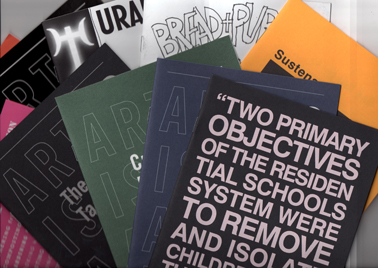
Artists & Activists Pamplets from Printed Matter
If you ask, Printed Matter will add the selection of Artists & Activists pamphlets in with an order. Including polemics by Fritz Haeg, The Center for Tactical Magic, Ultra-red, Cathy Busby, Raqs Media Collective, Critical Art Ensemble, amongst others, they addresses rights and responsibilities from the perspectives of the peripheries, and there is much to be learnt from the peripheries. And as Alasdair Gray says “Work as if you live in the early days of a better nation.”
Architectural Drawing Competition 2011
The Royal Glasgow Institute and the Norma Frame Foundation are calling for entries for an architectural drawing competition.
Anger at the neo-liberalisation of education and culture
The Turra coo
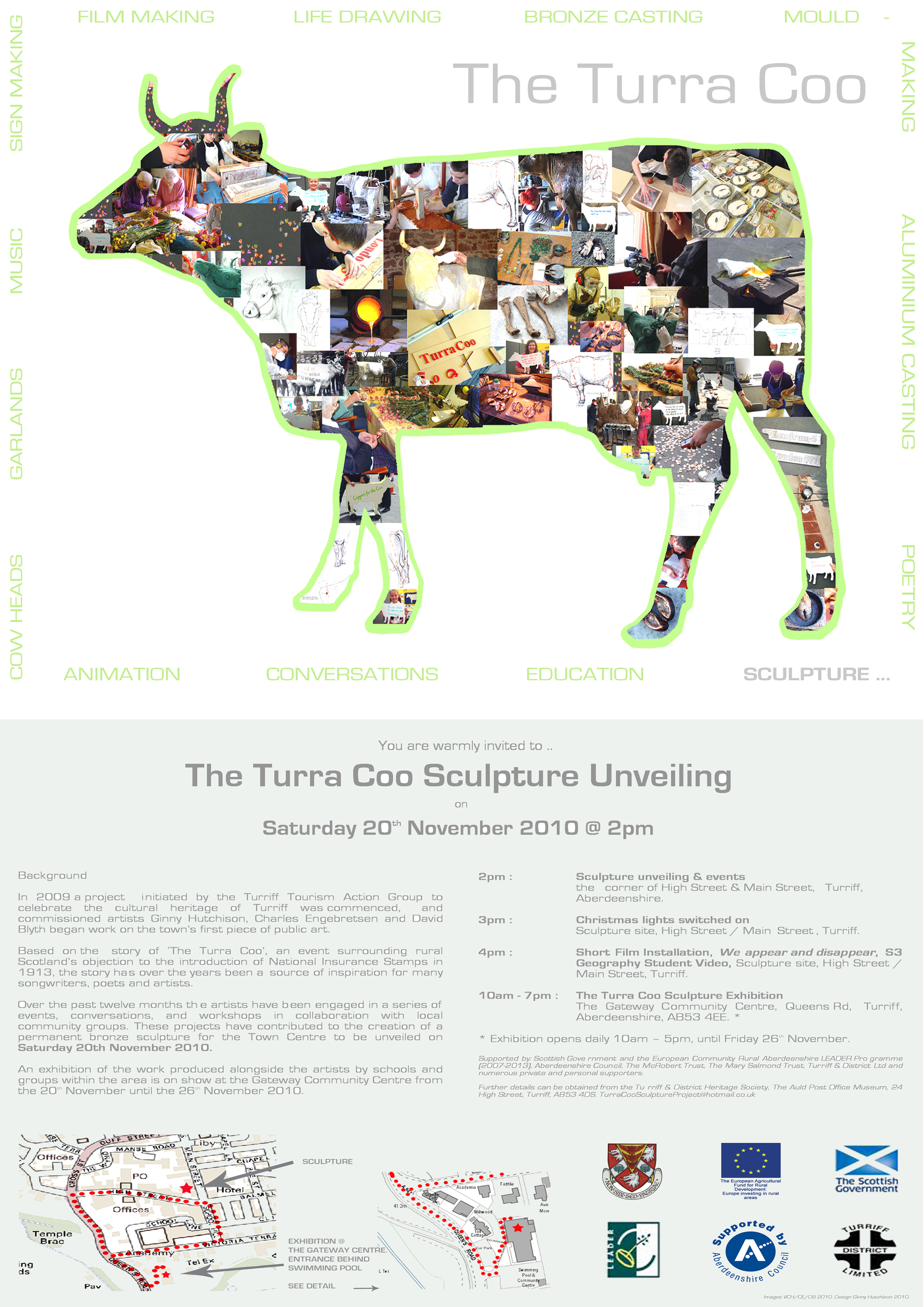 Those excellent artists Ginny Hutchison, David Blyth and Charles Engebretsen are finally unveiling their major new work, the Turra Coo. The original Turra Coo was the centre of a controversy about national insurance stamp. Slideshow on Radio Scotland.
Re: Fuelling ‘The Necessary Revolution’
Missions, Models, Money, the think-tank for the cultural sector, regularly produces interesting and provocative papers. The most recent Guide, entitled Fuelling ‘The Necessary Revolution’: Supporting best practice in collaborative working amongst creative practitioners and organisations – a guide for public and private funders addresses the subject of collaboration. This paper identifies a wide range of formats of collaboration and draws on the results of a two year programme of ‘action research’ involving six groups of organisations developing collaborations around a range of issues from marketing, to the management of spaces, from back office functions to programming.
Two other pieces of recent reading intersect with this.
Firstly, Bringing Humility to Leadership: Antecedents and consequences of leadership humility, by Morris, Brotheridge and Urbanski published in Human Relations 2005. This paper is one of a growing literature seeking to articulate alternatives to the conventional charismatic models of leadership, and was useful in our work on The Artist as Leader. The MMM Guide notes the importance of leadership within collaborations, but does not correlate important characteristics of leadership, as highlighted in this paper, with those of collaboration. The paper on humility, having tracked ideas of leadership through history, notes three key characteristics:
Self-awareness, or knowledge of ones strengths and weaknesses;
Openness, or being willing to learn from others;
Transcendence, or being aware of something greater than the self.
MMM’s Guide goes into some depth on the importance of organisational self-knowledge and the competencies, qualities and attributes required including, ‘seeing systems,’ ‘wanting to learn,’ ‘building a shared vision,’ ‘building a critical mass for change within an organisation,’ ‘developing mutual trust and respect,’ ‘managing across boundaries,’ communicating effectively and appropriately,’ ‘confronting issues and managing conflict,’ ‘adapting to changing circumstances,’ ‘valuing risk taking, tolerating failure.’ The correlation with the characteristics of leadership are quite clear. Just as the leader must want to learn so the organisation must build a culture that values learning amongst the staff and also as a whole.
What the MMM Guide doesn’t deal with, although it purports to be about creative practitioners, is the creative practitioner. Interestingly, collaboration between artists is taken as an ongoing and recurrent aspect of practice, but for the purposes of this paper the practitioner only exists as an undistinguished part of the organisation. In fact the relationship between the individual artist and the organisation is a particularly difficult area. Largely, the individual artist is at the behest of the organisation, competing for contracts and subject to management guidance. The Artist Placement Group‘s (APG) programme offers a structure for the artist to work with the non-arts organisation without becoming subsumed and instrumentalised. This is driven by the concept of the artist as ‘incidental person’ and the use of the ‘open brief’ responded to with the ‘feasibility study’, the need for a host and conditions of work parallel with staff (not only in terms of pay, but also expenses). APG remains an important example offering an as yet not fully absorbed model of working. MMM’s Guide explores the potential for organisational collaboration, but it does not fully address the question of human creativity, i.e. how cultural organisations fully engage with creative individuals. Given that within the cultural field there is now a real diversity of forms from artist-led galleries such as Transmission, temporary forms such as Vidokle’s unitednationsplaza and more permanent structures such as e-flux, through stable collaborative practices such as PLATFORM, one wonders if the lack of questioning of the forms of organisation isn’t a missed opportunity.
Secondly an important paper, Coase’s Penguin, or, Linux and ‘The Nature of the Firm’ by Yochai Benkler, published in the Yale Law Journal, 2002. Benkler discusses the emergence of ‘open source’ as a new means of production distinct from management and the market, the traditional organisers of production. Focusing on the characteristics of ‘open source’ projects such as Linux and Wikipedia that make them successful, Benkler teases out the distinctive characteristics of this form of collaboration. Whilst Claire Cooper focuses on management theory around collaboration, Benkler focuses on issues of movitation and its limits, and scale and its dynamics. Benkler’s paper argues that the forms of collaboration in the information and (digital) cultural sector are driven by human creativity, and it is the high value placed on human creativity within this territory that makes his paper particularly interesting.
The advantages of peer production are, then, improved identification and allocation of human creativity. These advantages appear to have become salient, because human creativity itself has become salient.
Benkler argues that the motivations for participation in ‘open source’ collaboration are social-psychological, rather than monetary, ranging from personal sense of worth through to indirect career benefits derived from positioning the individual to secure monetary rewards for services associated with the ‘open source’ product.
The argument around scale is also interesting, focusing on the granularity of the tasks. If each task is of a sufficient fine grain then the time required of an individual to complete the task is proportionate to the non-monetary value produced for the individual. Integration of the modules completed by self-selected individuals, and the associated quality management systems, are critical to success.
In Benkler’s terminology the MMM Guide focuses ways collaboration can make cultural organisations more competitive by re-organising the property and contract costs between organisations, rather than leaving them locked into individual entities. Of course, the challenges identified by the organisations participating in MMM’s action research are precisely those property and contract costs which are not a factor in ‘open source’ models: “marketing, technology, fundraising and partnership, programming, environmental issues and professional development.” But Benkler’s model provides a useful analysis of the challenge of unlocking large scale human creativity.
Attending the SKOR conference in Amsterdam
Actors, Agents and Attendants: Speculations on the cultural organisations of civility
On The Structure
SKOR (the Dutch Foundation for Art and the Public Domain) set out to focus on the shift from a welfare state to a neo-liberal state, and the implications for care and civility (health and state responsibility). There were regular references to mega-changes, not only political. The construction of discourse through multiple channels was embodied in the scenography of the conference (designed by n.office architects) constructed as a podium or soapbox for statements, bleachers for discussion and a table for panels. The multiple channels extended out of the conference to commissioned works in the streets of Amsterdam and a film programme presented prior to the conference. It was also manifest in the preparatory seminars bringing together first politics and policy and then practice and research into focus.

Felix Meretis, the venue, is an independent European centre for art, culture and science and a national and international meeting place in Amsterdam.
The form of [a] poem is like the form of a new public sphere, like the structure of a new idea. Paulo Virno
On The Purpose
Superficially focused on the issues of arts and health, the underlying issues raised by the conference included:
- questioning “the role of art and its assumed ameliorative function,”
- exploring “care as a political and philosophical concept,”
- the ability for art to be critical when it is also implicated in gentrification and “consensualising the increasingly capitalised infrastructures of public care.”
“We can say that care forms the core of public art’s aesthetic assemblage: that public art has been invented to produce ameliorative caring, performances and objects within a landscape organised by a welfare state. So what happens when that landscape is radically withdrawn?”
Day 1 Fulya Erdemci, Director of SKOR, introduced the day which was chaired by Andrea Phillips.
Mark Fisher, a UK writer and philosopher, started his presentation by channelling the experience of precarious work: swipe cards to get into buildings; submitting bank details and forgetting which organisation you have done it for; logon details for different computer systems; emails from institutional administrators; occupational therapists talking about stress; psychiatrists prescribing drugs: the obverse of flexibility is contortionism. Living with the impact of the business ontology and epistemology (business models of being and thinking) that have been imposed on health, education and culture. The therapy culture which reflects everything back onto the individual and the family. He suggested that the flip side of ‘no such thing as society’ is ‘the big society’ based on ‘magical volunteerism.’ I asked about the requirement that all activity be valued as work (caring for instance needs to be transmuted into work for it to be valued by society). He suggested that there are two responses: refusal to participate or total adoption where everything is defined as work and accounted for financially. Underlying this is the need to extend the discussion of ‘externalities‘ from the environmental discourse into the wider social discourse. In other words to find ways to deal with those costs or benefits not ‘transmitted’ through price. One strand of environmental policy seeks to ensure that environmental impacts, not historically acknowledged in cost, enter into the financial systems through, for instance, carbon taxes. Is it useful to financialise the value of care any more than it is useful to financialise the value of bees? Where attributing financial value to the negative environmental impacts of human activity should enable the costs of remediation to be met, attributing financial value to positives such as elements of ecosystem services can produce absurdities. A good example was the news the day that Lehman Brothers collapsed with an impact measured in billions of dollars, that bees were worth some hundreds of millions to the economy.
Steven de Waal, a politician and social entrepreneur who argued (as I understood him) for the potential of the Dutch co-operatist system, where a significant part of the welfare state is delivered through private not-for-profit institutions, to adapt and engage with the neo-liberalisation of care by reducing the bureaucratic stranglehold and increasing citizen participation in their own care.
Alfredo Jaar, the art star speaker, in a conventional artists’ presentation, showed us a series of projects located in the ‘real world.’ NB his construction of his practice is split across the art world, real world, education – his distinction between the art world and the real world being about the audience expertise. He talked about the role of artists working in public space trying to create the cracks in spaces of consumption to draw out resistance. Although a clearly charming and skilled man, these projects were nailed by Ian Hunter as ‘the spectacle of empathy’.
[apposite quote of the day: USE AN UNACCEPTABLE COLOUR, Gavin Wade]
Edi Rama, the Mayor of Tirana in discussion with Fulya Erdemci, Director of SKOR. Rama is famous for being the man who painted Tirana. In a short film Rama talked about colour as ‘dresses’ or colour as ‘organs.’ He compared relationship of the Mayor to the electorate with the relationship of the artist to the audience. Rama talked about the role of beautification in changing a culture and re-engaging the population in civic society. His colour strategy was one of desperation on discovering himself in a kafkaesque town hall with no budget at all (no one was paying taxes). When asked by an EU official responsible for repairing a bridge (?) in Tirana, “What colour should I paint it?” Rama replied the orange of the Dutch football strip! This immediately set off a public discussion. Based only on the fact that it was actually generating a public discussion of civic space, Rama continued painting buildings and urban structures in vivid colours. He reported that they undertook a referendum. In the referendum they asked two questions: “Do you like it?” and “Should we continue?” He reported that something like 55% said they liked it but 75% said they should continue.
Anton Vidokle, artist, curator and founder of e-flux talked about his understanding of art, referencing the French Revolution and the use of the King’s art collection for public benefit. Talking about the emergence of Manet and Courbet forty years later, the first artists one would associate with a critical practice as might be understood in contemporary practice, he speculated on a connection with transmutation of the royal art collection into a public art collection. He went on to describe various e-flux projects. I’ve written about Vidokle, e-flux and in particular the Martha Rosler Library before, so I’ll move on.
Chto delat?, the Russian artists’ collective. Dimitry Vilensky challenged the core subject by arguing that care is maintenance of the status quo, and that care contradicts change. “Where is violence in this discussion?” He questioned the value of health, coming from one of the most unhealthy countries and reminded the audience of the misuse of ‘a healthy body is a healthy spirit’ by the fascists. Vilensky, in describing the ideological fight, drew out the relationship between the work of Chto delat? and the role of artists during the revolution, particularly highlighting Rodchenko’s design for a workers’ club reading room which Chto delat? have reused in exhibitions. He noted the strategy of creating pedagogical spaces using furniture, murals and newspapers. He asked “Where is the factory that we can seize?” and noted that there were no revolutionary masses outside the conference waving flags and supporting the important deliberations. He commented on the importance of not only taking over the means of production, but also inventing new means of production (such as Vidokle’s e-flux).
Gavin Wade performed part of freee‘s spoken word choir event currently taking place at Eastside Projects in Birmingham, an artist-led space he has been involved in setting up. Wade is known for amongst other works STRIKE and his involvement in the organisation Support Structure. When challenged about something he had said about art not being useful, he referenced the Artist Placement Group and the complexity of working within non-art organisations without becoming completely subsumed by their agendas. He also commented that although Eastside Projects is undoubtedly contributing to the gentrification of the area and generating increased wealth for the landlord, he said, “We are not the tailors of Utopia.” They use a billboard (the only non-commercial one in Birmingham) attached to the building. They produced a manual for Eastside Projects, making the operation of the organisation explicit.
Introducing Day 2 Fulya Erdemci reiterated the mega changes, e.g. welfare state to neo-liberalism, analogue to digital. She also commented on commissioners becoming customers with their own aesthetic preferences (perhaps suggesting some recent experiences where SKOR’s aesthetic authority has been questioned).
Beatriz Colomina‘s presentation on x-ray architecture took us on a cultural historical tour of the relationship between the body and architecture by way of renaissance anatomical/architectural drawing, section and dissection, and the emergence of x-ray and the international style (not synchronous, but not unrelated). Relating health to architecture she highlighted Le Corbusier‘s language and then demonstrated the relationship between sanatorium architecture and domestic spaces. Referencing Susan Sontag’s Illness as Metaphor Colomina talked discussed the reshaping of the city by illness, in particular TB. She explored the evolution of CAT scans into architectural practice manifest in the increasing aesthetic use of sections. One comment was that medicine is also the end of particular forms of architecture such as TB houses and leper colonies.
Hedy d’Ancona, politician, spoke about the influence of the built environment on wellbeing, the importance of the healing environment as a concept coming out of both healthcare and public housing.
Matthijs Bouw of One Architecture discussed the Jozef and Geertruiden Projects. He said “We love markets because they encourage dynamism, teams, diversity and flexibility. We hate markets because they promote atomisation, arbitrage and risk management. Asked by hospital management to finalise the layout for a housing development on a site being vacated due to relocation of services, Bouw questioned the economic model and with the support of the hospital management developed a new approach. On one site, Geertruidentuin, existing hospital buildings were regenerated as housing without the involvement of a developer. On the other nearby site, St. Jozf, the ‘allied services’ (midwives, physiotherapists, etc.) dislocated by the hospital moving to a new site, but not themselves moved in the process, became stakeholders in a new healthcare facility utilising the remodelled existing building. This important example involved questioning the ‘means of production’ (i.e. developer-led regeneration) through which more value (cash) was produced for the hospital and more value (dislocated services becoming stakeholders) was produced for the locality. Bouw also raised an interesting point about the client/commissioner because the daily reality is that these are project managers, risk managers, quantity surveyors and legal representatives rather than individuals carrying the vision.
AA Bronson channelled St Paul’s letter to the Galacians setting out his own cv and then making clear he was addressing not only those present, but also those many different absent peoples. He talked about art, death and healing. Whilst in many ways adhering to the conventional artists’ talk, it challenged fundamental ideas about boundaries and limits.
The story took us from the early years of General Idea (“Felix Partz, Jorge Zontal and AA Bronson of General Idea lived and worked together for 25 years. Partz and Zontal died in 1994.”), through the emergence of AIDS and its impact on their community, their work and their lives. Whilst AA Bronson did not describe in detail the process or experience of caring for his two friends and collaborators as they died, he did show us the works he made with them during that process, and he did allow us to understand how he has since woven together an art practice and a healing practice. The weaving together of life and art is a constant process: Felix Partz and Jorge Zontal are diagnose with AIDS so pills enter their lives and so the pills entered the work becoming sculptures and installations, as large as sofas and as light as clouds.
Describing life after their deaths, AA Bronson developed his experience of healing built up with his friends and collaborators and how this began to form a fundamental part of his life. He set out his healing practice as a thing in itself and in his art practice, creating therapy rooms in galleries, and seeing clients in them before and after gallery hours. He described more recent collaborative work with younger artists (School for Young Shamans) and the group work (Invocations for Queer Spirits). He talked about his role as a medium for individuals to speak to their own bodies.
Perhaps like Alastair McIntosh who, in Soil and Soul, addresses spirituality and environment without descending into new age waffle, so AA Bronson spoke about healing and art in a compelling and challenging way, straddling uncomfortable boundaries with a compelling presence and story.
Bik van der Pol‘s discussion of happiness started with a short anecdote about advice not to test your sense of humour on policemen in other countries, from which they developed an argument about cultural difference, but more importantly about happiness. Touching on the World Values Survey and on Laughter Yoga, they talked about using nitrous oxide as part of urban public health programmes.
The programme ended with Willem Geerlings discussion of the challenges for health. He is the Chair of the Board of the Medical Centre Haaglanden and pulled Susan Sontag’s Illness as Metaphor from his pocket.
Mashing Up: Art+Labour
“MASHING UP” :
Art+Labour
a public conversation
CCA 5
Tue 9th Nov 2010
12.30-6pm
http://www.variant.org.uk/events.html
Art+Labour is a public conversation exploring the conditions and experiences of creative labour in the cultural industries – working conditions, pay, working hours; freedom and autonomy, pleasure and obligation; insecurity and uncertainty; social reproduction, networking and isolation – and artists’ organising within it – unions, artists’ associations, or self-organised studio/exhibition spaces.
Panelists include:
Angela McRobbie
Professor of Communications, Dept. of Media & Communications, Goldsmiths
Scottish Artists Union
The representative voice for artists in Scotland
Graham Jeffery
Reader: Music and Performance, The School of Creative and Cultural Industries, UWS
Katarzyna Kosmala
Reader, Centre for Contemporary European Studies, UWS
Gesa Helms
Researcher & artist
Brett Bloom
Member of Chicago-based art collective Temporary Services who recently produced ‘Art Work : A national conversation about art, labour, and economics’
Owen Logan
Researcher, School of Divinity, History and Philosophy, University of Aberdeen
Facilitated by Gordon Asher
Effective Learning Tutor, UWS Centre for Academic & Professional Development
Event is free but ticketed, tickets available from CCA Box Office:
CCA, 350 Sauchiehall Street, Glasgow G2 3JD
tel : +44 (0)141 352 4900
http://www.cca-glasgow.com
“MASHING UP” : Art+Labour is organised by Leigh French, co-editor of Variant, and Sophie Hope, member of Making A Living, in co-operation with Graham Jeffery of The School of Creative and Cultural Industries, University of the West of Scotland, and supported by CCA, Glasgow.
LOANS &
INTERNSHIPS
WORKSHOP
CCA 5
Tue 9th Nov 2010
10.30am – noon
Sophie Hope & Leigh French
examine the Case Studies
Public time?
 Claire Docherty’s comments at the Mapping the Future (of public art in Scotland) event in Dundee yesterday were billed as a discussion of ‘public time’ and focused on the current state of public art. She seemed to be arguing around a need to move beyond a dichotomy of monumentalism or critical ephemeralism looking in particular at what she called public time. She described a number of projects which were iterative or cumulative or strategic, i.e. that, without monumentalism, tried to develop relationships with audiences and participants (the public?) over a period of time. She highlighted gardening and pavilion projects, slow food, conversation and referenced her own year long programme of One Day Sculpture across New Zealand. The obligatory Ranciere reference – participation does not equal critical legitimacy – was made.
But her comments remained looking around in the (public) art world. Whilst time and space are different dimensions of the same experience, the focus of public art, certainly in Miwon Kwon’s construction, has been an evolution of the understanding of space and the abilities of artists and designers to shape and reveal space.
“Yet despite the meanderings of the last 15 years we often continue to use such a search for resolution in lieu of admitting that there is a need to understand the relative value of work that deals with time as much as space.” (Proxemics, 2006, JRP Ringier, p.99)
Nothing is ever cut and dried, but when Liam Gillick raised the issue of shifting the focus from public space to public time, and I’m not sure if that’s where Docherty got the idea from, he prompted in my mind thoughts about the public experience of time, not artists’ construction of time.
Turn your thoughts to public time and approach that idea:
Waiting, waiting lists, waiting rooms, wasting
Travelling, delays, speed, dislocation,
Working, pressure, shifts, holidays, nightworkers, clickworkers, payday
Boredom, repetition, necessity, cuts, dole,
Queuing, waiting,
Shopping, retail therapy, footering
Beer o’clock
Timeless places, casinos without clocks or natural light, skara brae
Sleep disorders, postcode lotteries,
Today vs PM, rolling news,
“The geese from Siberia are three weeks earlier this year”
(the list is as long as the time invested in making it – half an hour yesterday, another five minutes today)
Time is a curious phenomenon. It is structured within society, historically by culturally determined cycles derived from the process of the planet’s angle and rotation around the star at the centre of our solar system. In Scotland, because of our Northerliness, the pattern of the seasons mean that our school holidays are different from England. We have different festivals (Michelmas has just passed, Lammas before that, and in the future Candlemas) with associated happenings, including food and drink. Marking time and the pattern of activity related to the seasons has slipped our minds’ because we shelter, light and heat our lives. Other cultures have a more present experience of seasonality, including for instance the Sami (image above). We rarely extend our timescale to even one cycle of seasons, let alone thinking beyond our own lifespan.
If there is value in drawing attention to scale, then it is equally important to draw attention to value. Time is money. Or rather there is a more complex relationship where social position is related to time and money. Just as money is unspecialised form of exchange (and humans are unspecialised animals) so time (as we organise it in Western society) is an unspecialised form of measurement enabling a little of one person’s time to be valued very highly and a lot of another person’s time to be bought extremely cheaply. In this way time is like space. Public art is complicit in the gentrification of space. Can public art not also be accused of being complicit in the gentrification of time?
Detailed summary of all three Mapping the Future events on PAR+RS website.
Postscript
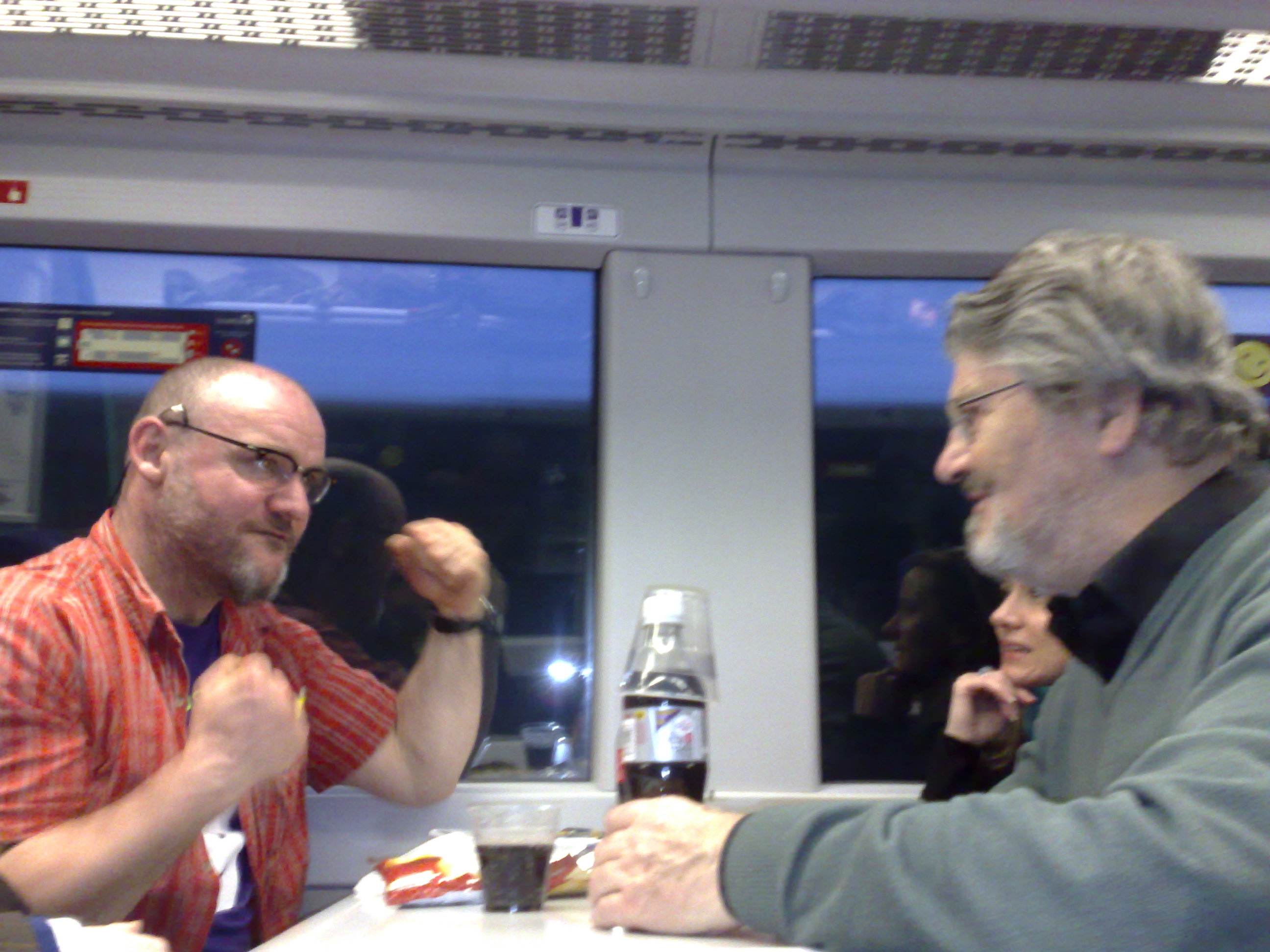
"I always knew you were wrong." Ross Sinclair and David Harding on the train returning from the seminar.
Anne Fremantle 1909 – 2002


Anne Fremantle by Leonora Carrington, Oil on Canvas 1975
Long bio here and short bio on NYTimes here.
Bio of writing https://www.encyclopedia.com/arts/news-wires-white-papers-and-books/fremantle-anne-jackson
Culture and the New Scottish Parliament
This event was focused on the Scottish Government’s draft National Cultural Strategy.
NATIONAL CULTURAL STRATEGY
Public meeting at Lumsden Village Hall to take place on 2 October 2000
This is an open invitation for you to join us for an unique opportunity to hear Rhona Brankin MSP, Deputy Minister for Culture and Sport, speak about the new National Cultural Strategy. The meeting is being held at Lumsden Village Hall at 7pm on Monday 2 October 2000. The meeting is open to everyone interested in culture in the North East of Scotland and there will be an opportunity to ask questions and raise issues with the Deputy Minister.
The National Cultural Strategy recognises that our culture is not only the arts, but is also the buildings and landscape of Scotland, the language and traditions, and that culture permeates every aspect of our lives. A strong and vibrant culture can have enormous social and economic benefits. The Scottish Sculpture Workshop initiated the programme of discussions on ‘Culture and the new Scottish Parliament’ because one of the strengths of our culture is discussion and debate. This is an opportunity to speak directly to the key politician with the responsibility for government policy on culture.
On the publication of the National Cultural Strategy Rhona Brankin MSP said:
“The breadth and vision of this document are in themselves radical. Scotland’s culture can flourish and can be accessible to all. It can develop and exploit its international potential. We can celebrate excellence and we can celebrate diversity.”
The National Cultural Strategy is available from the Scottish Executive on 0131 244 0340 or on their web site at http://www.scotland.gov.uk/nationalculturalstrategy/.
The Scottish Sculpture Workshop is an artists’ residency centre specialising in sculpture and known internationally. We provide a resource for artists including residential accommodation, facilities, and technical help. We initiate projects involving artists and facilitate the commissioning of public art in the North East of Scotland.
The meeting will take place in Lumsden Village Hall which has recently been upgraded with an award from the National Lottery Halls from the Millennium Scheme.
I very much hope that you will be able to join us for what promises to be an interesting and informative evening where you can hear about the National Cultural Strategy and raise issues concerning culture with Rhona Brankin MSP, Deputy Minister for Culture and Sport.
BACKGROUND
The Scottish Sculpture Workshop initiated a programme of discussions about the potential impact on culture of the proposed new Scottish Parliament in 1998 when we held an open meeting in Lumsden Village Hall prior to the referendum on Devolution. A note was taken of the meeting and ciculated
In 1999 we followed this up with another meeting, on this occasion prior to the elections for the new Scottish Parliament. This meeting took the form of a ‘cultural hustings’. The candidates for the four parties standing in our constituency we all invited to answer questions from an audience. Again a note of the meeting was prepared and circulated, and on this occasion was also published in Artists Newsletter.
The meeting at 7 pm on 2 October 2000 will therefore be the third meeting in the programme.
We would like to thank Gavin Renwick for stimulating the idea to hold these meetings and Eric Robinson for chairing them. Lumsden Village Hall has provided an excellent venue for these meetings.
This note was originally published on the Scottish Sculpture Workshop website.
Culture and the New Scottish Parliament
This event was held following the referendum on devolution which had taken place the previous September, but prior to the establishment of the new Scottish Parliament. It was inspired by Gavin Renwick and Wendy Gunn’s project Whaur Extremes Meet and the evident need for a space for discussion about cuture and politics particularly in the context of significant change.
Summary of Meeting held on 3 July 1998 at Lumsden Village Hall
Culture and the New Scottish Parliament
Chairman: Eric Robinson
Attendance: Robert Smith MP, Cllr. Rhona Kemp (Chair COSLA Language and Culture Ctte.), Cllr. Jock McGregor, Cllr. Stanley Tennant, Cllr. Mitchell Burnett, Cllr. Kenneth Benzie, Jim MacDonald (Chair Gordon Forum for the Arts), Sandy Stronach (Chair Doric Festival), Alison Simpson (Banff and Buchan Arts Forum), Roxanne Permar, Suzannah Silver, Sarah MacKenzie Smith (all Grays School of Art), David MacLean (Scott Sutherland School of Architecture), Mary Anne Alburger (Elphinstone Institute, University of Aberdeen), Ian MacKenzie Smith (SSW Board and Museums & Galleries Commission), Jonathan Young (Head of Service, Planning), Ron Reid (Leisure and Recreation), Barbara MacLeod (Senior Arts Development Officer), Sheila Waterhouse (Arts Development), Fiona Bushe (Visiting Specialist), Frank Bruce, Jonathan Claxton, Chris Bailey, Frederick Bushe, Keiji Nagahiro, Gavin Renwick (all artists), Phil Sands (Mobil North Sea Ltd.), Mavis Wainman, William and Edith Petrie, Gordon Gillies, Kenneth MacLean.
The Scottish Arts Council Initial Submission on Culture and the New Scottish Parliament to the Constitutional Working Party was circulated at the meeting.
Eric Robinson opened the discussion by highlighting four issues for culture and the new Scottish Parliament – structure, policy, regional needs, and rural issues.
It was agreed that critical points should be highlighted from the meeting, rather than a verbatim report. For the purposes of this report culture is used to include art, music, drama, poetry, language, etc.
Education
There is increasing pressure to deliver a widening range of subjects, and focus on the core curriculum. The result is that cultural and art teaching is being marginalised. This must be remedied, with culture becoming a fundamental component of the curriculum involved in every subject. If Scotland is to have a unique identity, this must be part of the educational system.
Language is critical in the support of culture and all children should have the right to be taught in their mother tongue. The strength of Gaelic culture is a result of the promotion of the language. This is a model for Doric. At present the strength of Gaelic culture has created a focus for tourism in the Highlands, brought £9 million into broadcasting as a direct support for the language, and created a strong cultural identity.
The involvement of youth in culture is vital. Sport presents a model for youth involvement. Sport is seen as an everyday part of life, not the domain of the adult, or of the school. ‘Education for leisure’ is a necessity in the light of the evolving nature of employment.
IT, which is currently prioritised, should be integrated into other disciplines. Alford Academy published the definitive CD-ROM on the Scottish Colourists – this is an excellent example of integration.
Visiting Specialists should be a statutory provision. Without culture teaching in Primary Schools children are disadvantaged in pursuing cultural subjects.
The Review of Scottish Culture report to SCCC was brought to the attention of the meeting. This report highlights many of these issues. This is clearly an area that requires further discussion.
Structures and Lines of Communication
The new Scottish Parliament should be transparent, its agencies should be transparent, and there should be ‘multiple lines of communication’ on cultural issues. The parliament should have a Select Committee on Culture. It was highlighted that the nature of the electoral process will create regional groupings of MSP’s. This should enable regional identity and culture to have a line of communication.
Regional and local arts forums, Local Authorities, and individuals should all be contributing to culture in the new Scottish Parliament. The national cultural agency should be transparent and dspersed. It was noted that SAC did not reflect on itself directly in its submission.
The tax system provides an opportunity for supporting the arts.
Scottish Culture and Culture in Scotland
There needs to be a balance created where the many Scottish cultures are promoted, and culture in Scotland is promoted. Scotland needs to develop culture in relation to Europe and look to models in other small European countries and regions. Beyond this Scotland needs to develop its culture on in an international context.
Point 2.12 in the SAC submission was commended “…the ability of the arts to be free ranging, unimpeded and dangerously creative.”
Broadcasting and International Cultural Affairs should not remain a Westminster responsibility. This is clearly an area which requires further discussion.
This note was originally published on the Scottish Sculpture Workshop website.

 CHRIS FREMANTLE
leave a comment