An artist reports on COP15
Read Aviva Rahmani’s reflection on attending COP15 in Copenhagen. She sees hope, not in transnational engineering of negotiations, but in all the NGOs and projects seeking to make a difference on the ground. It strikes me that the increasing attention focused on the periphery, whether it’s Eigg or Tuvalu, might be indicating a very basic shift (see posts on Landworkers). The sharpness of the challenges faced in remote edge locations is matched by the imagination and energy brought to bear on them. What is interesting is the extent to which these examples, of crisis or initiative, become visible and in turn become benchmarks and potentially become models.
What Art have I seen?
The End of the Line: Attitudes in Drawing
A Hayward touring show seen at the Fruitmarket Gallery in Edinburgh. Naoyuki Tsuji’s animations using charcoal, leaving the trace of each previous frame, were stunning. Wonderful, magical and fantastical episodes. Fernando Bryce’s work forms a catalogue created from newspapers, maps and photos drawing attention to colonialism in Africa and Europe. David Haines’ works were frankly scary groups of boys, the recurring theme of trainers and voilence. But there was something quite strange in the selection: whilst drawing is something done for many different purposes, frequently not art (e.g. engineering, architecture, anthropology, archaeology) none of this work was anything other than art. There was no aspect which blurred any boundaries between art and any other purpose for drawing.
Inspace – first exhibition in the new partnership between New Media Scotland and the Informatics Department at Edinburgh University. Went having seen the video of the Perpetual Storytelling Apparatus, I was more interested in the One project.
Bike Bloc and Environmental Crisis
Having been busy busy busy ticking off items on my to do list of project management, fundraising and research this morning, I decided to go and see if there were any pictures on Bike Bloc Blog “Put the fun between your legs” (I’m just dying to see these sculptures!) I followed a link and found the Great Indian Sale blog all about the crisis of environmental rights in India. I don’t know any more than you can see, but its interesting, and we might further extend our understanding out of a Euro-centric perspective.
Bike Bloc
Brian Holmes writes very well, and his piece Into Information on Productivist strategies suggesting informationist strategies is very provoking, but for sheer compelling, articulate, quality writing, read The Decade to Come. He ends with a link to the Bike Bloc video.
You can also hear something tantalising in the Guardian podcast from the Arnolfini where Bike Bloc is being tested.
Cybernetics (human machine interfaces)
The Perpetual Storytelling Apparatus is a work by Julius von Bismark and Benjamin Maus. It explores the possibilities of drawing as copying, as semantic, as mechanical, as technical, as legal, as durational, etc..
What art/science have I seen?
Ex- at the Zoology Museum, Glasgow University.
First, you have to go and find this gem of a museum in Glasgow University, proper old-fashioned place, not over-interpreted (though not quite sure about the size of containers for the live snakes).
This exhibition is the result of a field trip to Payamino in the Ecuadorian part of the Amazon Rainforest by a group of zoology students accompanied by Kate Foster, environmental artist, and Martin Muir, a photographer. The students were documenting and recording bird and amphibian biodiversity as well as learning about the life, culture and change.
The exhibition includes work by the students as well as Foster and Muir. The students have presented photography and drawing.
Foster’s sketchbooks seem to capture some sense of interconnectedness. Few of the drawings set out to isolate and analyse a single ‘thing’ in a ‘scientific way’. Rather they explore relations, interactions and situations. A small sketch at the back of one book of a ‘luggage jam.’ Tyre marks on the runway. Most pages have text in amongst drawing. Across two pages she has drawn a stream of ants some carrying cut pieces of leaf and others returning for more. The quality of drawing: suggesting movement by lightness of touch, suggesting pattern, suggesting context without providing one.
One of the students raises the issue of value. They are documenting and recording biodiversity under threat from oil extraction, soya farming, etc. What is the value of the biodiversity? And is it measured in monetary terms? This was crystallised for me recently when, on the radio, I heard a spokesperson for Natural England discussing the economic importance of bees. They said bees were worth £200 million to the UK economy. The next item on the news was about the commitment of £4 billion to some aspect of the financial crisis.
We say that we can’t put a price on life, but we are only talking about ourselves. We don’t understand that we can’t put a price on ecosystems, or on biodiversity. NGOs try and get us to make donations by showing us pictures of ‘charismatic mega fauna,’ but, and its horrible to say, the loss of polar bears or tigers will have a limited effect on ecosystems (as I understand it), where worms, bats, ants, small birds and especially bees have dynamic and exchange based roles. Our image of hierarchical food chains makes the big animals look like the most important, but if you begin to think about the other operations taking place at the ‘lower levels’ then your perspective changes.
The student was asking what to do: one answer is to think about what connects Scotland and Ecuador, now economically, and also in the past colonially. Bring forward the connections, make them visible. Make us aware of, not distant jungle lushness, but the ways our lifestyle in Scotland is implicated in the changes taking place there.
Art and Regeneration
Sophie Hope’s sharp questions about artists involved in regeneration projects.
C words at the Arnolfini
Nina Möntmann’s essay for the e-flux journal, (Under)Privileged Spaces: On Martha Rosler’s “If You Lived Here…” is a useful analysis which could almost be written about the C Words show at the Arnolfini. Many of the same issues are raised.
This essay was commissioned on the occasion of “If You Lived Here Still…: An Archive Project by Martha Rosler,” an exhibition of the archives of If You Lived Here… running from August 28 to October 31, 2009, at e-flux in New York.
The essay sets out the context of homelessness in New York in the 80s and 90s (for which we could substitute our own circumstances of climate change in the first decade of the 21st Century). It is precisely the market, as unquestioned driver, which is challenged by both exhibitions.
It discusses the role of the institution, then the Dia and now the Arnolfini, and the decisions leading to this form of work being programmed, concluding by linking this work to wider discussions of ‘institutional critique’ or ‘new institutionalism’.
If You Lived Here… was, like C Words, initiated by an artist/artist group, and drew in work by a number of other artists, through a cluster of linked elements. The character of documentary art raises questions about the role of art in public life, the reference to things that have, or are, taking place outside the gallery, and the questions that need to be raised about presence and absence, about knowledge and the senses.
One of the precursors to If You Lived Here… is evidently Joseph Beuys’ Free International University at Documenta 6 in 1977. In each of these cases, from Honeypump in the Workplace, through the Reading Room as Asylum Seeker’s home, to PLATFORM’s tent/boat/quadricycle, each seek to make the pedagogical space also a visceral, somatic space. Each of these works disrupts the artworld production/exhibition/distribution structure.
“Art that can not shape society and therefore also can not penetrate the heart questions of society, [and] in the end influence the question of capital, is no art.” Joseph Beuys, 1985
Of course the question of time plays a role, and we must be careful not to fall into a narrative structure that values avant gardism, making Beuys the greatest because he is the earliest, and PLATFORM an afterthought, as if it took 30 years for an idea to travel from Kassel, via New York, to Bristol. Furthermore, whilst Möntmann’s essay provides an effective ‘art history’ of a work, it also leaves many questions hanging, such as the inability of members of the ‘artworld’ attending events during If You Lived Here… to do other than sit silently.
What art have I seen?
C Words: carbon, climate, capital, culture, How did you get here and where are we going?
Arnolfini, Bristol
The collaborative practice PLATFORM articulate their work as research, campaigning, education and art. As a result of their long-term project Unravelling the Carbon Web (2000-) PLATFORM have been quoted in the financial and environmental sections of newspapers on subjects including hydrocarbon legislation in Iraq, and Shell’s role in the execution of Ken Saro-Wiwa. At the same time their opera And While London Burns… (2007) was widely reviewed and they are currently the subject (perhaps) of a major retrospective at the Arnolfini.
But this is not a solo show. PLATFORM have, in microcosm, demonstrated the Movement of Movements: simultaneously inhabiting the Arnolfini (at their invitation) are Ackroyd & Harvey, African Writers Abroad, Hollington & Kyprianou with Spinwatch, the Institute for the Art & Practice of Dissent at Home, the Laboratory of Insurrectionary Imagination, the Trapese Collective, and Virtual Migrants. Plus Amelia’s Magazine, Art Not Oil, Carbon Trade Watch, The Corner House, Feral Trade, FERN, Greenpeace, Live Art Development Agency, new economics foundation & Clare Patey, Sustrans – Art & the Travelling Landscape, Ultimate Holding Company and others. In parallel Ursula Biemann’s Black Sea Files, Peter Fend and Barbara Steveni are also exhibiting.
The PLATFORM aspect touches on several key points in 25 years of work – the walls have been lined with recycled timber and this frames a tent, a boat, a quadicycle, an image of a strategy game on a burning world stage, and a discussion. There are a lot of words in the Arnolfini at the moment, but this is an exhibition, not just a pile of documentation. This is activism brought into the gallery, but it is as animated as activism. There are events going on regularly, and between the many different contributors and the team of co-realizers, I don’t think you can just walk into the gallery, walk around and say “Seen it” without someone engaging you. It fights against being objectified, whilst still acknowledging the need for something aesthetic to engage with.
At the Friday afternoon Critical Tea Party there was an interesting discussion about combative art. Is this exhibition trying to tell you what to think? Is it propaganda for a leftist agenda? It certainly wants to say: you are complicit in all of this. Do you the world to be like this? Just because you are comfortable, is it ok that everything goes to hell and damnation? Is this what you call justice?
Underlying PLATFORM’s work is a deep understanding of radical educational theory. Yes, shock tactics are applied, but to the end of making each of us think for ourselves. Propaganda is about one truth, and there isn’t one truth here. Here there is one question: what future?
But we can also ask the question “Where is the art?” For me, I can’t answer this by saying that the installation of the boat, with the chairs placed next to it like a bow wave, is the art, though that has formal aesthetic elegance (and I do like a bit of formal aesthetic elegance). Of course the art has been taking place in public over the past 25 years, and this is a gallery. The danger is that all you can put in the gallery is the evidence of something that happened somewhere else. So, for me, it is important that what is in the gallery is something which is present, here and now.
And is this a PLATFORM show? Or a group show? Are PLATFORM curators? Is their work the most important?

And what about the education, research and campaigning? To discount them from the aesthetic of the practice is to fail to understand its roots in the work of Joseph Beuys. His idea of social sculpture is central here.
Or to put it another way, Hal Foster says that there is a fault line travelling through the term ‘art history’ because he says that art is judged on its own terms, not, as with history, enmeshed in the world. If we accept that art is only judged on its own terms (some strange connoisseur’s estimation of PLATFORM vs Beuys vs Kaprow vs APG) then we dismiss the world. Whereas PLATFORM want us to understand that life can be art and art life.
So we are left with more questions, but they are in sharp focus.
What art have I seen?
Fleming Collection exhibition from Scottish National Portrait Gallery.
What Art have I seen?
Ed Ruscha, On The Road: An Artist Book of the Classic Novel by Jack Kerouac, Gagosian Gallery, Davies Street, London


Beautiful. Needs careful reading to see the relationship between the images and the text. More info at Yummy Ink.
Did also see Glenn Brown.
Reading
Nat Tate, An American Artist: 1928-1960 by William Boyd, 21 Publishing, 1998
Turtle Island by Gary Snyder, New Directions, 1974
…
aimless executions and slaughterings
are not the work of wolves and eagles
but the work of hysterical sheep
The Demonic must be devoured!
Self-serving must be
……………………. cut down
Anger must be
……………………. plowed back
Fearlessness, humor, detachment, is power
…
from SPEL AGAINST DEMONS
What art have I seen?

Ed Ruscha at the Hayward. I was sorry that none of the early photo/book works, nor some of the experimental works were included. The paintings are great, but it reads as a one trick show. There is so much more to Ruscha.
What art have I seen?
I travelled up to Cairngorm Mountain for the official opening of the second phase of Arthur Watson’s Reading the Landscape.
There are many parts to this, developed in collaboration with a number of other artists.
The first phase works in the base station (images below), Drawing Dangerously, were installed some time ago. This is a series of images and texts created out of the mountain climbing culture. The huge screen prints were developed from photographs taken by Andy Rice, one of Watson’s collaborators. The words surrounding the images are the names of climbs. As climbers explore the rock face and discover a route, they give it a name, subsequent climbers discovering variations of the climb, in turn use variations of the name.

The image below introduces another dimension, collecting Scots and Gaelic words for snow. I have a small contribution to the first publication on Reading the Landscape and it focuses on this aspect.

The new works include several viewpoints and the Camera Obscura.
At the western end of the site a structure, designed by Watson and Will Maclean, has been built channelling a mountain stream through a platform and down three buttresses. Within the structure, poems and texts draw attention to the outlook. This is a development for Maclean from Cuimhneachain nan Gaisgeach (Commemoration of our Land Heroes) on Lewis.
Images of construction of viewpoints on CairnGorm Mountain’s Flickr Photostream
Nearer the base station, at the top of a set of steps from the carpark, is a seat built into the wall. Sit down and Stanley Robertson‘s voice comes out of two speakers built into the walls starts to tell you folktales. Robertson (1940-2009), certainly one of the foremost traveller storytellers of the North East of Scotland, and a longtime collaborator with Watson. This is an outdoor version of works that Watson made for Singing for Dead Singers.
In the mountain garden Fergus Purdie, architect, Lei Cox and Mel Woods, artists, have created a Camera Obscura.
This is a built structure sitting over and along a path. There is a small bay, something like a side chapel, which you enter through heavy curtains. Inside the landscape is laid out before you on a table, turning gently. Periodically you move in giant steps along cardinal lines to the sea. These latter steps are the art introduced by Cox and Woods, a series of videos taken at regular intervals of distance (12 steps to the sea in each direction) and time (going north is winter).

The rangers are already using this particular feature when the weather is bad and the school kids can’t do anything outside. Lay a piece of paper on the table, show the pupils all Cox and Woods images, let them choose one, and then they can collectively draw the image superimposed on the paper. Suddenly landscape drawing is both incredibly literal (the image is projected on the paper) but doesn’t come out looking literal – mark making takes precendence.
Images of construction of Camera Obscura on CairnGorm Mountain Flickr Photostream
It was great, eight years after my first journey’s to Cairngorm Mountain to meet Bob Kinnaird, to go back and see something so good. I suppose my job at the outset had been to suggest what might be possible, to help Bob see that something really interesting might emerge. I remember writing the application to Scottish Arts Council with the help of … and then being involved with the selection, which by then was being organised by Susan Christie, to whom I had handed the project when I left SSW.
Studio International on Arthur Watson
Previous post.
Designing Environments for Life
For the next event we have been asked “…we would like to invite and encourage you to prepare a very short presentation (5mins max) on a single reading. Please choose one text which has had a profound influence on your thinking and/or practice, and review it with the very specific brief of Designing Environments for Life in mind.”
So I’ve been thinking about texts…
Jane Jacobs’ Nature of Economies is a definite possibility
Helen and Newton’s piece for Structure and Dynamics pdf
Looking through books:
Vivienne Westwood’s Manifesto
Merle Laderman Ukeles Manifesto of Maintenance Art
(actually I have a lot of manifestos and statements by artists)
James Turrell talking about needing to continue Ranching whilst making Roden Crater
Robert Smithson’s Collected Writings are always good.
Renwick’s report “The land we live on is our home” pdf
Patrick Scott’s Stories Told about the impact of the Berger Inquiry on First Nation Politics and the importance of storytelling. Or Alistair McIntosh‘s Soil and Soul.
I could also suggest Distance & Proximity, a book of Thomas A Clark‘s poems, and then I could just read a few!
(e.g. “In the art of the great music, the drone is eternity, the tune tradition, the performance the life of the individual”
or “”The routines we accept can strangle us but the rituals we choose give renewed life”
or “A book of poems in the rucksack – that is the relation of art to life”
And I should certainly consider Gary Snyder who I was reading over the summer.
Designing Environments for Life
The Designing Environments for Life programme at the Scottish Institute for Advanced Studies.
How can we address the gap between the two distinct meanings of environment: that which surrounds us as haptic, somatic and experiential; and that which is planned, managed and described as an ‘urban environment’ or a ‘learning environment’ or a ‘fragile environment’?
Drawing together anthropologists, architects, designers, artists and other disciplines, we are exploring this complex double meaning particularly in relation to practices.
What art have I seen?
Robert Stone’s Polka Fever at the Pump House Gallery, Battersea Park
Trees
Jen Clarke’s PhD tentatively entitled Working between art and forestry in Scotland
Ayr to Zennor
Talk entitled Soil 2.0 addressing context, and various projects I gave at the BOSarts Seminar, part of This Weekend.
What Art?
Ginny Hutchison on Radio Scotland’s Highland Cafe talking about the Inverness Old Town Art Project. She described the movement of the sun through the town, from hitting the church at 8am to creating a geometric shape, a triangle, under a bridge at 11am.
Paying attention to the movement of the sun. Marking the shapes it makes on the urban landscape. Creating new shapes in gold leaf, capturing the sun.
Goethe vs. Petronius and also de Certeau
Until one is committed, there is hesitancy, the chance to draw back, always ineffectiveness concerning all acts of initiative (and creation).
There is one elementary truth, the ignorance of which kills countless ideas and splendid plans: that the moment one definately commits oneself, then providence moves too. All sorts of things occur to help one that would never otherwise have occured.
A whole stream of events issues from the decision, raising in ones favor all manner of unforseen incidents and meetings and material assistance which no person could have dreamed would have come his way.
Whatever you can do, or dream you can, begin it.
Boldness has genius, power and magic in it.
Begin it now.
Goethe
vs.
We trained hard; but it seemed that every time that we were beginning to form into a team we would be reorganised. I was to learn later in life that we tend to meet any new situation by reorganising, and a wonderful method it can be for creating an illusion of progress while producing confusion, inefficiency and demoralisation.
Titus Petronius
and
“In him, the productivist law that requires a specific assignment (the condition of efficiency) and the social law that requires circulation (the form of exchange) enter into contradiction. To be sure, a specialist is more and more often driven to also be an Expert, that is, an interpreter and translator of his competence for other fields. … They do it through a curious operation which “converts” competence into authority. Competence is exchanged for authority. Ultimately, the more authority the Expert has, the less competence he has, up to the point where his fund of competence is exhausted, like the energy necessary to put a mobile into movement.”
de Certeau
Reading
Forest Tunes, The Library, 1995-2008 by Shai Zakai
Can remember when I was reading this. Think it was 9 months ago when I was trying to persuade Rozelle Maclaurin to show this important work. Located as they are in parkland, it seemed to me an interesting and worthwhile exhibition around which a stimulating series of events could have been organised, a sort of arborischool, with speakers like Richard Mabey, David Haley and Thomas Pakenham, as well as local rangers, academics from Auchincruive, etc.
I think its at the Centre for Contemporary Art and the Natural World this autumn.
What Art have I seen?
RAQS Media Collective at the Frith Street Gallery in Golden Square
The gallery as a trading floor for evoking human experience. A series of clocks correlated with places (New York, Lagos, Johannesburg, Kuala Lumpur, etc.), the faces modified by changing the numerals for emotions (epiphany, anxiety, duty, guilt, indifference, awe, fatigue, nostalgia, ecstasy, fear, panic, remorse). So the ‘time’ in Kabul: the hour is between panic and remorse and the minute at anxiety. In amongst the real locations are some imagined ones, Macondo (the town in Marquez fictions), Shangri La, etc.) Here the clocks go backwards.
In the middle of the room circling (on four screens) around a pillar is a face, still in the context of a global emotional roller-coaster. The sounds are an inscrutable background.
Anne Douglas, some time ago, introduced me to the Rasas, an aesthetic structure of emotional expressions (love, mirth, sorrow, anger, energy, terror, disgust, astonishment) for theatre in traditional Indian culture.
What Art have I seen?

Imaging the Forest at the British Museum
Dinabandhu Mahapatra’s Trees of Orissa. A painting on silk representing all the trees of the region of Orissa. Some are very much icons, others are more representational. This work, made in the early 1980s, was as I understood it part of a response by a particular patron to the loss of traditional crafts. It is a response to the 12th Century poem, the Gitagovinda, which tells the story of Krishna and Radha. The forest is a place where the social rules are more relaxed and Krishna can carry on with his favourite female cowherds.
Reading
The Artistic Turn: A Manifesto
Kathleen Coessens, Darla Crispin and Anne Douglas
Radical Nature at the Barbican
Radical Nature: Art and Architecture for a Changing Planet 1969-2009 is an important exhibition. Much has been written about it in the papers and on the Eco Art Network. It is a really valuable opportunity to see seminal works by a range of artists and architects. I hadn’t seen Beuys’ Honey Pump, nor the film of Ukeles‘ Touch Sanitation, nor Smithson‘s film Spiral Jetty, nor any of the Harrisons’ Survival Series (1970-1973).
But I finally worked out the essence of my problem with the exhibition. The title frames ‘art and architecture’ and there are works by both artists and architects included in the exhibition. The artists and architects included, particularly the works from the 60s and 70s are radical, there’s no question about that. But the real radicalism of some of the artists and architects is in the scale of their work, and in the exhibition this is only really conveyed in the Center for Land Use Interpretation work The Trans-Alaska Pipeline. Even the film of Touch Sanitation doesn’t convey the eleven month performance of shaking 8,500 sanitation workers’ hands and saying to each of them “Thank you for keeping New York City alive.” The exhibition feels like its driven by a curatorial focus on artwork as object, rather than artwork as question or consideration of context.
The real shared territory between artists and architects is in thinking at scale about boundary, organisation, information, energy, metaphor, systems and people; not the superficial similarity of objects.
Think about Hans Haacke’s Shapolsky et al., Manhattan Real Estate Holdings, a Real Time Social System, as of May 1, 1971, shown at the Tate’s exhibition Open Systems: Rethinking Art c.1970 a couple of years ago where he focused on the ownership of tenaments in New York by one family through a network of businesses. This would have been as relevant an introduction to social ecological concerns.

Think about the Harrisons’ work Peninsula Europe (2001-2003)which presented the European peninsula as single entity considering the role of the high ground in the supply of fresh water to the population.

Think about Tim Collins and Reiko Goto’s work 3 Rivers 2nd Nature (2000-2005) which involved the strategic planning of the whole Pittsburgh river system area. Goto and Collins “addressed the meaning, form, and function of public space and nature in Allegheny County, PA.” They developed the Living River Principles which were used as a tool for lobbying public officials. They worked with a team of volunteers to develop monitoring systems documenting land use, geology, botany and water quality.
Or PLATFORM’s work Unravelling the Carbon Web (2000 ongoing) which asks us to understand the social and environmental consequences of oil through multiple iterative works drawing attention to the oil industry and its associated networks to Universities, Government and other corporates, working with inhabitants, NGOs and Unions along BP’s Baku-Tbilisi-Ceyhan pipeline, and in Iraq. The purpose of this work is social and ecological justice, but it is also to relate this distant business to the lives of people living in London and the UK.
Or even Peter Fend, one of the most interesting artists, whose work with the Ocean Earth Development Corporation actively seeks to challenge the relationship between art and business by developing approaches to ecological problems through the means at the disposal of artists – colour theory, conceptual synthesis and the use of emerging tools such as satellites.
All of these works:
- Are of a scale which touch on or encompasses whole political, social and ecological systems.
- Involve communication between artists, scientists, politicians and inhabitants (i.e. in multiple and complex ways, rather than from singularly from artist to audience).
- Foreground the connections between living and non-living structures, such that the work is relevant to our daily lives, rather than objects for aesthetic contemplation.
- Blur the idea of the artist, raising the question “is it art?” because the work and the artist are also economist, environmental scientist, planner, etc..
- Raise the question, “Who made the work?” breaks down the idea of the artist as individual, because the work is made through the input of a range of people.
- Embody diversity of description (something very problematic in museum contexts).
- Embody and make relevant all phases of the life-cycle of the art.
Whilst much of the work in the exhibition is also characterised by the above points, it has not been chosen to emphasise these points. Rather it has been chosen because it meets a different set of criteria, criteria of objectness. Thus there are at least five works that involve plants in the gallery – Helen Mayer Harrison and Newton Harrison’s Farm, Hans Haacke’s Grass Grows, Simon Starling’s boat for Rhododendrons, Henrik Håkansson, Fallen Forest, 2006. But the differences between these works, between ironic comment and practical application is lost. The Harrisons’ work is of a practical character “What can we do in these circumstances?” where Starling’s work has an ironic purpose, raising questions about nativeness and protection. Haacke’s work Grass Grows is a work that demonstrates the Manifesto he wrote in 1965,
…make something which experiences, reacts to its environment, changes, is nonstable…
…make something indeterminate, that always looks different, the shape of which cannot be predicted precisely…
…make something that cannot “perform” without the assistance of its environment…
…make something sensitive to light and temperature changes, that is subject to air currents and depends, in its functioning, on the forces of gravity…
…make something the spectator handles, an object to be played with and thus animated…
…make something that lives in time and makes the “spectator” experience time…
…articulate something natural…
Hans Haacke, Cologne, January 1965 republished in Art in the Land. A Critical Anthology of Environmental Art, ed. by Alan Sonfist, (New York: Dutton, 1983
The off-site project in Dalston, which I wrote about earlier, is a more interesting work than some in the exhibition, precisely because it was not curated, but rather made.
What Art have I seen?
Timo Jokela: Northern Traces: 1999-2009
Collins Gallery, Glasgow
Sculpture Parks and Gardens
International Directory of Sculpture Parks and Gardens
New resource developed out of Cameron Cartiere’s research. The section on Scotland includes Galloway Forest, Glenkilns, Jupiter Artland, Little Sparta and Tyrebagger. No reference to those that are gone, including Cramond and Glenshee.
The category Sculpture Parks and Gardens raises a few conceptual challenges and complexities. Because ‘public art’ is associated with regeneration and the creative city, it has gain far more bureaucratic currency and also funding. Is a group of work by a number of artists in the landscape a public art project or a sculpture park? Is a landscape made by artists a sculpture park?
So some other possible inclusions:
Place of Origin though I’d say its a park as sculpture rather than a sculpture park? see essay in writing.
Place of Origin
Kemnay
Aberdeenshire
Yet to be completed is Arthur Watson’s Reading the Landscape, a collaborative scheme developed with Will MacLean, Lei Cox, Stanley Robertson and others for CairnGorm Mountain. All the works are intended to contributing to a cultural understanding of the landscape as lived in and used.
CairnGorm Mountain Ltd,
Cairn Gorm Ski Area,
Aviemore
PH22 1RB
tel: +44 (0)1479 861261,
I was very pleased to see Glenkilns included, but I wondered why Charles Jencks and Maggie Keswick’s Gardens at Portrack House, Dumfries were not included? Best reference I can suggest is http://www.gardensofscotland.org/garden.aspx?id=c2a160c8-f9fc-4306-95d0-9c0300966100 It’s only open once a year for Scotland’s Gardens Scheme, usually first weekend in May.
Portrack House
Holywood
Dumfries
DG2 0RW
And you cannot leave out the Hidden Gardens behind the Tramway as a new and award winning ‘art garden.’ The Hidden Gardens are a project of NVA, and are a focus for intercultural dialogue and shared experiences. Very much driven by community focused activities in a brilliant space.
The Hidden Gardens
Tramway
25 Albert Drive
Glasgow G41 2PE
0141 433 2722
http://www.thehiddengardens.org.uk/
There is a group of works by Ronald Rae in the grounds of Roselle House/the Maclaurin Trust in Ayr. I understand that they were made as part of a Manpower Services project in 1979 http://www.ronaldrae.co.uk/
Roselle House Galleries
Roselle Park
Monument Road
Ayr KA7 4NQ
Finally the Scottish Sculpture Workshop in Aberdeenshire has a Sculpture Walk
Lumsden
Aberdeenshire
AB54 4JN
01464 861372
See also thoughts on Sculpture Parks after visiting Centre international d’art et du paysage de l’île de Vassivière.
Pecha Kucha: 6 mins 20 secs
If you start with the sentence “My practice is focused by place,” then the next sentence that logical follows is “I’ve been working in … Ireland, Palestine, Siberia.” Whereas if you start with the sentence “My practice is focused by context,” then the next logical sentence can be any one of a very large number of things… [more]
This text and the associated slides were presented at the Pecha Kucha held at the RSA in Edinburgh.
What art have I seen?
Don’t go and think about Dalston Mill as a whacky eco retro art project. Think of it as architects working very hard to imagine a future for us all. And bear in mind that they are sleeping in this structure, above the bar cafe, next to the seminar room and adjacent to the toilets.
The bus dropped me on Dalston Lane and I towed my wheelie suitcase over the uneven pavement. Leaving Liverpool Street and the skyscrapers we’d passed through Little Nigeria on Shoreditch High Street. I’d seen the main Radical Nature exhibition at the Barbican a few weeks ago, and Dan Gretton had said this “off-site” project was really worth seeing. I’d caught a glimpse of the mural you are meant to look out for and seen a black painted wooden wall with words hand painted in white saying Dalston Mill, but it looked closed. So thinking that there was another entrance I walked through a yard, caught sight of a scrubby patch of wheat, went through an opening in a builders temporary fence and wandered around. It was 2pm and a few people were casually doing stuff. One guy in a t-shirt and shorts was sweeping up fag butts whilst smoking.
Going to Nils Norman and Michael Cataloi’s University of Trash at the Sculpture Center, my mother’s comment “I saw this in the 70s” is still firmly with me. She’s got a point.
And the answer may lie in the blurb about the show Into The Open currently in Philadelphia. This was the official US representation at the 2008 Venice Bienniale of Architecture. The sixteen groups represented are at the cutting edge of thinking about the urban, the landscape, the recycled and the social. I immediately recognise Center for Land Use Interpretation, Center for Urban Pedagogy, Project Row Houses and Rural Studio as landmark initiatives. I have a collection of CLUI and CUP materials, the book Rural Studio produced on my shelves and I’ve been to Project Row Houses.
The blurb goes:
“Critics noted the exhibition’s unusually sober assessment of the challenges America faces, as well as the inspired attempts by grassroots architects to mitigate these conflicts.”
But I do have a problem, and it was hell of an easy to walk in look around and walk out – to do the artworld strut – and say “seen that”. I did end up talking to the guy clearing up the fag butts and he turned out to be one of the architects. I nearly voluntarily got roped into making dough, and I really should have (no strutting making dough) but in the end they were just getting organised and I was heading for a train. Vidokle does address this so directly and effectively: The Martha Rosler Library as well as the Video Store and the Night School are all about stopping (or tripping) the strut. And I wish the University of Trash and Dalston Mill had, in addition to the events programme, something which when you walk in off the street, sucked you into ‘the sober assessment of the challenges,’ whatever time of day it was.
Because in reality, these architects and artists have created a structure which is lightweight, adaptable, portable, generates energy, supports social activities, addresses questions of food and land use, and therefore embodies some very serious issues. And I loved the scarecrows with milk containers for heads. And I hope that as they take it all to pieces and move on, that they clean up the site, including the archaeological trash from the periphery, which has clearly been there longer than the three weeks of this exercise, and leave the site better than they found it, whether they have left us wiser or not.
Eco-thinking?
Paul Kingsnorth in the Guardian 1 August 2009
Technology and hubris. What is the role of technology in solving the huge challenges that face the world (i.e. all the species living on the planet earth)? Watching the Center for Land Use Interpretation’s slide show of the Trans Alaskan Pipeline in the Radical Nature Show at the Barbican, I was struck by the scale and sophistication of our engineering (technological) capacities. I came away feeling that it was not optional. Yes, I might use the car less, walk more, fly less, use the train more, recycle more, reuse more, eat more vegetables and less meat, grow more potatoes. I might also be political working on projects which raise environmental issues, join the green party, read the latest thinking on green issues. But the idea that we, as unspecialised animals, don’t use technology to solve our problems, is impossible. Kingsnorth rightly highlights the real problem about the application of existing assumptions to the new challenges: they are not ‘wind farms’ they are ‘ wind power stations.’ But pride is a great driver of human development, technological as much as philosophical. How do we apply our technological imaginations and skills with modesty and humility and a respect for all the other lifeforms on the planet?
Pecha Kucha

Edinburgh Volume #5 at Royal Scottish Academy of Art and Architecture
The Mound, Edinburgh, EH2 2EL +44 (0) 131 225 6671 http://www.royalscottishacademy.org
On 7 August 2009 START 19:30 END 21:30 DOOR £5, £3 concession (includes refreshments)
Places are limited: to book e-mail studiodub@mac.com
To compliment their two “Lyrical Abstraction” exhibitions of sculpture (see http://www.culture24.org.uk/spliced/art69969) in the interiors and gardens of William and Robert Adam’s Mellerstain House 14th June – 30th Sep. 2009, and Charles Rennie Mackintosh’s Hill House 15th Aug. – 31st Oct. 2009 as part of the Japan UK 150 Festival, Kate Thomson and Hironori Katagiri of Ukishima Sculpture Studio, in association with architects Gordon Duffy and Rebecca Wober of Studio DuB, have organised a pecha kucha on the theme of relationships between Art & Architecture.
Pecha kucha is a great fun idea started in Tokyo a couple of years ago by Mark Dytham and Astrid Klein – two architect friends of sculptors Kate Thomson & Hironori Katagiri. It has gone viral and is now on in over 218 cities around the world.
Participants show 20 slides for strictly 20 seconds each, meaning that the audience experiences an exhilarating high speed journey through a kaleidoscope of inspirations, ideas and work, with the concise nature of the presentations keeping the interest level high. 6min40 seconds each means there is the opportunity to introduce more interesting speakers and still have time to move around and talk to each other over a drink during the interval and afterwards.
See http://www.pecha-kucha.org/cities/edinburgh/5 for more information.
Featuring presentations by…
Jock McFadyen, painter http://www.jockmcfadyen.com
Hironori Katagiri, sculptor http://www.ukishima.net
Kate Thomson, sculptor http://www.ukishima.net
Calum Colvin, multi media artist http://www.calumcolvin.com
Charlie Sutherland, architect: Sutherland Hussey http://www.sutherlandhussey.co.uk
Gordon Duffy + Rebecca Wober, architects: Studio DuB http://www.studiodub.co.uk
Dan Brown: Edinburgh Sculpture Workshop http://www.edinburghsculpture.org
Alastair Clark, Assistant Director: Edinburgh Printmakers http://www.edinburgh-printmakers.co.uk
Michelle de Bruin, sculptor http://www.artist.org.uk
Elaine Alison and Pat Bray, sculptors http://www.allisonandbray.com
Chris Fremantle, environmental art producer and researcher
What Art/Reading?
Chris Biddlecombe’s book when visitors appear produced as part of his work with the Arthur Conan Doyle Richard Lancelyn Green Collection and the Aspex Gallery which resulted in the exhibition Between Worlds, 2009.
Biddlecombe explores his own interests through the cypher of Arthur Conan Doyle and the Richard Lancelyn Green Collection held by Portsmouth City Council.
Conan Doyle’s public persona as author of the Sherlock Holmes stories is entwined with his less well known involvement in Spiritualism. Richard Lancelyn Green obsessively collected anything to do with Conan Doyle and Sherlock Holmes. Biddlecombe has, in turn, obsessively explored this material during an off-site project co-ordinated by the Aspex Gallery.
The book is a juxtaposition of the moments when Holmes and Watson first meet their ‘clients,’ drawn from the stories; and a number of psychic research photographs found in the Richard Lancelyn Green collection. Biddlecombe has made drawings of an almost anthropological or illustrative character from the photographs. Each photograph appears to contain both people and spirits, not always human. Interestingly Biddlecombe’s drawings apply the same mark making techniques to both subjects, and therefore emphasise an equality of reality. The spirits are as real as the sitters.
As is highlighted in the text for the exhibition, trickery does not necessarily preclude truth. Visitors may be the product of the imagination, but that makes them no less significant.
What Art?

The unacceptable face of Britain
Aesthetic of European stag party culture
Blue Cowboys out of Newcastle rebranded to maximise market penetration take Gdansk by storm
Find them on youtube under the name StudioSzkic
Explore Polish bars
Tree climbing, table Squennis, arm wrestling,
begging bankers
Sexercise disco on a streetcorner in NY in PLish
Who is mixing the beats? They should be on iTunes as well.

Resources on the history of climate change and science
A timeline of the development of the science of climate change (1800 to the present), part of a much larger site and educational resource created by Spencer Weart (author of The Discovery of Global Warming) and hosted by the American Institute of Physics.
An article on the history of Climate Change science from the Guardian in 2007
Reading
Gary Snyder
Endless Streams and Mountains
This web site has the first section of this book length poem, and juxtaposes it with the visual work it refers to – very interesting to see the two together. The poem is a deceptively simple description of the contents of the images.
What Art have I seen?
Garden and Cosmos: The Royal Painting from Jodhpur at the British Museum
Poor. Old. Tired. Horse. at the ICA
Radical Nature at the Barbican
What Art have I seen?
The University of Trash at the Scultpure Center
Art space become alternative pedagogical space. Quote “I saw enough of this sort of thing in the 70s.”
So are we revisiting the 70s? If so, why? And what is the difference between now and the 70s?
What art have I seen?
Socrates Sculpture Park, Long Island City.
What sticks in the mind?
Fifty bums raised in the air: yoga in the Park.
A giant doilly suspended in the trees
(Jennifer Cecere, Mom, 2009)
Looking across to Manhattan’s volume.
A series of physical challenges modelled on an exercise assault course
(Risa Puno, The Big Apple Showdown Spectacular, 2009)
A carnival wagon with artefacts displayed
(Dana Sherwood and The Black Forrest Fancies, The Ladies Society of Alchemical Agriculture, 2009)
A black barn of jig-sawed patterns
(Bernard Williams, Socrates Ply- Teck Barn, 2009)
A small garden, the most valuable space for urban-dwellers
(Jeanine Oleson, Retribution, 2009)
Socrates Sculpture Park reinvents itself as a cross-over public space between art and temporary amusement park. Away with formal sculptural concerns: roll up, roll up to the crazy summer Saturday on a field in the sun. Is it New York or is it somewhere in Kansas? Is it Little House On The Prairie or is it socially engaged practice? Even without the specific ‘dialogics’ intended to captivate the art audiences, Socrates is busy.
What art have I seen?
Art Sites in Riverhead. I noticed a sign saying art + architecture. It’s a gallery with an outdoor sculpture space that also seems to be involved in local green developments. The building looks like it used to be a light industrial unit and is really well converted, both the building and the landscape.
I’d have liked to see the exhibition Called to Action, curated by Lillian Ball, on Restoration projects.
Outdoors there was an interesting mix of large scale sculptures – some made of very permanent materials (steel)

and others clearly very temporary tent structures.
 The relationship of the tents to the ground, the way they protected an area of grass and weeds, was interesting.
There was a small patch of plants with a sign indicating that this was based on work done by Cornell University Extension programme: Weeds and Your Garden.
Sag Harbor Whaling Museum
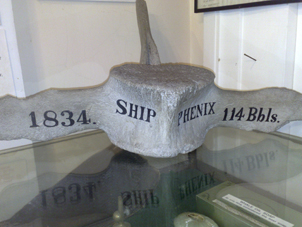
The Whaling Museum at Sag Harbour, Long Island, is a remarkable cabinet of curiosities. There isn’t a hierarchy and there isn’t a narrative or simple message. Located in the former Masonic Temple, a remarkable building originally built as a home, it contains a wide range of products of 18th and early 19th Century whaling industry as well as aspects of town history. From a cabinet of walking sticks with ivory handles, to memorials made of whale vertebrae, to the tools for carving up the carcases, all the ephemera of the industry is represented – and it’s not all scrimshaw. But in amongst this is also the stuff of seafaring: the medicine cases, the shackles for punishment and the ships logs. There are even Inuit artefacts collected by sailors, and a display indicating the relationship between the indigenous Americans, their own whaling, and the Europeans arriving on the Island. We are so used to the managed learning of museums, that this looks like an installation by Mark Dion. In fact the Museum should contact other museums to do with whaling and make a publication of whaling ephemera from different parts of the world – I found a list of museums connected with whaling at Whalecraft (there are a number in Scotland).

Rural and city
Martin Wolf in the FT (3 May 2006) summarises Jane Jacobs’ arguments for the importance of cities (not countries) and their role in relation to regions.

 CHRIS FREMANTLE
leave a comment