The Institute of Unnecessary Research (Culinary Arts – Lucy McCabe)
The Institute of Unnecessary Research (Culinary Arts – Lucy McCabe).
Lucy McCabe has a degree in Medicine and explores pathogens through pastry.
Postdoctoral Research Fellow in Rural Health and Creative Community Engagement – University of the Highlands and Islands – jobs.ac.uk
Just saw this on jobs.ac.uk – another important development.
Applications are invited for a Postdoctoral Research Fellow (PDRF), funded until June 2016, to conduct qualitative work within Highland. The work will explore the nature of the relationships between rural community life, identity, health and well-being.
The post is funded by the Arts and Humanities Research Council and Economic and Social Research Council as part of a large grant in the Connected Communities Programme, led by Prof. Gareth Williams at Cardiff University. The overarching aim of the project is to establish how community representations produced through creative arts practices (e.g. storytelling, performance, visual art) can be used as forms of evidence to inform health-related policy and service development. Through analysis of existing representations of communities in literature, film etc. and the production of new community self-representations, the work will explore the relationship between ‘official’ representations of community health and well-being (e.g. in statistical data) and how communities understand and present their own health and well-being.
The project will take place across five distinct case-study communities in Wales, Scotland and England. This post will be based within the UHI Department of Diabetes and Cardiovascular Science (Inverness) and affiliated with the Centre for Rural Health (a joint research centre for UHI and the University of Aberdeen). The PDRF will be report to Dr. Sarah-Anne Munoz who is leading the remote and rural work within the larger project. The PDRF will carry out a remote and rural community case study to feed into the wider project. As one of several PDRFs appointed to the project, the successful candidate will be expected to collaborate with the other PDRFs and members of the academic team. This will involve attending team meetings throughout the UK.
The post involves a focus on understanding and gathering existing representations of a Highland community; both artistic (e.g. in literature) and formal (e.g. statistics) and then using creative engagement methods (e.g. life mapping, storytelling and deep mapping) to work with community members to generate new self-representations. This work will be in partnership with arts and health organisations/professionals.
The successful candidate will have a PhD in a health humanities area relevant to the project themes and have experience of carrying out qualitative research. Experience of using participatory and/or creative methods would be beneficial.
The closing date is Sunday 29 September 2013 and interviews will be held on 15 October 2013 in Inverness.
What art have I seen?

Glimpse, Will Levi Marshall and Donald Urquhart, 2013. Photo Chris Fremantle

Glimpse, Will Levi Marshall and Donald Urquhart, 2013. Photo Chris Fremantle
Glimpse, one of the Featured Projects in the Environmental Art Festival Scotland, is an ephemeral installation just off the A701 – we went into the woods at the Barony, but perhaps the best way to see the work is as you travel along the road between Dumfries and Moffat.
What art have I seen?
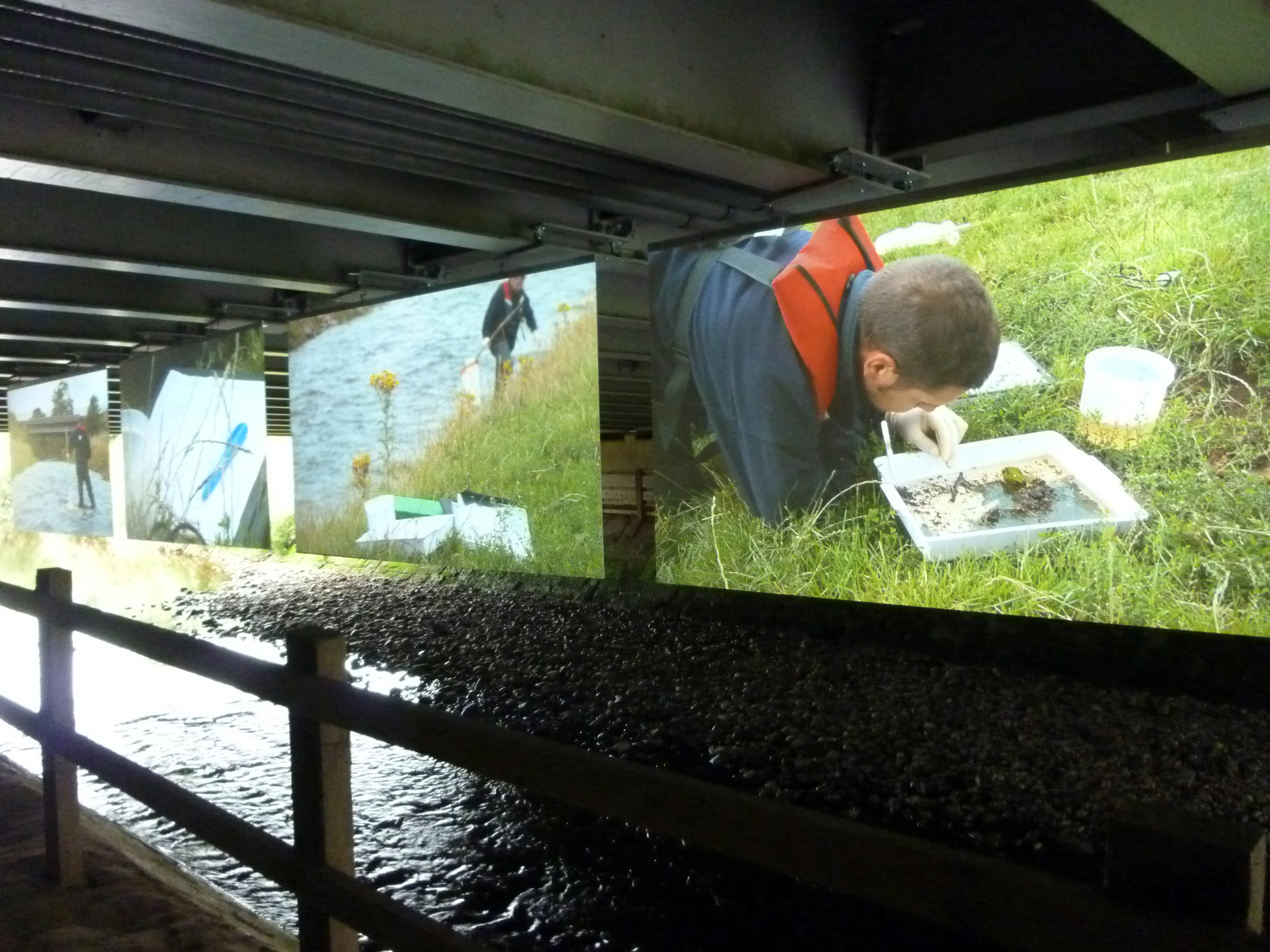
Cinema Sark, Prof Pete Smith and John Wallace, 2013. Photo Chris Fremantle
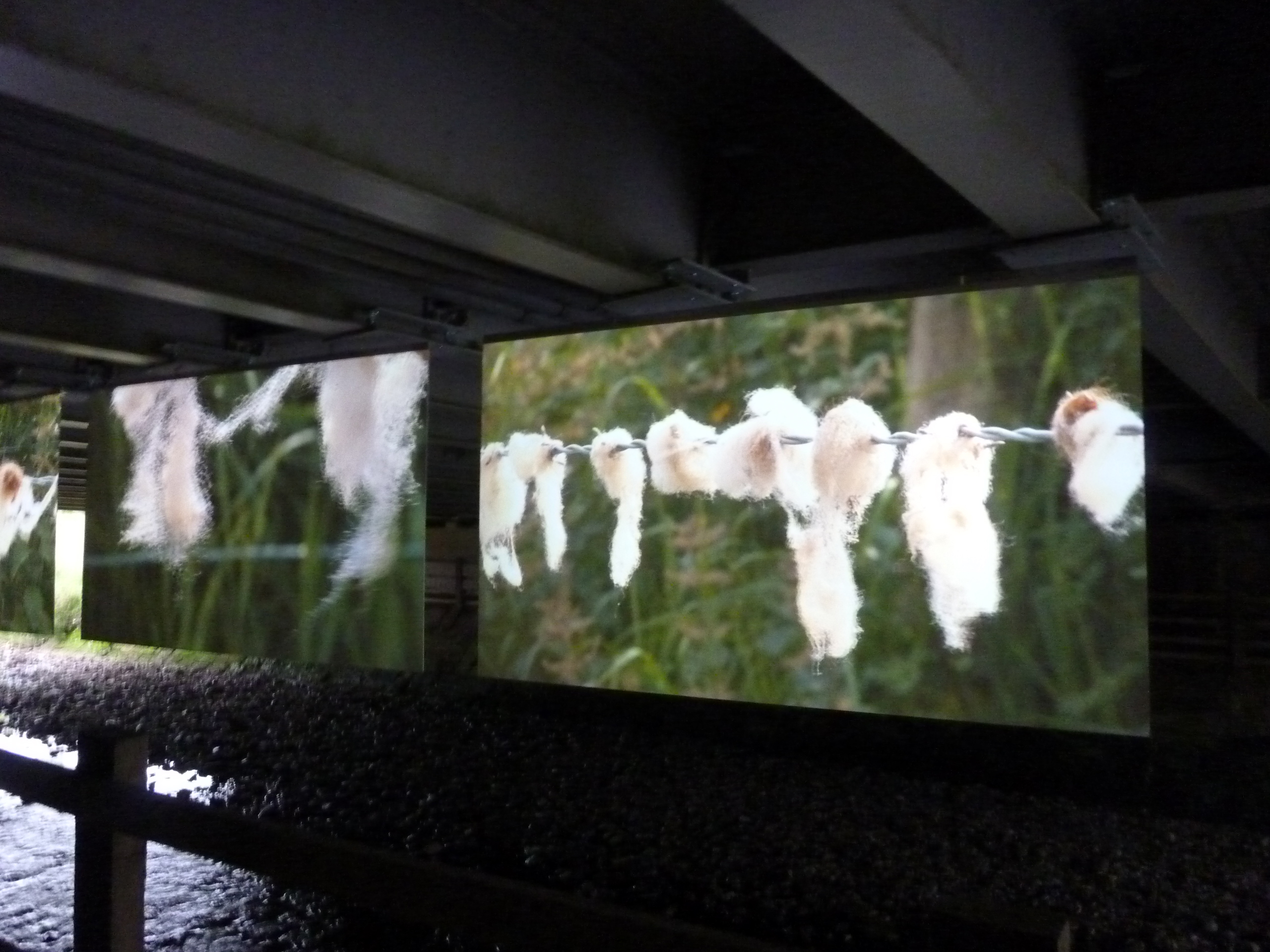
Cinema Sark, Prof Pete Smith and John Wallace, 2013. Photo Chris Fremantle
Cinema Sark at the Environmental Art Festival Scotland. It’s not often that video presented as sited work so elegantly uses it’s setting, or so engrosses the viewer. This work is a meditation on the many dimensions of the Sark, the river that divides Scotland and England in the West. The space under the M6 motorway is both a constant reminder of the context, but also an ideal location for the screening.
Velocity Talks 19 September
Jackie Sands, Arts & Health Senior, Health Improvement, NHS Greater Glasgow and Clyde, and I (as Project Manager for Ginkgo Projects) have been asked to give one of the Velocity Talks. It’s take place at the Lighthouse in Glasgow on the 19th of September, its free, but please book a place here.
Jackie will talk about the 6 year public art strategy she’s implemented across now perhaps 10 new healthcare facilities, and I’ll talk about the strategy for the New South Glasgow Hospitals as a key example.
What art have I seen?
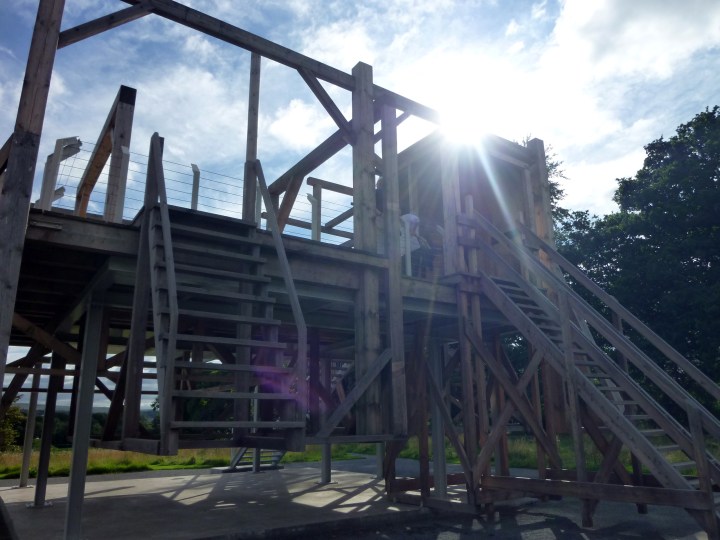
Sam Durant’s work first shown at Documenta. Photo Chris Fremantle
Failure

Beach structure. Photo Chris Fremantle
Simon Biggs and the CIRCLE (Creative Interdisciplinary Research in Collaborative Environments) have a day called Glitch’d: Purposeful Mistakes at Edinburgh College of Art next week. They say,
The glitch is the defect or malfunction; when technology misbehaves. Distinct from noise, which corrupts information, the glitch affects the decisions our technologies increasingly make for us, amplifying the outcome. This one day event, encompassing promenade performance, an intelligent search engine, technological demonstration, dance performance and manipulated light installation, explores how interactive media art projects can offer insights into the affects and effects of the glitch.
Info here.
What art have I seen?
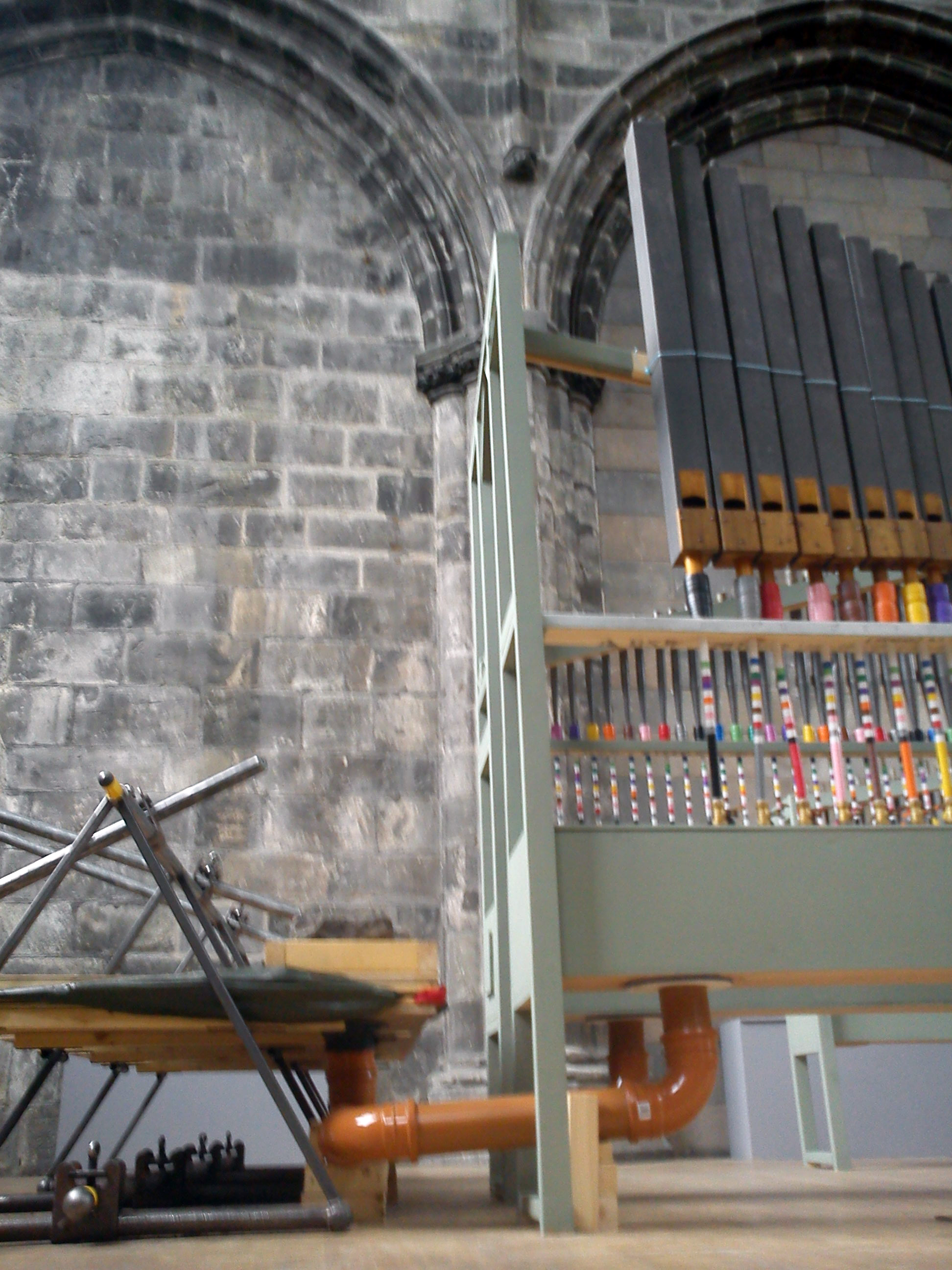
Sarah Kenchington’s Wind Pipes, 2013. Photo Chris Fremantle
Sarah Kenchington’s Wind Pipes for Edinbugh
Another World Is Possible – What about an Anonymous Istanbul Biennial?
Anonymity is perhaps the best resistance to the market, and the most provocative challenge to artists.

via Ahmet Ögüt
I never performed for the media. I tried to reach people. It was not acting. It was not some media muppet show. That is a cynical interpration of history. *
Abbie Hoffman* After his act at New York Stock Exchange, hurling/throwing one-dollar bill at the brokers.
On May 25, 2013, just before the beginning of the Gezi Park protests in Istanbul, I co-signed a letter by more than 100 arts and cultural practitioners that invited the Istanbul Foundation for Culture and Arts (IKSV) and 13th Istanbul Biennial curatorial team to change their authoritarian reflex and judgmental attitude to the protest staged on March 10th at a Biennial-sponsored event and to rethink the proposed structure of the 13th Istanbul Biennial.
Although I could argue in support of several concerns that were pointed out in the letter, one reason alone was enough to sign it: It was…
View original post 828 more words
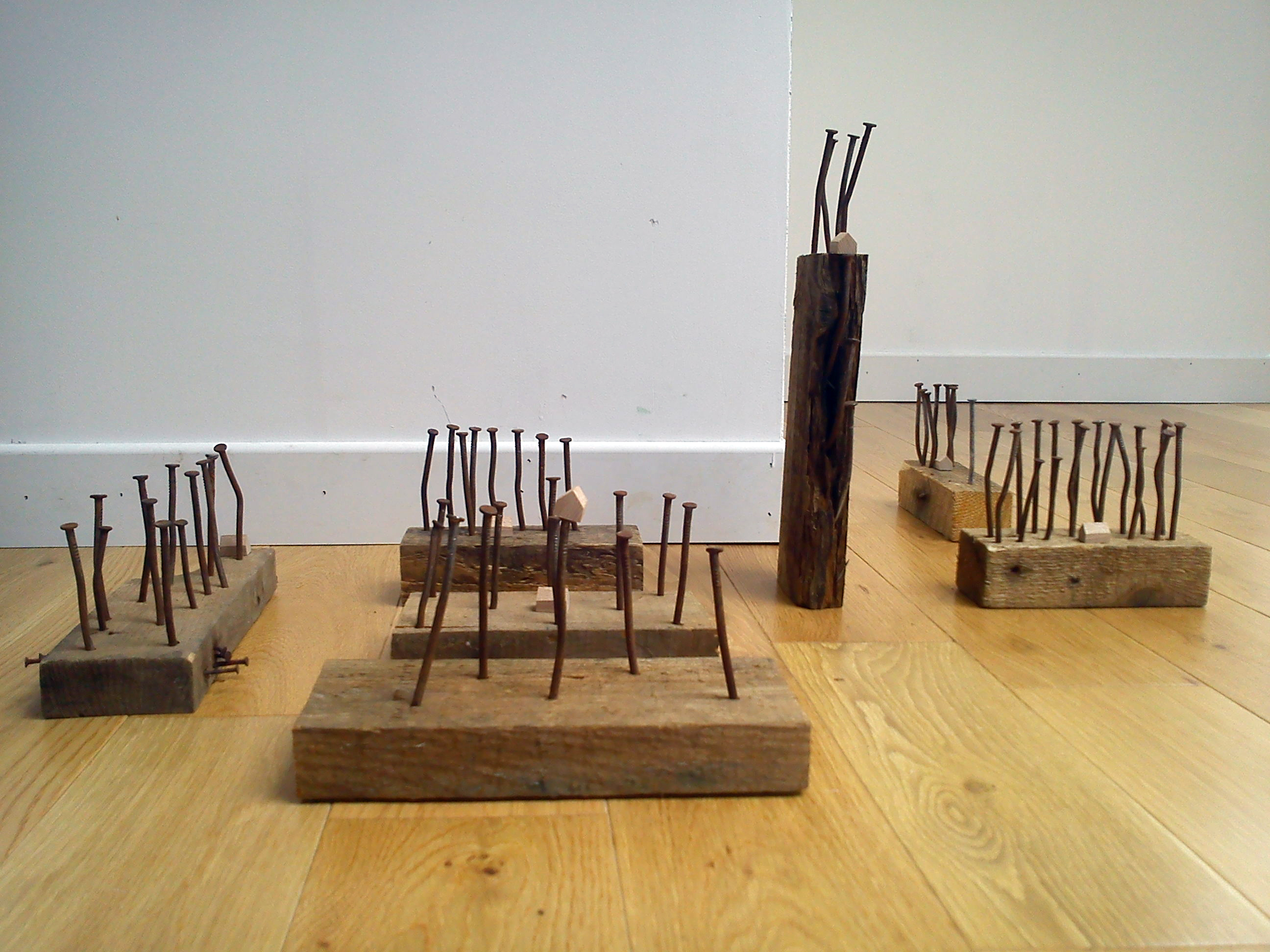
What art have I seen?
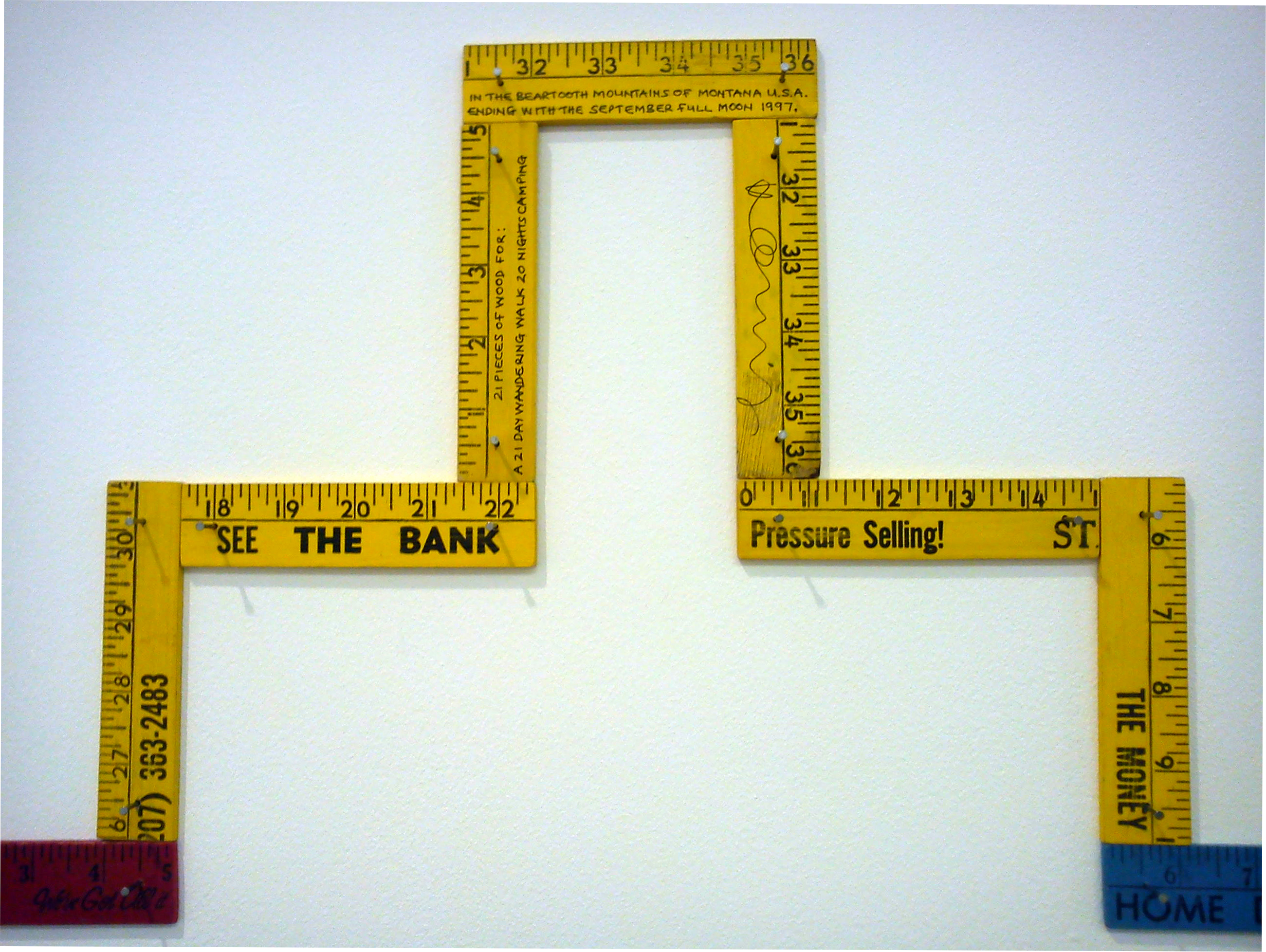
Photo Chris Fremantle
Hamish Fulton at Maureen Paley.
and I think Fulton has a good sense of humour.
Professor Gavin Renwick on “working with elders” 22 August, Ayr
ayr converses presentation/conversation
Be Strong Like Two People: Learning from the Elders of the Tlicho First Nation People in the North West Territories of Canada
Gavin Renwick, Professor and Canada Chair of Design, University of Alberta
Thursday 22 August 2013 : 6pm – 9pm : Ayr Auld Kirk Hall (Upper Hall)
Gavin Renwick, Professor and Canada Chair of Design at the University of Alberta, has spent more than ten years working with the Tlicho first nation people in the North West Territories of Canada on their land claim to the Canadian Government. Renwick was until recently Professor of Art and Policy at Duncan of Jordanstone College of Art and Design, University of Dundee, where he continues to be a visiting professor. His role with the Tlicho has been as a cultural intermediary assisting with the articulation of the understanding of land and inhabitation of the Tlicho, who are a nomadic people.
Renwick has regularly reported on key aspects of the thinking of the Elders, particularly around their relationships with young people. In his presentation, Gavin Renwick will explore the Elders understanding of the pressures on the young. First, the need to be “strong like two people”, which is a reference to the need for young people to be both strong in their own culture and strong in western culture. The second is the need to be “modern in your own language”, which clearly sets out one way to address the first challenge.
Gavin Renwick is originally from Motherwell. He was brought up among the last generation of Lanarkshire people who worked in coal, iron and steel. He has realised projects across Europe, as well as in Turkey and Canada. His present work utilises practice-led methods that place the practitioner-researcher as a cultural intermediary between indigenous and metropolitan culture. His applied and curatorial practice aims to facilitate cultural continuity for traditional communities. For the past decade he has been working between Scotland and the Canadian Northwest Territories, most recently for the Tlicho (formerly Dogrib) Dene community of Gameti as founder and coordinator of Gameti Ko, an incorporated society directed by a board of Elders.
The presentation/conversation will be chaired by Chris Fremantle, ayr converses co-founder with Lianne Hackett.
Following the presentation and Q&A, there will be the opportunity to converse with a glass of wine or soft drink. A small collection will be made towards venue hire and refreshments.
Please confirm your attendance by Friday 16 August info@ayrconverses.org.uk
What art have I seen?

Robert Irwin installation, Photo Chris Fremantle
Robert Irwin at Pace London
New Economics for Artists
Harry Giles’ excellent twenty (?) questions on the cultural economy in relation to its own inconsistencies and in relation to certain other economics that we all might have experienced (4 months working for London Electricity in their call centre in Victoria in about 1990-1; 6 months working as an outdoor clerk for a firm of solicitors; 4 years working as an amanuensis for a paraplegic philosophy professor whilst at University; 10 weeks as an unpaid intern at the Cooper Hewitt Museum in New York one summer during University).

I wrote this brain-dump for Andy Field, who was asked to prepare a presentation on “how artists can think about new financial models for themselves and for audiences”. He collected 150 bits of advice, sold them for £1 each, and used the proceeds to pay a violinist to play music for the length of the presentation: hurrah for the meeting of form and content! I keep attempting to write something long and thoughtful on art and money and how it all fits together, or maybe organise a conference about it, or a piece of action-research, or… well, none of that has happened yet. Maybe it will. In the mean time, two very nice people recently reminded me that I’d written this, so I reread it, and it turns out I’d already said most of the things I’ve been thinking about. So here it is. it’s a start, anyway.
“New…
View original post 756 more words
The Patient as Person Full Report
In May Donald Urquhart asked me to do a presentation on his behalf at a conference called ‘The Patient as Person’ hosted at the Albertus Institute in Edinburgh. They have just published the full report here.
Along side other presentations on the policy context and the philosophical issues I presented on the physical environment and how Donald Urquhart creates human spaces in healthcare contexts. Obviously Donald isn’t the only person/artist/designer working this way or tackling these challenges, but it was very useful to focus on one practice and the key issues that one process of research and development has highlighted. What is the expression? “Other artists are available”?
What art have I seen?
Saints Alive at the National Gallery
and
Memory Palace at the V&A
Saints Alive is as interesting a response to the contents of the National Gallery as I have seen in this long running series of Artist Associates (not that I’ve seen them all). The images, drawings and collages are worth spending a lot of time with, and the kinetic sculptures are as visceral as they needed to be – when Thomas’ finger pokes Christ’s chest it is scary.
The Memory Palace is better than I expected having seen the programme on last week, and I thought it would be good. I have to say that I think the curators could have pushed the idea of illustration harder. There are some exciting responses to the potential of the project, but there are also 3d realisations of what are recogniseable graphic novel tropes and there are parts that are simply graphic novel elements on walls, albeit beautifully done. Other parts, the printing (stereotype?) plates are stunning. It is interesting to see so many hands contributing to the telling of a story, and each brings its own subtle implications.
Collaborate Creatively at Firstsite
Very much looking forward to being at Firstsite in Colchester on Wednesday morning to talk about collaboration. We have two excellent presentations, one from Lyndall Phelps and the other done jointly by Lawrence Bradby and Jevan Watkins-Jones – there’s loads of links and info on the a-n website here: News | a-n.
Interview with Alec Finlay on Navigations
Alec Finlay was in residence at the Beatson West of Scotland Cancer Centre, Glasgow. This is an Interview with Alec Finlay on Navigations.
A Graphic History of the Gezi Resistance – Bianet / English – Bianet
Remarkable image A Graphic History of the Gezi Resistance – Bianet / English – Bianet.
Afternow- the future of health
AFTERnow is a collaborative enquiry into the impact of modern culture on health involving Professor Phil Hanlon, Dr. Sandra Carlisle, Dr. David Reilly, Dr. Andrew Lyon and Dr. Margaret Hannah. Our work was funded for six years by the National Programme for Improving Mental Health and Well-being in Scotland and supported by the Glasgow Centre for Population Health.
As the era of seemingly endless growth comes to an end, we all need to find new ways to live our daily lives. How do we redefine ‘prosperity’ in this new world? How do we imagine and then create a future that is profoundly different from the way we live today? There is a growing realisation that we all have to learn how to live with less. So what’s the answer? How should we live?
I woz here
Susan T Grant asked me to do a bit of writing for one of the publications following her residency in Dalkeith and the associated exhibition at Edinburgh Sculpture Workshop.
My text is on the I woz here project website here. I didn’t put footnotes in, but if you are interested in participatory practices and town artists, you might like to read David Harding’s piece on Town Artists here, and the Artworks Scotland programme here.
A Sense of Someplace
Lindsay Perth’s two year residency with NHS Forth Valley has resulted in a book of photomontages, A Sense of Someplace, made in collaboration with people using the mental health services. There is a launch event on the evening of 13 June at Streetlevel in Glasgow also featuring audio artist Mark Vernon.
Mr Seel’s Garden and other food research
Research projects on food
Concerns such as food miles, climate change and unhealthy lifestyles mean that local food-growing initiatives are becoming increasingly popular. But how do you make them work in a city? Memories of Mr Seel’s Garden, an AHRC-funded project funded through Connected Communities (webpage) [link], is delving into the history of local food production in Liverpool to find out.
‘If you want to learn about food sustainability, one way of getting ideas and being inspired is by researching your area to see how people used to get their food,’ explains project lead Dr Michelle Bastian of the University of Edinburgh. ‘Finding out about the past can help us think about different possibilities for the future.’
Mr Seel’s Garden – Arts & Humanities Research Council.
Also saw this through the Cultural History group
Applications are invited for an AHRC-funded PhD working on food distribution networks between 1920 and 1975. This studentship is one of eight fully-funded awards made by the newly-established Collaborative Doctoral Partnership managed by the Science Museum Group. The project will be supervised by Colin Divall (University of York) and Ed Bartholomew (National Railway Museum, York). The studentship, which is funded for three years full-time equivalent, will begin in September 2013.
The Studentship
How and what we eat is high on public and political agenda. While the particulars are new, the underlying issues are long-standing. Industrialization of the UK’s food supply from the late-C18th enabled unprecedented levels of urbanization and population growth but destroyed local, regional and even national sources, encouraging consumption based more on price than nutritional value. Today’s globalized food-chains can deliver huge amounts of high-quality food: but they also allow unscrupulous suppliers to escape the scrutiny of national and even international regulators.
This project explores one critical shift in Britain’s food supply in the last century: the change over the roughly half-century from 1920 from a rail- to a road-based system of distribution within the UK: from port to market, from farm yard to manufacturer, town shop or supermarket. This change was perhaps not inevitable: while the railways’ inter-war battle with road hauliers reflected traditional concerns such as price, reliability and security, neither service provider was able to demonstrate a clear advantage. Hence there was considerable scope to persuade consignors; the railways’ interest in marketing passenger traffic had some purchase with regard to goods. How did the railway companies imagine, market and deliver the distribution of food between the world wars? Railway publicity suggests that the high profile given to food distribution was partly an attempt to win public and political opinion to the companies’ case for more regulatory freedom. And how did road hauliers (including own-account operators like the food retailer Sainsbury’s) respond to such initiatives before 1939? What did consumers think?
The Second World War is sometimes portrayed as a temporary period of reprieve for rail distribution before the ‘inevitable’ victory of road haulage. But this project might explore whether the war and the following decade of austerity prevented the railways acting soon enough on pre-war ideas about how to handle food. It will also complement existing studies of British Railways’ attempts to reform freight services from the 1950s by analysing the particularities of food distribution. While exogenous factors such as better lorries, state-funded improvements to roads (notably motorways) and wider changes in food retailing (especially processed foods and just-in-time deliveries to supermarkets) arguably increasingly favoured road distribution, BR continued to develop and market services targeted at food suppliers and retailers until around the mid-1970s. How did BR work with the food industry? Did Beeching-era ideas like Freightliner have any role in the motorway age? Could the railways have kept more of the bulk transport of imported foodstuffs? Did food manufacturers, wholesalers and retailers drive innovations in food distribution, or did they adapt to initiatives from the haulage industry? And how did the road and rail operators ‘sell’ their competing notions of modern food supplies to consumers and politicians?
This is chiefly a qualitative study that will draw out the connections between the imagining of food distribution systems, the politics of building food chains, and the practices of using them in the period ca 1920-75.
How to Apply
Applicants must have a good undergraduate degree in history or other relevant discipline, and should normally also hold a master’s (or equivalent) degree in an appropriate subject. A full statement of the AHRC’s criteria for academic and residency eligibility is available on the AHRC website www.ahrc.ac.uk.
Applicants should submit a short curriculum vitae and a brief letter outlining both their
qualifications for the studentship and their ideas about how the research might develop. This should be in the form of a single MS Word, Open Office or PDF file no more than three pages in total, using a typeface no smaller than 11 point. The names and contact details of two academic referees should also be supplied. Applications should be sent to Colin Divall at colin.divall@york.ac.uk to arrive no later than 12.00 Wednesday 12th June 2013. Applicants should not at this stage make a formal application to the University of York.
Interviews for short-listed candidate will be held at the National Railway Museum, York, in the morning of Friday 28th June 2013.
For further information, please contact either of the project supervisors: Colin Divall colin.divall@york.ac.uk or Ed Bartholomew ed.bartholomew@nrm.org.uk.
No Flowers on the Psych Ward
Thanks to Tanya Geis for highlighting this article.
No Flowers on the Psych Ward – Amelia Rachel Hokule’a Borofsky – The Atlantic.
Launching Greens Continuous Cover Forest policy at Irish Forestry Show

Main points of the Irish Green Party Forestry policy (2013-16):
- To promote a graduated adoption to Close to Nature-Continuous Cover permanent forestry silvicultural systems and management (without clear felling), thus (i) ultimately creating permanent biodiverse forests containing trees of all ages, (ii) providing a more sustainable flow of products once the system is in place and (iii) maintaining the “capital” of mature and diverse forests to resist the threat and risks associated with climate change, such as new pests and diseases.
- The planting of 10,000 ha (preferably 15,000 ha– double what was planted in 2011) trees per annum until 2035, of which broadleaves should be well over the 38% planted in 2010. 15,000 ha would give 490 direct sustainable jobs per year, plus downstream employment, mostly in rural areas. (This would still leave Ireland with well below the European average of 43% forestry cover.)
- The retention of hedgerows and…
View original post 654 more words
Provocation for ArtWorks blog
You have in front of you a typewritten text. It could be poetry. It is an invitation to action, but not exactly an instruction. It reads:
planting a square of turf
amid grass like it
planting another
amid grass a little less green
planting four more squares
in places progressively drier
planting a square of dry turf
amid grass like it
planting another
amid grass a little less dry
planting four more squares
in places progressively greener
This is an artwork by Allan Kaprow, a score in his terminology. Kaprow wasn’t a musician, and in using the term score he was borrowing the terminology of music.
Reading the ArtWorks’ programme’s International Next Practice Review by Chrissie Tiller and in particular the Participation Spectrum proposed by the James Irvine Foundation, it strikes us that this work could operate at any point along the passive to active audience spectrum proposed. It could simply be read by an audience, or at the other end of the spectrum, made by them. A group of artists and researchers from Gray’s School of Art took this score as a starting point to make new work. We called that Calendar Variations. Were we artists or audience? Were we performing Kaprow’s score?
But what was Kaprow doing? Would he have defined his practice as participatory?
We’d like to suggest that Kaprow is breaking out of the norms of being an artist. The score was a prototype for a co-creative relationship. Kaprow authored the score, but other people played it.
Perhaps Kaprow simply thought that music benefited from having three different roles of composer, performer and audience, where in visual art there might be understood to be only artist and audience. Of course the performer could be many things: composer; professional performer, hired to perform the work; or member of the audience who goes home and performs the work themselves. Is the person who whistles the melody also more than passive audience?
But it could also be another composer who creates new work in response to the original, or a painter who makes something in another form. The more improvisational you get, the more that the role of the composer recedes and the role of the performer comes forward. Kaprow’s Calendar Activity is something with which to improvise. As soon as you set out to perform it, you realise that you have to interpret it.
Having done a series of projects on social practices, we have recently been working on improvisation, looking to understand the aesthetics of social practice.
Currently we are exploring participatory and co-creative practices across art, design and architecture.
Professor Paul Harris, Professor Anne Douglas and Chris Fremantle
Gray’s School of Art
This was just published as a provocation on the ArtWorks blog and is an element of a wider programme of work on participation and co-creation across art, design and architecture.
My responses to Calendar can be found here.
What art have I seen?
David Batchelor at the Fruitmarket and Ian Hamilton Finlay at Ingleby Gallery with ECA Art, Space and Nature
What art have I seen?
Reposted from www.publicartscotland.com
It’s common place to see elements of exhibitions spilling out of galleries (so-called off-site projects, and don’t get me started on that terminology). But artists who work in public sometimes spill into galleries (although documentation of sited work doesn’t always make for good exhibitions).
Culture Hijack, curated by Peter McCaughey of GSA, and Ben Parry, PhD candidate at UWS, takes on this most slippery subject extremely well. The artists in this show are pranksters and activists from across the world (including Japan, India, the US, Canada and a fair bit of Europe).
These artists take on the city, the streets, regeneration, consumerism, bureaucracy, capitalism, neo-liberalism: politics. They’re at home in a pedagogical space concerned with urbanism and inhabitation. And it’s therefore very apt that it’s in the Architecture Association and also all over the city. The issues raised are the issues that embroil architects and planners as much as cultural theorists and artists.

Photo: Ben Parry, 2013, temporary intervention Bedford Square, London, for Culture Hijack Exhibition
And the exhibition points the spotlight at the blurred, constantly moving, shape of these practices. Right outside on Bedford Square there’s an installation by Tatzu Nishi that has the formal elegance of sculpture and sometimes turns into the absurdity of a good happening. He captures the circularity of the building industry: tearing down and piling up.
Inside, in an installation that borrows it’s language from outdoor exhibitions and temporary conferences, are a lot of videos, one of the best being by Tushar Joag, who spoke at the CCA in Glasgow last week. In his piece a bunch of wide-boy London window cleaners join Tushar (in hisUnicell Public Works Cell boiler suit) to perform the cleaning of the Olympic landscape. A bunch of trained performance artists could not have got into the spirit of ‘cleaning’ the vistas of the east end with more energy and sense of the dance of life.
Video: Tushar Joag collaborating with Gaze a Glaze.
In another space, created by scaffolding tubing and banner fabric, a solitary figure on a handcar travels the train tracks of a German city (Matthias Wermke & Mischa Leinkauf’ In Between). It’s a beautiful moment of living on the edge, not angry, not ironic, just playful.
On the same day at the Barbican was the official launch of the evaluation report on the Cultural Olympiad, saying that some 43 million people had experienced this four year cultural programme leading up to the Games and that it had succeeded in raising Britain from 5th to 4th on the list of nations as desirable brands.
As the international-sporting-event-with-cultural-programme bandwagon moves on towards Glasgow we need to make sure that we question it, poke fun at it and make sure it doesn’t bulldoze anything that really matters (like a community or an allotment).
Culture Hijack is at the Architectural Association, Bedford Square, London and around the city 26 April – 25 May 2013
Chris Fremantle
Portraying the change – evaluating 14 years’s work
How can you describe a cultural programme that has extended over 14 years, 9 countries and 3,000 projects? How do you account for its outcomes, the change it may have contributed to, and the effects on culture or society?
Portraying the change. Fascinating in depth report prepared by Francois Matarasso on the Swiss Cultural Programme in South Eastern Europe focused on participants, rather than organisers.
ESRC Arts, Health & Wellbeing Research
Highlighted through the London Arts in Health Forum‘s newsletter:
Welcome to the Arts, Health & Wellbeing programme. We are a thematic, multidisciplinary programme funded by the Economic and Social Research Council aiming to develop understandings of how the arts may contribute to health and wellbeing.
We also aim to facilitate a UK network of academics, service users and practitioners to help develop research projects of the highest quality and of national and international significance.
Project Ginsberg
Project Ginsberg highlighted in the Alt-w mailing from New Media Scotland
I saw the best minds of my generation destroyed by madness
Howl Part 1, Allen Ginsberg 1956
Project Ginsberg’s vision is a future where every Scottish citizen who experiences common mental health problems has a wide range of interventions available to them.
People with common mental health problems may look like they are coping – they walk the dog, look after their children, go to work – but the reality is that for those with common mental health problems the experience is chronic; resulting in months and years of feeling like they aren’t coping with life.
Project Ginsberg is about helping to define, design and prototype the vision of a range of effective interventions for the people of Scotland, with a focus on exploring the role of everyday web and mobile technology, and alternatives to the traditional patient-clinician model.
We think there is a huge opportunity to improve people’s life experience through rethinking our approach to common mental health problems, especially by using technology in ways that fit around people’s everyday lives.
The work is driven by Scottish Government’s Mental Health Strategy 2012-2015, which commits to developing a Scotland-wide approach to improving mental health through new technology in collaboration with NHS 24.
What art have I seen?
Schwitters in Britain at the Tate Britain.
Schwitters after Duchamp yesterday evoked a further set of relationships. Fascinating to see these two masters of the 20th Century, one sometimes derided and the other not well known. The Duchamp exhibition, well described here, is explicitly about influence. The Schwitters exhibition is a more traditional historical narrative shaped by geography and war. It has two contemporary responses Laure Prouvost and Adam Chodzko attached at the end. There are also interesting similarities in the exhibition design, though the Barbican is perhaps more compelling.
Peter McCaughey reminded me, Schwitters’ interest was achieving the smallest, shortest, gap between idea and realisation (“Merz art strives for immediate expression by shortening the path from intuition to visual manifestation of the artwork” Merz Painting, 1919 http://en.wikiquote.org/wiki/Kurt_Schwitters). What is the relationship between Schwitters and Latham? One second drawings?
Brian Eno’s new work for a hospital
Beautiful piece on Radio 4’s Today programme Friday 19th April talking about Brian Eno’s new work for a hospital in Hove. It absolutely captured all the thoughts about our experiences of hospitals. It was also reported in the Independent here.
What art have I seen?
They saved the hill. But can they save forgotten Scotland?
Dalmellington is one of a series of villages and small towns including Cumnock and New Cumnock, Auchinleck, Beith, Kilbirnie, Glengarnock, Drongen, Muirkirk, perhaps Patna and Tarbolton, certainly South as far as Dailly, which are part of a post industrial rural landscape which is distinctive in Scotland. It runs across Central Scotland and up into Fife.
Kenneth Roy’s short comment on the demise of Scottish Coal Ltd, just put up on the Scottish Review, highlights the undoubted determination of the people living in these towns: they value their places and fight for them.
Glasgow may be onto its fourth major international event next year, but the whole discourse of regeneration and creative cities has pretty much bypassed the issues of the post-industrial rural landscape. The development of Dumfries House and the associated new settlement of Knockroon are perhaps an element of a rural story, as are Booktowns, though as Roy notes Dalmellington was meant to be Scotland’s before Wigtown grabbed the mantle.
If Creative Scotland has a challenge today, it’s to develop a Place Strategy that speaks to this set of challenges.
What have I been reading?
Tim Etchells’ piece Moon Story for the Arnolfini is a beautiful call to arms for performance.
Methodologies of Failure
Justin Langlois put a set of questions (a self-evaluation toolkit?) directed at artists engaged in social practice on Portland’s Art and Social Practice Masters blog. It’s humourous, provocative and pointed.
Ghost of Water Row on RIAS shortlist
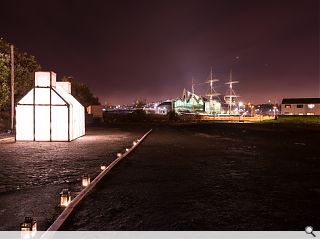
Edo Architecture‘s Ghost of Water Row has been shortlisted for the Royal Incorporation of Architects in Scotland’s Award, as reported in Scotland on Sunday. For more information.
Andy McAvoy of Edo said in an email,
we tried something, we failed, we burnt it down
“How you can be doing that work, how you can be this radical alternative, and those oppressive structures return so unconsciously?”
Transcript of a discussion about collectives and failure. Collectives, which are meant to be a radical alternative to the marketisation of the individual in the art economy, end up sliding unconsciously into patriarchies, or being co-opted by institutions and failing in the ambition to be radical.
Two views of participatory art
Eleanor Heartney’ review in Art in America provides a useful comparison of Kester and Bishop’s new books which continue the argument between these key theorists of socially engaged and participatory arts practices.
What art have I seen?
Peter Howson‘s exhibition From Death to Life at the Maclaurin Galleries, Ayr
Open Studios Ayrshire 22-24 March
A group of artists has gotten together to organise the first Open Studios in Ayrshire over the weekend 22-24 March 2013. The brochure can be downloaded osabrochure2013.
Fail better | e-flux
Fail better at the Hamburger Kunsthalle (not a case of What art have I seen?)
“Try again / fail again / fail better,” is an inspirational quote by the Irish writer Samuel Beckett. During his visit to Germany around 75 years ago, Beckett made a number of extended visits to the Hamburger Kunsthalle, and now—in keeping with his famous motto—the Kunsthalle is presenting a diverse selection of films and videos on the theme of failure. In works dating from the 1960s to the present day, internationally acclaimed artists explore this complex phenomenon, highlighting not only the playful, amusing and surprising aspects of failure but also its mournful and tragic dimensions.
Imagining Possibilities Conference | Public Art Scotland
This piece just went out on Public Art Scotland,
This Participation was the focus of the Imagining Possibilities conference at the University of the West of Scotland, but the conference is only a manifestation of a wider concern. The conference is part of the Remaking Communities project funded as part of Connected Communities. The Connected Communities programme embraces all the Research Funding Councils in a broad alliance to engage communities and thus increase impact. The Paul Hamlyn Foundation is currently funding four strands of the ArtWorks programme, including one in Scotland. The Scottish Government is currently working its way through a new bill on Community Empowerment and Renewal and the Westminster Government has already legislated on ‘localism’. All of these programmes put community participation at the heart of, respectively, academic research, arts practice and local democracy.
Ideas for Ayr Beach
Lianne Hackett and I, under the banner of Ayr Converses, have been thinking about Ayr Beach. We’ve set up a Storify to enable us to pull together ideas and examples. If you have any, please feel free to send me a link or add a comment below.
Legacies of British Slave-ownership
UCL have just put a new database online which allows searching for owners of slaves by name and address. So put ‘Ayrshire’ into the search field and you’ll find the addresses in Ayrshire, the Plantations in the British Carribean, Mauritius and the Cape. The last item is a sum of money. It’s the compensation paid to the slave owners.
What art have I seen?
George Wyllie: Scul?tor and Navigator at the Royal Glasgow Institute of Fine Arts and Critical Dialogues: Scotland + Venice at the Lighthouse.

 CHRIS FREMANTLE
leave a comment